Chertoff's Remarks on Aligning U.S., European Air Security
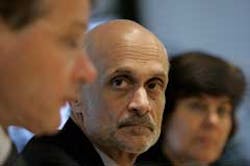
Brussels, Belgium, German Marshall Fund and European Policy Centre May 23, 2005 (Remarks as Prepared)
Thank you very much Ron for that kind introduction. I appreciate the opportunity to speak before this distinguished group. This is my first trip to Europe as Secretary of Homeland Security – the first of what I hope will be many occasions to further enhance our work together to secure our nations and peoples from the threat of terrorism.
Both the German Marshall Fund and European Policy Centre offer critical forums for the vital types of discussion and dialogue that must occur between the United States and Europe as we confront the challenges and complex issues surrounding our efforts to protect our citizens and preserve our freedoms. So, I thank you for the opportunity to be with you today. More than sixty years ago, a well-known European statesman was invited to speak at Harvard University and in his speech he spoke of our shared responsibility to “faithfully serve great causes.†That mantle of responsibility is one that has been passed on to those of us here in this room. And the call to serve issued by Churchill those many years ago is one that we continue to carry out – by faithfully serving the cause of liberty. Europeans have had a much longer history with those who embrace terror as a weapon against freedom and justice. As such, America has learned a great deal from our allies and gained valuable insight and information on how to contend with this type of enemy.
From the attacks of 9/11 to those carried out in Madrid, Beslan, Jakarta, and Istanbul -- we know that terrorism is a scourge that is felt globally and must therefore be addressed globally. Together, Europe and America, along with our other international allies, have worked to eradicate the threat terrorism poses to our safety and our freedom. Over the past few years, much has been done to bolster our transatlantic alliance and build upon an already strong foundation of collaboration and partnership. But if we are going to arrive at a day when international terror no longer haunts our countries and our citizens, then we must be prepared to advance our cooperation to the next level and further engage each other and the entire global community.
The reality is we cannot expect to defeat terrorism the same way we have defeated enemies in the past – by massing superior forces in the field. With terrorism, we are facing more than an army – we are fighting a network – an insidious network of terror that stretches across the globe. Economist Thomas Friedman recently observed in his book, The World is Flat, that terrorism in the 21st century is really the globalization of the kind of individual terror acts we saw in the 20th century.
And much as globalization has transformed the world of business, it has transformed the world of terror. The 9/11 attacks are a primary example of this type of terrorist globalization at work. In that instance, a plot was hatched in Central Asia with recruits who came from Saudi Arabia, who were trained in Afghanistan, who set up and began to develop their infrastructure and their platform in Europe, and who then carried out and executed their mission here in the United States. That is globalization. That is networking. That is outsourcing. All in the service of evil. For terrorism has now outfitted itself in the techniques and technology of a 21st century organization. So, we must respond by examining the 21st century structures and systems that terrorists exploit in order to carry out their missions so that we pinpoint the vulnerabilities and shut them down. In most networks, vulnerability points tend to be in communication, financing, and transportation. Those are the kinds of activities that bind a network together.
Our responsibility is to break apart those points within the terrorist network – cut off their communication, isolate their financial resources, eliminate their transportation capabilities – and in doing so dismantle the network entirely. However, to do so, to challenge the kind of interdependence a terrorist network thrives upon, we must be able to confront the network everywhere it operates. And that means we have to be able to function internationally and work together seamlessly. We have to build up and refine our own network if we are going to compete with and combat the terrorist network.
This is not necessarily a new insight. We've certainly had movement in this direction over the past couple of years. The Department of Homeland Security, along with our European and international allies, has been working on issues such as container security, biometrics and secure travel documents, as well as aviation security. In my previous job as head of the Criminal Division of the Department of Justice, we put people overseas to work with prosecutors and investigators in Europe precisely because we needed to build up a network of law enforcement that could rival the network of terror.
So this is not a new concept, but two years after the Department was formed, we have a good opportunity to start thinking about how we can build on what has already been accomplished. How do we move beyond simply partnering on an occasional, episodic basis to building a true partnership that will operate with a mission-oriented focus?
Allow me to share with you where I would like to see us move – toward a world that is banded together by security envelopes, meaning secure environments through which people and cargo can move rapidly, efficiently, and safely without sacrificing security or privacy. A world where, with the proper security vetting, the proper technology, the proper travel documents, and the proper tracking of cargo, it would be possible to move relatively freely from point to point all across the globe.
For those within the security envelope, we will have a high degree of confidence and trust, so that trusted travelers and shippers don't have to be stopped at every point along the way to be re-vetted and rechecked. And that would enable us to focus more of our resources for those outside the security envelope – for the kind of in-depth analysis and the kind of in-depth vetting that is necessary to make sure those who seek to harm us do not slip through the cracks.
The vision of a technologically-based system of security envelopes would happily not require a sacrifice of liberty or privacy in order to promote security. Rather, it is a vision that would actually maximize these values, that would preserve our lives, but also to foster our way of life, and uphold the civil liberties both Europeans and Americans cherish. In large part, the purpose of my trip this week is to open a dialogue on issues such as these and discuss with our European partners the way ahead. While I’m here mostly to listen and learn, there are specifically three areas in which I think we can start to move forward concretely as we try to develop this worldwide security envelope.
First, the area of screening. We have to develop a systematic approach to screening that is compatible on both sides of the Atlantic. One that takes advantage of modern technology, provides maximum protection of sensitive traveler information, and gives a real sense of confidence that we are screening out those with evil intent. Right now, in many ways we are using the most primitive kind of screening -- meaning we screen for names that match lists of terrorists and criminals. And of course, names are not the best way to identify people. They’re certainly not as good as biometrics.
Names can be changed, identification documents can be forged. But biometric identifiers can help reduce that type of fraud and protect the identity of the visa holder by making it much more difficult to impersonate someone. In the area of cargo, we inspect with technology and by hand searching for certain kinds of harmful materials. And, we are starting to move forward using somewhat more technologically advanced devices at our ports that now allow us to look inside cargo containers without actually breaking bulk. So we are making progress, but we must press forward.
Our ability to inspect efficiently and swiftly depends on accurate screening and targeting high-risk cargo. That boils down to the overarching issues of information-sharing and tracking. The more we know about what is moving in containers, the more readily we can speed the majority of benign cargo through our ports, reserving the delay of inspection for those shipments that pose potential risks.
To be sure, information sharing and exchange presents important cultural and legal considerations. Fundamentally, we do share the same belief in the importance of privacy and civil liberty, but we sometimes differ sometimes in our views of how to implement those values. We need to start to resolve these questions of implementation so that we can promote our common values. We’ve made headway on this issue, and I hope that we can start to talk about how we can finish the process of getting our information shared appropriately and with due respect for people's privacy.
Let me turn to a second area – technology. Technology is obviously crucial to creating a global security structure. We're doing a lot of work in the United States, just as you are here in Europe. We ought to make sure we get on the same page with that work for two reasons.
First, we maximize our resources if we have fully available to us all of the ingenuity and talent across the globe of people who are developing and thinking about ways to use technology. Second, we have to be compatible. For example, it doesn't make a lot of sense to have radio frequency chips that use different kinds of modalities in the United States and Europe and in Asia, because that’s only going to make it harder for us to connect and work together. Therefore, to the extent that we can start to build common platforms and common technological approaches, we will move ourselves closer to this concept of a security envelope. And we will also save ourselves some money, effort and time.
Finally, the area of law enforcement. As I've indicated, intelligence sharing and law enforcement sharing have been critical to dealing with the threat of terrorism globally. We need to continue to advance on that front. Both the U.S. and EU have done a lot within our respective borders to strengthen law enforcement coordination.
Now, we must move aggressively to do the same across the Atlantic. We must work to connect and network our respective law enforcement authorities so that we can more fully match the resources and abilities of the enemy. For example, each country holds a reservoir of fingerprints taken from terrorists and violent criminals. Exchanging such biometric data is an important way to ensure that terrorists and murderers do not exploit informational seams between countries.
In sum, these are some of the areas I look forward to discussing over the next few days and in the months to come. In the end, our methods for defeating terror must align with our values as free and democratic peoples. We won’t achieve a true victory if we destroy those things which we value in our own lives. We defeat terror by being able to carry on with our daily lives, we defeat terror by not giving way to fear, we defeat terror by preserving privacy and fostering prosperity…we defeat terror by once again heeding Churchill’s advice and faithfully serving the cause of freedom.
It is a cause we have championed together through many years and many struggles, and one that is well worth our continued vigilance, perseverance, and fortitude. Together, we have won great victories for freedom. And, if we continue to engage each other; if we continue to work together as we have on the difficult trials of the past, then together we will shape a future of hope and peace for our children and future generations.