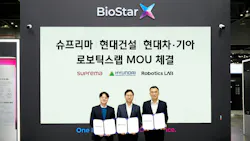
Hanchul Kim, CEO of Suprema; Seung Min Oh, Executive Director of Hyundai E&C; and Ri Goon Choi, Executive Director of Hyundai Motor and Kia Robotics LAB
Suprema has signed a three-party memorandum of understanding with Hyundai Motor Group Robotics LAB and Hyundai Engineering & Construction to collaborate on the development of residential environments powered by service robot technology.
The agreement brings together capabilities in AI security, robotics and architectural infrastructure to create residential complex models where service robots can operate safely and seamlessly alongside residents. The collaboration will move forward in phases, including proof-of-concept testing and eventual commercialization.
Integrating Robotics, Security and Architecture
The companies aim to address key requirements for future residential environments, including architectural designs that support robot mobility, AI-driven security systems that distinguish residents from outsiders and a unified platform that integrates these elements.
Under the agreement, Suprema will build an AI-powered integrated security infrastructure across residential complexes. The company will leverage its facial authentication technology and BioStar X platform to connect robot systems with building security, serving as the system integrator.
Hyundai Motor Group Robotics LAB will focus on designing robot services tailored to residential settings and will lead the development of technical standards based on autonomous robots and its Robotics Total Solution platform.
Hyundai Engineering & Construction will support the initiative by providing robot-friendly architectural designs and pilot sites within its residential projects, helping generate demand for robot-enabled services.
Focus on Safety, Mobility and Standardization
Company executives emphasized the importance of integrating robotics, security and construction from the outset to enable widespread adoption of service robots in residential spaces.
Suprema CEO Hanchul Kim highlighted the role of AI-powered security infrastructure in ensuring safe interaction between robots and residents, pointing to the company’s unified security platform and biometric authentication technologies as key enablers.
Ri Goon Choi of Hyundai Motor and Kia Robotics LAB noted that residential robotics will require tightly integrated infrastructure across disciplines, adding that ongoing platform enhancements will support optimized robot services and the development of new industry standards.
Seung Min Oh of Hyundai E&C emphasized the construction sector’s role in designing environments where robots and residents can coexist naturally, with the goal of improving mobility, convenience and safety in future residential complexes.