Beyond ADA: How Inclusive Door Hardware Design Improves Campus Safety for Everyone
Key Highlights
- Lockdown drills happen in more than 95% of schools and can reduce casualties by 60% – but their effectiveness hinges on something often overlooked: whether everyone, including people with disabilities, can instantly tell if a door is locked.
- ADA compliance is a floor, not a ceiling – inclusive indication trims with high-contrast text, tactile feedback, and plain language account for the cognitive load spike that hits every occupant during a lockdown.
- Mechanical indication trims need no wiring, networking, or power supply, making them one of the most practical and cost-effective security upgrades for campuses working through phased retrofit cycles.
This version of this article originally appeared in the June 2026 issue of Security Business magazine. Don’t forget to mention Security Business magazine on LinkedIn or our other social handles if you share it.
Campus lockdowns are a vital part of any school security protocol, and lockdown drills are practiced in more than 95% of schools. When successfully implemented, they have been shown to reduce casualties by 60%. But in those high-stress, time-critical moments, students, staff, and visitors need to know instantly whether a door is locked and secure – and for those with disabilities, that need is even more acute.
Indication trims on classroom locks provide immediate visual confirmation of door status. If that trim lacks high color contrast, large text, symbols, or an oversized viewing window, students and teachers may be left guessing at the worst possible moment. That uncertainty can introduce delay that compromises safety.
For K-12 and higher education security directors and facilities managers, door hardware is a foundational element of both life safety and a robust security plan. The Americans with Disabilities Act was passed in 1990, but many buildings in use today predate it.
While most campuses have addressed the obvious accommodations – wheelchair ramps, elevators, automatic door operators, bright lights paired with alarms – door hardware details are frequently overlooked beyond what ADA and model building codes require. Those codes typically include the International Building Code (IBC), International Fire Code (IFC), and the NFPA Life Safety Code. Meeting minimums is not the same as meeting needs.
How often do we stop to consider the perspective of people with disabilities in the context of campus safety? Do you know where the nearest wheelchair ramp or elevator is in your building? Would a student with a mobility limitation need to access a different entrance or take a longer path to reach an otherwise directly accessible classroom? If you remove your glasses or squint, how far across a lecture hall can you actually see?
On an individual level, day-to-day life for people with a range of disabilities can be drastically different. People with disabilities may need to spend significantly more time or energy just navigating an average day on campus. When an emergency occurs, those existing challenges are compounded by stress, urgency, and reduced cognitive capacity.
The Case for Inclusive Design
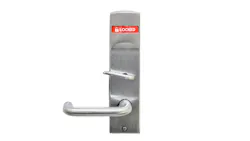
The Partner Alliance for Safer Schools (PASS) Safety and Security Guidelines, 7th Edition, explicitly recommends indication trims for classroom doors as a Tier 1 strategy. Manufacturers have responded with mortise, cylindrical, deadbolt, and panic hardware indication trims featuring oversized windows, unmistakable red-and-white messaging, tactile feedback, and symbolic cues.
Under stress, the ability to process complex visual or mechanical information degrades quickly. Inclusive hardware design accounts for that reality before an emergency occurs.
ADA standards for door hardware focus primarily on operating ability: hardware must be operable with one hand, require no tight grasping or twisting, and operate with five pounds of force or less. ADA also dictates mounting heights and basic tactile signage for permanent rooms at the doors they serve.
Inclusive design goes further. It anticipates a wider range of human abilities and recognizes that during a lockdown – or even a rushed class change – cognitive load spikes. Under stress, the ability to process complex visual or mechanical information degrades quickly. Inclusive hardware design accounts for that reality before an emergency occurs. Prioritizing these elements in door hardware can reduce confusion under stress, shorten decision times during emergencies, and foster an environment where every student, staff member, and visitor is afforded the same level of safety.
Where Indication Trims Matter Across Campus
The need for clear door status communication extends well beyond the classroom. Any space with an occupancy of 50 or more requires panic hardware, and security indicator trim on exit device push bars gives staff and students immediate confirmation of lock status in larger rooms. Gymnasiums, music rooms, auditoriums, and lecture halls all benefit from this capability.
The PASS guidelines highlight classrooms as the critical starting point, but a comprehensive campus security plan should address every space where occupants may shelter in place.
Designing for Specific Needs
When evaluating indication hardware for a campus, security directors and facilities managers should consider how specific disabilities interact with door hardware choices:
Low vision and blindness: Students with severe visual impairments rely heavily on tactile and audible cues. Maximized viewing windows, high-contrast text and symbols, and anti-glare finishes improve legibility under fluorescent lighting and in low-light emergencies such as power loss. Tactile feedback or audible clicks provide confirmation through more than one sense – an important redundancy when visual processing may be compromised.
Colorblindness: Red/green colorblindness affects an estimated 300 million people worldwide. An indicator that relies solely on a small colored dot excludes a meaningful portion of any campus population. Pairing color with clear text or distinctive shapes is the more inclusive – and more reliable – solution.
Intellectual disabilities: Plain language ("LOCKED/UNLOCKED") and consistent hardware placement across campus reduce cognitive load significantly. When a student learns how a lock operates in one classroom, that knowledge should transfer directly to every other room on campus. Standardization is itself a safety feature – one that benefits all users under stress, not just those with intellectual disabilities.
Motor and dexterity limitations: Students with cerebral palsy, arthritis, or conditions requiring mobility aids need hardware operable with gross motor movements. Single-hand operation, no twisting or grasping, and a maximum of five pounds of force are ADA baselines. Inclusive design treats them as a floor, not a ceiling, and specifies hardware that exceeds those minimums wherever possible.
Installation and Retrofit Considerations
Upgrading existing classrooms and assembly areas in older buildings presents real challenges for facilities teams. Mechanical visual indication trims are often the most practical and cost-effective solution – they require no complex wiring, networking, or power supply, yet immediately upgrade the security posture of a space. That combination of low installation complexity and high safety impact makes them a logical starting point for campuses working through phased upgrade cycles.
Several factors require careful attention during planning:
Mounting height: Hardware must fall within ADA and model code requirements. For indication trims specifically, sightlines for wheelchair users matter – what is clearly visible at standing height may be partially obscured when seated if placement is not considered carefully.
Door prep and compatibility: Standardizing hardware across campus from a coordinated product line simplifies installation and reinforces the predictability that benefits users with intellectual disabilities. Installers must account for differences in door prep between mortise locks, cylindrical locks, and push bars, particularly on fire-rated doors where modifications are strictly regulated and must be coordinated with the door manufacturer and AHJ.
Code and AHJ compliance: Any lock installed in a classroom or assembly space must comply with local building and fire codes. Facilities managers must work closely with the Authority Having Jurisdiction (AHJ) to ensure hardware allows for free egress via single-motion operation and aligns with established lockdown protocols. When interpretations are unclear or site conditions are unusual, the AHJ should be consulted directly before installation proceeds.
The Takeaway
Lockdown drills matter. So does the hardware on the door. In addition to regular drill practice, upgrading to inclusive indication trims is one of the most direct investments a campus can make in daily safety – not just for students and staff with disabilities, but for everyone operating under stress in a time-critical situation.
By moving beyond basic ADA compliance and embracing inclusive design, K-12 and higher education security directors and facilities managers can work toward eliminating confusion, reducing panic during emergencies, and ensuring that critical life-safety information is accessible to every person on campus regardless of ability. Indicator trims with large, high-contrast, unmistakable messaging are not a premium feature. They are the standard a modern, secure, and inclusive educational environment requires.
This article originally appeared in Locksmith Ledger, a member of the SecurityInfoWatch Group at EndeavorB2B. https://www.locksmithledger.com
About the Author
 Ken Cook
Ken Cook
Ken Cook is Director of National Education Safety and Advocacy for Allegion.
https://us.allegion.com