Why Fire Alarm and Lockdown Systems Remain Disconnected in K-12 Schools
Key Highlights
-
Fire alarm, security and door hardware are often specified, installed and commissioned separately in K-12 projects.
-
Conflicting fire alarm and lockdown signals can expose gaps in how door hardware is expected to respond during an emergency.
-
Integrated functional testing can help ensure fire alarm, access control and lockdown systems work together as intended.
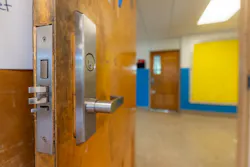
Every K-12 project I’ve reviewed splits life safety into three separate bid packages. You have one for fire alarm, one for security integrator and one for door hardware. Each contractor tests their own system and signs their own commissioning form, but they aren’t responsible for checking whether all three work together when a door has to do two different things in the same building, sometimes in the same minute.
That split is the story in school life safety right now, and a code update doesn’t fix it on its own.
Two codes, two different emergencies, one door
Start with what is actually required. Schools had been solving classroom lockdown with barricade devices and rope, workarounds that technically worked but weren’t code compliant and created their own egress risks. The 2018 edition of NFPA 101 finally gave them a solid solution. Existing classroom doors could now use a second, non-simultaneous releasing operation. A teacher could lock the door from inside without a key, and egress from the classroom side still took one motion, same as before. Specifiers finally had a compliant way to let a classroom lockdown without turning the door into an egress hazard.
Separately, more than a dozen states have now passed some version of Alyssa’s Law, which requires schools to install a silent panic alert system that notifies law enforcement directly, without an audible alarm that would tip off an intruder.
Put those two side by side, and you’d think they were written to work as a pair where one governs how the door locks in a threat, and the other governs how the building tells someone a threat exists. In practice, they’re adopted, funded, and installed as if they have nothing to do with each other. NFPA 101 says nothing about panic alert systems. Alyssa’s Law implementations say nothing about door hardware. Neither NFPA 101 nor most Alyssa’s Law implementations directly require integrated verification of access control logic, lockdown hardware and panic alert systems as a single operational sequence.
That’s not on the codes because they weren’t written to coordinate trades. What’s falling short is specification and commissioning, and I keep seeing it happen.

Where it breaks: the walkthrough
Here’s what that looks like in the field. A fire alarm contractor walks around a building to verify horns, strobes, and pull stations meet NFPA 72. A security integrator walks the same building, on a different day, to verify access control and panic devices function and report correctly. Both walkthroughs get signed off and both systems pass, but nobody walked the building asking the only question that matters in an actual event. If a lockdown is triggered while a fire alarm is active, or a fire alarm triggers during a lockdown, does the door hardware do the right thing?
That’s not a hypothetical edge case for schools. It’s exactly the type of conflict scenario that schools must now consider as lockdown and life safety systems become increasingly interconnected. If a magnetic lock or electrified strike is wired to release on any fire alarm activation, without accounting for a false or unrelated fire signal occurring mid-lockdown, you’ve built a door that can be forced open from the hallway side during the exact scenario the lockdown hardware was installed to prevent. Where access control locking is required by code to release under fire alarm conditions, the project team should account for and ensure that the resulting emergency sequence has been reviewed against the school’s lockdown strategy and emergency procedures.
I’ve talked with integrators who caught this only because a facilities director asked a pointed question during a walkthrough, not because a commissioning checklist required it. On many projects, no formal process is assigned to catch this. It gets caught when someone happens to be sharp enough to ask the one cross-system question not assigned to anyone.
I heard a version of this constantly in conversations with integrators and school security contacts at ISC West this year. Two-button and break-glass lockdown solutions have real, named buyers in K-12 right now, districts that know exactly what they want to install. But the installer base doing that work skews toward whoever’s available and comfortable with the product, not necessarily whoever understands how that device needs to talk to the fire alarm panel it shares a wall with.
When installer familiarity drives product choice more than system-level compatibility does, the coordination problem doesn’t get smaller as more schools install this hardware. It gets more common.

What it takes to fix
This doesn’t take a new code or product category. Both of those already exist. Instead, you have to treat door hardware coordination as its own line item in design and commissioning rather than assuming it falls out automatically once each system passes its own test.
A few things I’d tell any specifier or integrator working on a K-12 project right now:
Put the conflict scenario in writing during design, not during commissioning — Before hardware gets ordered, the design team should document, in one place, what the door does if a fire alarm and a lockdown signal occur within the same window. If you can answer that question during the design phase, it probably won’t get answered correctly in the field.
Run one joint walkthrough, not two separate ones — The fire alarm contractor and the security integrator should conduct an integrated functional test together, on site, as its own commissioning step, distinct from each trade’s individual sign-off. It’s an extra hour, but it’s the one that’s vital.
Match the hardware to the site, not the catalog — Delayed egress hardware, request-to-exit devices, and electrified locks all behave differently under a combined fire and lockdown signal. The right choice depends on the specific door, the specific panel it’s tied to, and the specific sequence the school’s emergency plan calls for. A spec that was fine for one building isn’t automatically fine for the next.
Ask who owns the coordination check — On most projects right now, the answer is no one. Assign it. It doesn’t matter whether that’s the security consultant, the fire protection engineer, or the general contractor’s commissioning agent, as long as one person is accountable for confirming the two systems were designed to work together, not just installed near each other.
Schools have made substantial progress on both sides of this problem over the last several years. The code language exists and funding for panic alert systems exists in more states every year. What’s still missing is the person in the room whose job it is to make sure the two systems that now exist in the same hallway were designed to recognize each other.
Right now, a lot of this depends on whether a facilities director happens to ask the right question. Until it’s a standard line item instead, schools will keep passing two separate inspections on a door that only works if both systems pass together.
About the Author
 Sibtain Naqvi
Sibtain Naqvi
Global Head of Product Management at Safety Technology International (STI)
Sibtain Naqvi is Global Head of Product Management at Safety Technology International (STI), where he oversees the company's product portfolio across U.S. and EMEA markets. He holds an individual NFPA membership and has represented STI at industry forums including the Fire Industry Association, EURALARM, EUSAS and the Fire Safety Event at the NEC Birmingham.