Preparing for the Shift to Mobile Driver's Licenses
Key Highlights
- Mobile driver's licenses are creating new opportunities for systems integrators as organizations prepare to support digital identity verification.
- Evolving standards and interoperability challenges require infrastructure that accommodates both physical and digital credentials.
- Integrators can help customers assess readiness, conduct pilot programs and develop phased deployment strategies.
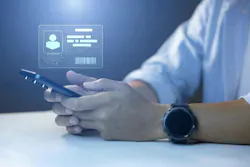
Ready or not, mobile driver’s licenses (mDLs) and digital identification are coming to businesses to speed merchandise pickup, hotel check-in, banking, rentals and other transactions that require ID verification.
Consumers increasingly want to reach for their phones rather than their wallets to verify their identities. Millions of Americans are already using mDLs to move through TSA checkpoints, car-rental desks and hotel check-in, and they increasingly expect the same speed everywhere they verify their identity.
Technology vendors, equipment manufacturers, integrators and consultants cannot afford to ignore the emergence of mDLs and digital IDs, also called verifiable digital credentials (VDCs). As these tools gain traction, organizations are assessing whether their in-person identity-verification infrastructure can support digital credentials alongside physical IDs, which can open the integration market.
Standards help propel mDL efforts
Industry estimates put roughly eight million mDLs issued in the U.S. so far, with adoption climbing steadily. At the beginning of 2026, mDL programs were up and running in 21 U.S. states and Puerto Rico, with development occurring in a dozen more states. By 2030, the U.S. mDL install base is projected to reach 143 million, according to ABI Research. The European Union is requiring its 27 member states to offer digital wallets by 2030 to its 450 million residents, and similar efforts are under way in South Asia, Australia and other geographies.
Mobile driver’s licenses are one facet of VDCs, which also can include passports, national health or identity cards and other identifiable information that can be verified cryptographically.
Fortunately, the industry is coalescing around global standards that eventually should make digital ID acceptance uniform throughout most of the world. As defined by ISO/IEC 18013-5, an mDL is a digital driver’s license stored on a mobile device that uses standardized interfaces, cryptographic keys and issuer signatures for secure, consent-based presentation and verification. While this standard supports in-person use, ISO/IEC TS 18013-7:2025 extends standardized presentation to online verification, helping make mDLs more resistant to cloning, counterfeiting and tampering than physical cards or screenshots.
U.S. efforts are also guided by the American Association of Motor Vehicle Administrators (AAMVA) Mobile Driver's License Model Legislation, a framework that helps ensure mDLs are trustworthy, interoperable and usable across different states, devices and verification environments. Mobile driver’s licenses are not simple images of a plastic card, but cryptographically protected credentials designed to operate within standards-based interaction models.
Integration challenges present market opportunity
Like any emerging technology, mDLs face adoption headwinds, including compatibility gaps, inconsistent acceptance and the need to support physical and digital credential workflows in parallel.
End-users are known as “relying parties,” organizations that accept and verify IDs as part of their operations. A relying party could be a government entity, bank, hotel, liquor store, concert venue, law enforcement, border control or secure facility. Relying parties are looking for flexible platforms that can support both physical and digital credentials, often to streamline access control and verification for employees and customers.
A recent survey reveals that just half of enterprises have unified reporting ownership for physical and digital identity. Nearly 60% report having three or more distinct credential and authentication systems, which can create technical challenges and bottlenecks as users and customers navigate among systems. But it also presents an opportunity for systems integrators.
Reading an mDL involves two steps. First, the verifier must understand the standardized data format and extract the needed fields. Second, the verifier must cryptographically confirm that the credential is genuine. That verification depends on accessing the issuing authority’s public keys, which allow the system to check the mDL’s signature and distinguish a real credential from a fake one.
Deploying mDLs improves privacy by sharing only the information needed for a transaction, rather than a complete identification record. This selective disclosure can help companies streamline their operations by reducing data overcollection, which can lower security, compliance and data-storage burdens.
In practical terms, that means a traveler from Japan could present an VDC in the U.S. and the receiving system would know how to read it. Instead of interpreting many different physical documents, verifiers can rely on one common structure, reducing confusion and friction and making identity checks more reliable worldwide.
Help customers prepare for a digital future
Mobile driver's licenses are advancing as part of a broader transition to digital identity, but adoption will vary by jurisdiction, use case and customer readiness. Systems integrators and equipment manufacturers can help customers navigate this transition by taking a measured approach that accounts for their operational needs and existing infrastructure.
The following six steps can help integrators guide customers through the planning and implementation process:
- Build support for hybrid credentialing. Design and configure solutions that can verify physical IDs and mobile driver’s licenses side by side. This may include integrating mDL reader capabilities, compatible scanning hardware and fallback workflows for locations or users that still rely on physical credentials.
- Offer structured pilot engagements. Help customers introduce mDL verification through pilot projects focused on specific workflows, locations or use cases. Define success measures in advance. These can include transaction times, verification completion rates, user experience, fraud outcomes and operational reliability.
- Translate capabilities into operational value. Integration of mDL should be more than a technical enhancement. Show how customers can reduce friction and improve assurance by streamlining check-in, age verification, access control, onboarding and other identity-dependent processes.
- Maintain standards and vendor interoperability expertise. Track relevant mobile credential standards, wallet ecosystems, reader technologies, and government and industry programs on digital identity. Devise architectures that avoid lock-in and can accommodate changing credential formats, issuer requirements and verification methods.
- Coordinate the implementation ecosystem. Integrators serve as the focal point of any implementation, bringing together customers with credential issuers, technology vendors, hardware providers, identity-verification platforms and security teams. Deployment risk can be lessened by clarifying roles, interfaces, data flows, operational ownership and support responsibilities before implementation.
- Help customers prepare without forcing premature deployment. Integrators can help customers assess readiness for mDL and other digital ID verification, pinpoint high-value use cases, modernize underlying infrastructure and develop phased roadmaps so any implementation occurs only when users and business demand justify it.
The industry cannot wait for a unified mDL solution to present itself. Integrators can take the lead on this important issue by engaging with vendors and partners who understand mixed verification environments, evolving standards and real-world interaction constraints.
About the Author
 Jean-Baptiste Milan
Sales Director BIO Commercial North America at HID
Jean-Baptiste Milan is head of sales, commercial, North America, for HID's Biometric Identity Technologies business. He has more than 15 years of experience in electronic identity projects worldwide, including work on electronic passports, mobile driver's licenses and digital identity standards. He has also contributed to international standardization efforts through ISO and served as chair of the International Biometrics + Identity Association's Mobility Working Group.