The Machine That Watches Everything: How Ambient.ai Is Disrupting Reactive Security
Key Highlights
- Ambient.ai founder Shikhar Shrestha argues that agentic AI – which perceives, reasons, and initiates responses autonomously – is about to shatter the industry's reactive ceiling, where organizations with 50-plus cameras have essentially nobody watching in real time.
- The proof points are striking: one enterprise customer saw 94% of 240,000 alarms auto-cleared, and Shrestha predicts remote video monitoring as we know it won't survive contact with truly agentic systems.
- Backed by $72 million and a new Securitas Technology reseller deal, Ambient.ai targets an 80% automated, 20% human security operation – with the shift arriving in the next two to three years.
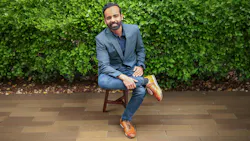
This article originally appeared in the June 2026 issue of Security Business magazine. Don’t forget to mention Security Business magazine on LinkedIn or our other social handles if you share it.
Shikhar Shrestha has a simple question for anyone who runs a physical security operation: If you have more than 50 cameras, how many of them are actually being watched by a human right now?
The answer, in his experience, is close to none – not because security teams are negligent, but because the math has never worked. A camera count that would require hundreds of attentive human eyes to monitor instead feeds into a VMS that records everything and reveals almost nothing actionable. Analytics fire, operators tune them out. Access control logs pile up unverified.
The industry has built sophisticated infrastructure around a fundamentally reactive posture, and most organizations have accepted that posture as the ceiling of what’s possible.
Shrestha, founder and CEO of Ambient.ai, thinks that ceiling is about to come down.
His company has spent nearly a decade building what it calls agentic physical security: an AI platform that perceives events in real time, assesses their significance, and initiates responses autonomously, working alongside human operators rather than waiting for them. The company has deployed at Fortune 100 enterprises across technology, finance, manufacturing, and critical infrastructure.
Once truly agentic products are deployed at these sites, I don't think remote video monitoring will exist the same way we think of it today.
- Shikhar Shrestha, CEO of Ambient.ai
Shrestha arrived at ISC West this spring with a set of claims about where the industry is heading that integrators and monitoring professionals would do well to take seriously.
From Analytics to Reasoning
The security industry has offered AI-powered video analytics for years. Most of it works by training models to detect specific objects or behaviors within a camera frame: a person crossing a line, a vehicle in a restricted zone, a package left unattended.
These systems generate alerts. Humans respond to the alerts, or more commonly, they learn to tune them out because the false positive rate makes them operationally useless.
Ambient.ai is doing something architecturally different. The core of its platform is a reasoning Vision-Language Model called Ambient Pulsar, purpose-built for physical security and deployed at the edge on dedicated appliances powered by NVIDIA hardware. Pulsar processes every camera frame continuously, preserving context across time. It understands sequences and behaviors, not just individual moments. It knows the difference between someone who badged into a door normally and left vs. someone who followed another person through without badging at all.
The platform connects to a customer’s existing cameras, regardless of manufacturer, and simultaneously ingests access control events. At a large enterprise deployment, Shrestha says, the system monitors for 150 to 200 distinct threat types across thousands of cameras in real time. It also auto-verifies every access control alarm it receives.
“We can basically use AI to automatically video-verify them," he says. "We can tell you these three alarms are real; everything else is false.”
That capability alone addresses one of the most persistent and expensive problems in enterprise security operations: alarm fatigue. Security operations center staff at large organizations spend enormous portions of their shifts chasing events that turn out to be irrelevant. Every hour spent on a false alarm is an hour away from a real one.
Ambient.ai measures its customer outcomes in those terms; in fact, ServiceNow, one of its named enterprise customers, has seen more than 240,000 alarms processed by the platform, with 94% auto-cleared and more than $500,000 (reportedly) in avoided labor costs.
The 50-Camera Threshold
One of the more surprising elements of Shrestha’s argument is who he believes Ambient.ai actually serves. The intuitive assumption is that a platform this sophisticated is built for the Fortune 50: the hyperscalers and global manufacturers with dedicated GSOCs, massive camera infrastructure, and security budgets to match.
Shrestha pushes back on that directly. “Any customer that has even 50 cameras is not really watching those cameras in real time," he says. "Their security posture today is reactive.”

He argues that the value proposition scales in both directions. A large enterprise with a fully-staffed GSOC can use Ambient.ai to do more with fewer people, extending proactive coverage across more sites than its human analysts could manage alone.
A mid-sized organization with 50 cameras and no dedicated monitoring operation gets something it has never had: genuine real-time situational awareness, delivered by AI, at a cost and complexity level that a full GSOC operation would never make practical.
“Day zero, they’re getting the same kind of security that a Fortune 10 global company that would have invested in a GSOC and 50 to 100 people on site would have gotten, because AI is doing everything a GSOC does, virtually,” Shrestha explains.
That framing carries significant implications for the integration community. The traditional path to enterprise-grade security has run through large system integrators, substantial hardware investments, and ongoing staffing costs.
Shrestha is arguing that AI compresses that path considerably, making sophisticated security operations accessible to a much broader customer base.
Video as Ground Truth
Shrestha is emphatic that video is the foundational layer of everything Ambient.ai does, and his reasoning shapes the company’s entire product philosophy.
“If I asked you to go secure a stadium in the best possible way, our best bet would be to hire 200 people and stand them everywhere around the stadium, observing and reporting," he says. "If they do see something, say something, and we respond, every incident can be prevented.”
The logic extends to sensors. Shrestha does not dismiss non-video sensors such as millimeter wave, time-of-flight, or LiDAR, and he brings credibility to the subject: before founding Ambient.ai, he built time-of-flight cameras at Google.
His position is specific: Any sensor that detects an event creates an immediate verification problem. Something triggered. Now what? “You have two options, he says. "You send a guard to take a look, or you pan a camera to it and visually verify it.”
The camera is always the endpoint. The AI is always the brain that makes sense of what the camera sees. For integrators who have built practices around sensor-based detection systems, the message is that those systems become more useful inside an AI-driven platform, not less. The platform, though, has to be the organizing intelligence.
The Remote Monitoring Question
Perhaps the most pointed disruption Shrestha describes involves remote video monitoring, a service around which many integration firms have built significant recurring revenue.
The traditional RVM model works because the environment it monitors is simple: A car dealership after hours, a construction site at night, a retail location outside business hours. The environment is sterile.
An analytic alerts, and a central station operator pulls up the camera, verifies the event, and calls it in or dismisses it. The human verification step is the business.
Shrestha believes that model will not survive contact with a truly agentic system. “If you have a small site and you deploy a product like Ambient, you don’t really need a human to look at the analytic and verify it, because the AI is that good. Not only that, you’re monitoring daytime too. Even when you have all this activity at the site, it can still see something suspicious. The environment does not need to be sterile.”
The implications are significant. RVM has historically worked at sites too small to justify a GSOC and too active during business hours to use analytics reliably. Shrestha's pitch is that agentic AI closes both gaps simultaneously.
“Once truly agentic products are deployed at these sites, I don’t think remote video monitoring will exist the same way we think of it today,” he adds.
The Trust Problem
None of this matters if end-users refuse to adopt it. Shrestha is clear-eyed about the conservatism of the security buyer. “Trust is the word," he says. "The big thing is you just have to prove the technology works in the field.”

Shrestha says the company actively designs for transparency in how the platform communicates its reasoning: it generates plain-language descriptions of what it sees, so an operator reading an alert understands why the system flagged something. “Once they read that and understand, they kind of get it that it’s not the same foreground, background, motion detection analytic – it’s doing something deeper.”
There is also a technical answer to a question the industry is starting to ask about AI reliability: Who watches the AI? Shrestha described the use of ensemble models, a practice where multiple independent AI model paths analyze the same event simultaneously, each biased toward a different perspective or confidence threshold.
“The [AI] can analyze from different perspectives," he explains. "One model path may say, 'this really looks like a weapon.' Another model may say, 'it is a weapon, but it’s not a real weapon.' It may just be a Nerf gun.”
The ensemble approach builds a layer of internal verification into the AI’s own decision-making, reducing the risk of a single model generating a confident but wrong conclusion. For security applications where a false response can be as costly as a missed threat, that architecture matters. It is also the kind of technical detail that tends to sway conservative buyers, because it demonstrates that the vendor has thought carefully about failure modes, not just performance metrics.
What Comes Next
Ambient.ai has raised $72 million across four funding rounds, with its most recent closing in April 2025. The company counts Andreessen Horowitz, Y Combinator, and Allegion Ventures among its investors, along with George Kurtz, the CEO of CrowdStrike.
In March 2026, it announced a global reseller agreement with Securitas Technology, a move that signals an intent to scale beyond direct enterprise sales and into the broader integration channel.
The company currently goes to market with three agentic product lines, and the roadmap is already moving. In May, Ambient.ai announced new capabilities for Ambient Access Intelligence, its access control platform module, adding real-time diagnostics for chronic door infrastructure problems and live visibility into physically unsecured doors across a customer’s entire site.
Shrestha says the company intends to expand from its current three products to nearly 10 over the next two years, all oriented around automating discrete functions within a security operation.
“There aren’t many purely doing AI agentic software in the industry right now," he says, "and we think that market and that opportunity is growing.”
Whether or not that milestone lands on schedule, it is building toward a security operation where AI handles volume, pattern recognition, and initial response decisions, and where human operators handle judgment, leadership, and crisis management.
Shrestha describes the target ratio as 80% automated, 20% human, and he believes the timeline is shorter than most of the industry expects. “In the next two to three years, we’ll see a pretty strong change happening in the industry.”
For integrators, the relevant question is positioning. Agentic AI is arriving in physical security, whether the channel leads it or reacts to it. The firms that move early, build competency around these platforms, and help customers navigate the transition from reactive to proactive security postures will find themselves on the right side of that change. The ones that wait may find the conversation has moved on without them.
About the Author
 Paul Rothman
Paul Rothman
Editor-in-Chief/Security Business
Paul Rothman is Editor-in-Chief of Security Business magazine (www.securitybusinessmag.com) and has been covering the security industry for various outlets since 2001. Email him your comments and questions at [email protected].