Ungoverned AI Agents Are Already Inside Your Clients’ Buildings
Key Highlights
- Three in four organizations running AI agents in physical environments have already had an incident involving one, and the integrator may get the first call.
- Only 13% of organizations reach a defensible governance posture, and 29% have found agents running in production that nobody approved.
- Integrators and consultants who get involved at the specification stage can set permissions, logging, and boundaries before agents are deployed.

This article originally appeared in the November 2026 issue of Security Business magazine. Don’t forget to mention Security Business magazine on LinkedIn or our other social handles if you share it.
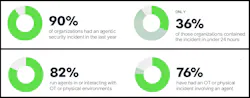
The AI agents already running inside your clients’ buildings, access control systems, and connected infrastructure are, in most cases, operating without anyone named as accountable for what they do. Three in four organizations running agents in physical or OT environments have already had a security incident involving one. Most can’t see the majority of their agents in real time, and nearly a third have discovered agents running in production that nobody approved or even knew existed.
That’s not a prediction; that’s where things stand today, according to Deployed but Ungoverned: The State of Agentic Security, a study ServiceNow released today based on surveys of 3,766 senior security and technology decision-makers – VP level and above – across 20 countries and eight industries.
Think about what “physical environment” means in the security world: access control, video surveillance, building automation, industrial controllers, connected medical devices. Security clients are deploying AI agents into systems that consultants specified and integrators installed and often still maintain.
When an AI agent misbehaves inside that infrastructure – and ServiceNow’s research says that 75% of organizations running agents in physical environments have already had an incident – the integrator may well be the first call they make.
The Governance Gap Is Worse Than Anyone Is Admitting
The study’s broader finding that will resonate with anyone who has ever conducted a security assessment is that organizations are dramatically overestimating how well-governed their AI deployments actually are.
While 56% of security leaders rated their agentic security posture as “established,” when ServiceNow measured those organizations against five observable domains – attack surface, accountability, security by design, visibility, and audit readiness – only 13 percent cleared a defensible threshold. Nearly half of all organizations surveyed recognize the governance gap but haven’t built a structural response to it. Another quarter have a defined framework in place, but coverage is still incomplete. Fourteen percent have governance that was never designed with AI agents in mind. Only one in eight reaches what the study defines as a defensible posture.
Only 20 percent of organizations have a single named, accountable owner for agentic AI governance. Only 32 percent have an automated deployment gate that blocks an agent until it clears a defined security check. “What gets missed may surface later as shadow AI, found only after it was already running,” says Rahul Prakash, VP and GM of Identity Security at ServiceNow and a co-author of the report.
The numbers bear that out: 29 percent of security teams found agents running in production they had never registered or approved.
Integrators and consultants have been navigating that same gap between perceived and actual security posture for decades – this version just runs at machine speed inside systems that operate autonomously.
Tools That Weren’t Built for AI
The report’s most instructive section is a collection of real incidents where existing security tools and processes proved inadequate for agentic AI. The scenarios are worth reviewing because they map directly to environments integrators and consultants work in every day. Mitigation tools were simply designed for a world where humans make decisions and agents don’t exist:
- A retail SVP described a coding agent with legitimate credentials that deleted email volumes before anyone could intervene. No kill switch or governance mechanism existed to prevent or detect the unauthorized actions.
- A hospital security VP described a customer support agent that was manipulated through prompt injection into leaking internal project names – traditional data-loss prevention tools missed it entirely.
- A government agency compliance officer described an admin token that deleted backup snapshots; their SIEM logged the action but treated it as routine cleanup because the token came from a trusted service account.
- A specialty retail compliance officer offered the scenario most relevant to physical security practitioners: endpoint tools failed to block shadow AI agents that staff had deployed, with no policy in place to audit unapproved agent creation.
- An automotive CIO described an internal AI agent that began pulling customer data across five tools and emailing summaries before anyone identified what was happening.
The Problem with Agents Always Being On
In traditional identity governance, access ends when an employee departs – HR closes a record, a cascade of disablements follows, and the system works because the trigger is reliable. Unlike human employees, an AI agent has none of those triggers. It goes live for a specific project, the project ends, and the credentials keep working indefinitely because nothing in the environment registers that the project is over.
Seventy-six percent of organizations say they maintain a complete, current map of every agent’s access. Only 19 percent can see more than 90 percent of their agents in real time. “They’re describing what’s written down, but the space in between that and what’s running is where attackers start looking,” Prakash says.
An access control agent deployed for a building renovation project doesn’t badge out when the contractor leaves. It retains whatever permissions it was granted at deployment, across whatever systems it could reach, until someone actively revokes them – assuming anyone remembers it exists.
Security Retrofitted Is Security Compromised
The report makes a structural argument that security teams brought in before design begins produce fundamentally different outcomes than teams brought in after deployment. Only 44 percent of organizations involve security before agent development starts.
“When security comes in after the fact, the team usually has to retrofit controls around something already built,” explains Accenture Managing Director Paul Kunas, who contributed to the ServiceNow report. “That is slower, more expensive, and often less effective.”
The organizations with a defensible posture have built governance into the architecture before that architecture existed, and the data shows it: 55 percent of organizations with defensible posture are able to contain incidents in less than 24 hours vs. 33 percent for everyone else.
For integrators and consultants, this is the argument for getting into client conversations at the specification stage rather than the implementation stage. As the report states: “Security that arrives before the design work starts sets the permissions, defines the logging, and draws the boundaries the agent will run against. Security that arrives later inherits all three.”
An agent’s permissions are easy to grant and hard to revoke. A deployment gate added after the fact can inspect an arrangement it had no hand in making.
Unified Visibility Leads to Better Outcomes
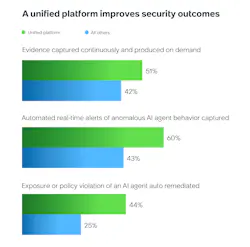
Organizations running agentic security on a unified platform significantly outperform those spreading risk management across integrated tools, point solutions, or manual processes on every measured outcome; in fact, 60% of them have automated real-time alerts for anomalous agent behavior and 44% can auto-remediate an exposure or policy violation.
“Their confidence comes from visibility and control, not simply intent,” says Ben de Bont, CISO at ServiceNow and a co-author of the report.
Sixty-six percent of all organizations cannot act automatically when an agent behaves anomalously – a human still has to intervene before anything changes in the environment. At machine speed, that intervention lag is where an incident finds room to expand.
What This Means for Integrator and Consultant Practices
For integrators, the near-term implication is awareness. If your clients are within the 82% running agents in physical environments, ask them who owns governance for those agents. Ask whether those agents were registered when deployed. Ask whether anyone has mapped what those agents can reach and whether access has ever been formally reviewed. The research suggests most organizations will have uncomfortable answers to all three.
For consultants, the five moves ServiceNow identifies for reaching defensible posture read like an engagement checklist:
1. Build a continuous agent inventory with access mapped at deployment
2. Embed security requirements before architecture begins
3. Unify visibility across agents, identities, and posture on a single platform that extends into OT and physical environments
4. Capture evidence continuously rather than assembling it under pressure
5. Assign a single accountable leader with genuine enterprise-wide scope.
Most security clients likely know they have a problem with agentic AI governance but haven’t yet built the structure to address it. That creates a well-defined entry point for consultants.
Physical and Cyber Are One Problem Now
The physical security industry has spent years arguing – correctly – that physical and cyber security need to be managed together. Agentic AI is making that argument impossible to ignore.
An agent managing building access or monitoring a camera network is no longer just a cyber asset. It’s operating inside the physical world, with real-world consequences when it behaves outside its intended scope, and – based on this research – a better-than-even chance that nobody named is accountable for what it does.
The governance architecture for that reality needs to exist before the next incident, not after.
Editor’s Note: The full report, Deployed but Ungoverned: The State of Agentic Security, is available at www.servicenow.com/workflow/ethics/state-agentic-security.html
About the Author
 Paul Rothman
Editor-in-Chief/Security Business
Paul Rothman is Editor-in-Chief of Security Business magazine (www.securitybusinessmag.com) and has been covering the security industry for various outlets since 2001. Email him your comments and questions at [email protected].