A Practical Guide to Specifying Gunshot Detection
Key Highlights
- Gunshot detection has gone mainstream across utilities, campuses, and municipalities – but with a crowded market of nearly identical-looking solutions, integrators earn their trusted advisor status by helping clients ask eight critical questions before committing.
- The biggest architectural divide: legacy mesh networks requiring multiple sensors to triangulate a shot versus modern edge-based systems that detect, classify, and localize from a single intelligent sensor.
- Hidden costs lurk in recalibration truck rolls, multi-sensor zone requirements, and vendors who retain ownership of the client's own acoustic data – a contract question worth raising before the sale closes.
This article originally appeared in the June 2026 issue of Security Business magazine. Don’t forget to mention Security Business magazine on LinkedIn or our other social handles if you share it.
Gunshot detection has moved into the mainstream of physical security. Utilities, campuses, municipalities, and commercial properties are adding it as a core layer of perimeter protection.
For integrators and consultants, that demand creates both opportunity and responsibility, because the market is crowded, and many solutions look nearly identical on paper. They all promise alerts, maps, dashboards, and AI, but once installed, the architectural differences become obvious.
Some systems reduce response time and increase operator confidence. Others introduce complexity, latency, and long-term cost that end up reflecting poorly on the integrator who specified them. Helping clients ask the right questions before committing is where the real value of a trusted advisor lies.
Here are eight questions worth discussing with every client:
1. Does the system require a mesh network to function?
Many legacy architectures rely on triangulation – multiple sensors must "vote" to confirm a shot and calculate location. That approach adds hardware, cabling, infrastructure cost, latency, and additional points of failure, all of which affect installation complexity and ongoing reliability.
Modern edge-based systems localize from a single intelligent sensor. Detection, classification, and location happen on the device itself. Fewer sensors, fewer cables, fewer dependencies. That difference alone changes installation cost, deployment flexibility, and long-term maintenance burden.
2. Is the algorithm tuned for outdoor acoustics?
Outdoor environments are acoustically chaotic. Fireworks, construction noise, backfires, wind shear, and thermal layering all distort sound. If a vendor describes their system as detecting "loud impulsive sounds," that should prompt a deeper conversation. Loudness alone is not sufficient.
A point on a map is not situational awareness. Operators need to see what happened, where it happened, and whether the threat is credible before committing resources.
A viable outdoor system must distinguish between the muzzle blast and the ballistic shockwave of a projectile. That dual-signature analysis separates true gunfire from environmental noise. Systems relying primarily on decibel thresholds will generate false positives. Systems trained on decades of outdoor acoustic data will not treat every bang as a threat. Ask vendors directly which approach their system uses.
3. Where does the processing happen?
If audio must be sent to a remote server or cloud for analysis, latency is introduced – and in an active situation, seconds matter. Cloud dependency also creates network vulnerability; if connectivity drops, detection can degrade or stop entirely.
Edge processing changes that equation. When AI resides inside the sensor, detection and localization occur instantly. The system continues to function even if external connectivity is intermittent. For clients in environments where network reliability is a concern, this distinction is worth emphasizing.
4. Does the client get visual verification, or just a map dot?
A point on a map is not situational awareness. A modern system should automatically slew a PTZ camera to the detected shot coordinates, with audio validation and video confirmation arriving together inside the VMS. That integration turns an alert into actionable intelligence – operators see what happened, where it happened, and whether the threat is credible before committing resources. Specify accordingly.
5. Is the system portable and scalable?
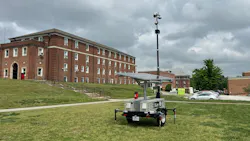
Threat landscapes shift. Permanent installations have their place, but events, protests, festivals, construction projects, and emerging risk zones require flexible coverage. Systems that demand fixed infrastructure and minimum sensor counts limit operational agility. Single-sensor architectures with edge processing can be deployed on light poles, masts, or mobile trailers and redeployed as risk evolves – a meaningful advantage for clients managing dynamic environments.
6. What are the hidden costs?
Some legacy systems require periodic manual recalibration and frequent truck rolls to maintain performance. That erodes client ROI and creates recurring service demands. Remote health monitoring and self-contained processing reduce those disruptions – and reduce callbacks. Multi-sensor triangulation models often require three or more devices per zone, multiplying cabling, mounting, and labor costs. Single-sensor localization reduces hardware footprint and simplifies deployment.
7. Who owns the data?
Acoustic event data should belong to the organization that purchased the system. Clients should be cautious of vendors that retain ownership of operational data or charge for access to historical logs. This is a straightforward contract question worth raising before the sale closes.
8. How does it integrate with existing infrastructure?
Gunshot detection should not be a standalone tool. It should integrate with the client's existing VMS, trigger PTZ control via open standards, and support downstream workflows, including access control responses and mass notification. Open interoperability protects long-term flexibility and avoids the vendor lock-in that creates problems down the road.
About the Author
 Timothy English
Timothy English
Managing Director, Acoem ATD Division
Timothy English is currently the Managing Director of Security Solutions at Acoem. Tim has 14 years of experience in commercial leadership of sensor-based technology companies, including SKF, Pruftechnik (Fluke), and RDI Technologies. Before his industry career, Tim spent nine years on active duty in the United States Navy, primarily as an officer in the E-2C Hawkeye platform. He holds a BA from Penn State University, an MBA from Miami University, and is a recipient of the Bronze Star Medal. Industry certifications include Project Management Professional (PMP), Certified Reliability Leader (CRL), and Vibration Analyst, Category II (ISO 18436.2).