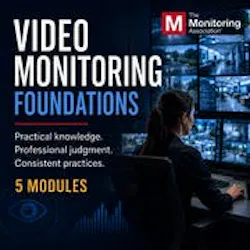
TMA’s new Video Monitoring Foundations program uses realistic monitoring center scenarios, guided exercises, knowledge checks and assessments to connect core concepts with day-to-day operator responsibilities.
The Monitoring Association (TMA) has launched a new online training program aimed at providing video monitoring professionals with foundational knowledge, judgment and professional practices for today’s monitoring environment.
Video Monitoring Foundations is initially available exclusively to TMA members, with public availability beginning Sept. 1, 2026.
The five-module program is designed to complement an organization’s existing operator training rather than replace company-specific instruction. TMA said the curriculum provides a shared industry foundation that organizations can reinforce through standard operating procedures, account instructions, platform training and applicable jurisdictional requirements.
Developed by industry subject matter experts, the vendor-neutral program incorporates realistic monitoring center scenarios, guided exercises, knowledge checks and final assessments. It is designed for monitoring centers, systems integrators and security professionals seeking a common foundation for modern video monitoring.
“Video monitoring technology continues to evolve rapidly, but effective outcomes still depend on well-prepared professionals who can interpret what they see and respond with sound judgment,” said Wes Usie, vice president of TMA and co-chair of TMA’s Surveillance and Video Verification Committee. “Video Monitoring Foundations gives operators a practical, consistent framework for combining technology with situational awareness, clear communication, accurate documentation and fact-based decision-making.”
The complete course consists of five modules covering different aspects of video monitoring operations:
- Introduction to Video Monitoring Systems addresses the purpose, services, tools, benefits and limitations of video monitoring.
- Proactive Video Monitoring: System Meets Operator examines how analytics and AI-assisted alerts work alongside operator context, judgment, communication and documentation.
- The Video Monitoring Process covers event evaluation, camera tools, evidence, alarm validation, communication with public safety and fact-based reporting.
- Operator Self-Care focuses on stress, fatigue, resilience, recovery and sustained readiness.
- Legal and Computer Safety addresses privacy, confidentiality, cybersecurity, secure work habits, documentation and professional responsibility.
Learners can enroll in the complete five-module course or select individual modules for targeted development. Across the curriculum, TMA emphasizes situational awareness, professional judgment, communication, documentation and fact-based decision-making, as well as the relationship between monitoring technology and trained operators.
Enrollment and additional information are available through TMA’s online learning catalog.