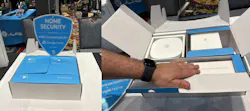
The platform requires no technician visit for installation. Customers can set up the device kit themselves, and AT&T has partnered with Affirm to offer financing options. One of the AT&T representatives at its booth showed off the company’s installation kit, which is packaged and opened in a step-by-step process designed to make it easy for the average homeowner to install the system.
While the experience is designed to work best with AT&T broadband services including fiber or fixed wireless, the platform is available to any AT&T customer nationwide. A customer could use a competitor’s broadband solution as long as they maintain an AT&T mobile account.
The platform is designed so customers cannot distinguish which components come from AT&T, Google, or Abode. “It cannot feel like three different partners,” Brower said. “The beauty of what we’ve done with our partners here is that it feels like our customers literally don’t know which of these devices are AT&T, which are Google, which are Abode, and we don’t want them to ever have to care.”
Brower added that the company sees the offering as complementary to its broadband and mobile solutions. “As an example, knowing that I am driving into my neighborhood vs. a foot away from my front door makes a big difference to people – especially at night when it comes to unlocking the door,” he said. “If you’re an AT&T mobile customer, we are building the capability to know within centimeters exactly where you are, so we make the right decision at the right time. That type of experience is going to be better when you have AT&T core services, and this is a complementary service.”
Digital Life Background
AT&T launched Digital Life in 2013 as an ambitious attempt to create a comprehensive smart home platform covering security, automation, and energy management. The service required professional installation and featured proprietary hardware and a monthly subscription fee.
The company began winding down Digital Life in 2022, citing evolving customer preferences and the maturation of the smart home market. According to a Dallas Morning News report, AT&T had shifted resources away from the platform as the market became increasingly crowded with competitors offering DIY solutions. Additionally, AT&T’s phasing out of its 3G network – which powered the original system – led to its migrating of many customers to Brinks Home and requiring users to switch to Brinks’ LTE-based equipment or lose service.
Brower said customer feedback drove the decision to re-enter the market. Survey data showed that customers prioritize security and protection in their online experience, second only to connection quality and reliability.
“One of the things our customers tell us is that being connected is not enough,” he said. “They actually look to us to make sure they’re not just connected, but they’re actually protected in their online experience. That matters a lot to them. Behind just the quality and reliability of the connectivity that we offer, making sure it is a protected and safe experience is top-of-mind for our customers.”