Dutch Startup Eyeo Demos Game-Changing Video Surveillance Tech at CES
Key Highlights
- A Dutch startup called Eyeo Imaging arrived at CES 2026 with a sensor technology that uses nanophotonic structures to split and guide light instead of filtering it — capturing three times more light than conventional sensors while maintaining full color in conditions where traditional cameras go black-and-white or switch to infrared.
- The business case for security integrators goes beyond image quality: higher sensitivity means cameras can be spaced farther apart — potentially every kilometer instead of every 500 meters — cutting total camera counts in half and reducing infrastructure, cabling, and maintenance costs even if per-camera pricing runs higher.
- Eyeo's evaluation kits are targeted for select camera manufacturers by mid-2026, with finished sensors expected in late 2026 or early 2027 and camera products reaching market around 2028 — giving forward-thinking integrators a window to get ahead of what could be a fundamental shift in low-light surveillance performance.
This article originally appeared in the February 2026 issue of Security Business magazine. Don’t forget to mention Security Business magazine on LinkedIn or our other social handles if you share it.

A Dutch imaging technology startup came to CES 2026 with cutting-edge image sensors that could fundamentally alter how video surveillance cameras perform in low-light conditions by eliminating the color filters that have defined sensor design for five decades.
Eyeo Imaging, which spun out of European research institute IMEC in 2024, uses nanophotonic structures to split and guide light directly to sensor pixels rather than filtering it. The company claims the approach captures three times more light than traditional sensors while maintaining full color resolution in conditions where conventional cameras would switch to infrared.
The technology addresses a longstanding limitation in image sensor design. Traditional sensors use color filters layered over pixels to create color images, but these filters absorb approximately 70% of incoming light. Eyeo’s approach uses vertical waveguides to split light into different wavelengths and direct each color to specific pixels without light loss.
“Color filters filter out a lot of light, and 70% is wasted,” says Jeroen Hoet, CEO of Eyeo, demonstrating the technology at CES 2026. “We don’t use color filters on our sensors; we use nanophotonics, which splits light into color.”
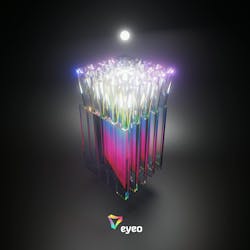
How the Technology Works
Eyeo’s sensor architecture replaces both the color filters and microlenses found on current image sensors. When light enters the sensor, it hits a collection funnel that channels photons into a vertical waveguide. Inside the waveguide, the light splits into different colors, which are then injected into adjacent pixels. “Then, at the output, we inject different colors into the pixels,” Hoet explains. “This way, we don’t filter any light, but we split and guide the light into the pixel.”
The result is a sensor that delivers three times the sensitivity of conventional designs while transmitting the same data payload. The increased light capture does not add bandwidth requirements for streaming or storage because the pixel count remains unchanged – obviously a potential game-changer for video surveillance image detail and definition in the security industry.
“At the end of the day, we still send the same amount of pixels,” Hoet says. “So the image will be exactly the same size, but it will have less noise and more signal in that same data.”
The approach addresses a problem that has existed since the invention of color image sensors. While companies including Samsung have worked on color filter alternatives for a decade, Eyeo claims its vertical waveguide design represents a more comprehensive solution.
“This problem of color filtering has existed for 50 years,” Hoet says. “Samsung has been working for 10 years on a solution, and they just recently introduced a technique – but it is far different than what we’re doing.”
Enterprise Security Applications
Eyeo is targeting high-end security applications where image quality justifies premium pricing. The company’s demonstration at CES showed the technology maintaining full-color visibility in lighting conditions where traditional sensors could no longer resolve details or color information. And it accomplished this feat without the need for any specialized software – just within the camera itself, which is something Hoet says has never been accomplished in a security camera.

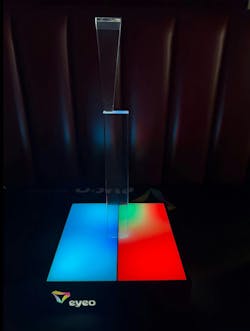
In the demonstration, as ambient light decreased to simulate moonlight conditions, a conventional sensor lost the ability to capture objects and color data. Eyeo’s sensor continued to display full-color images with readable text and visible details that had disappeared from the conventional sensor’s output.
The advantage becomes particularly pronounced in tracking applications across multiple cameras. “If you want to track a certain event across different cameras in an enterprise solution, that will become possible if you’ve got information,” Hoet says. “But today it may be black and white, which is not [always] useful.”
The technology also reduces motion blur. Because Eyeo’s sensors collect more light, they require shorter exposure times than conventional sensors operating in the same conditions. This translates to clearer images of moving subjects.
“If it is very bright in full daylight, our exposure times are shorter,” Hoet explains. “That means that for things that move, you will have less motion blur and artifacts.”
Challenging the Megapixel Race
Eyeo’s approach raises questions about the security industry’s emphasis on resolution over sensitivity. While camera manufacturers have pushed from 1080p to 4K and beyond, Hoet argues that higher sensitivity at lower resolutions may deliver better results for many applications than higher resolution with compromised low-light performance.
The trade-off becomes evident in analytics applications. A 1080p camera with Eyeo’s sensor could maintain full-color detail in low light, whereas a 4K camera with conventional sensors would lose color information or require infrared illumination. For AI-based analytics that depend on color data for object classification or tracking across multiple cameras, the lower-resolution sensor with better sensitivity could outperform the higher-resolution alternative.
“There has been a trend that the higher resolution means that you get a better picture,” Hoet says. “But that’s not necessarily the case. Lower resolution with better sensitivity gives you a better picture.”
This has cost implications beyond the camera itself. Lower resolution reduces storage requirements, network bandwidth consumption, and server processing loads for video management systems.
For large installations running thousands of cameras, the cumulative savings from reduced infrastructure requirements could offset higher camera costs.
The sensitivity advantage could also reduce dependence on supplemental lighting. Security installations currently rely on infrared illuminators or white light to ensure adequate image quality at night. If cameras can maintain color imaging in moonlight conditions, some installations could completely eliminate supplemental lighting, reducing both equipment costs and power consumption.
The Economics: Hardware vs. Software
Eyeo acknowledged that software-based low-light enhancement technologies exist, such as Axis Communications’ Lightfinder, solutions from i-PRO and Vicon, and others; however, Hoet argues its hardware-level approach provides advantages that software cannot replicate. “We fundamentally solve it at the start,” he says.
The key distinction is data capture. Software can process only the information a sensor captures initially. If details or color data never reach the sensor because light was filtered away, the software cannot reconstruct them. “If a sensor did not capture it in the beginning, it is impossible to reconstruct it,” Hoet says.
This hardware vs. software distinction could influence system economics. Hoet suggested that Eyeo’s enhanced sensitivity could allow cameras to be positioned at greater intervals – potentially every kilometer instead of every 500 meters for perimeter security applications – reducing total system camera counts despite higher per-camera costs.
“Cameras are now placed every 500 meters and use zoom,” Hoet explains. “But the zoom lens itself is also lowering the light. If we can boost the sensitivity, you can actually see further away, so now you only have to place a camera every kilometer instead of 500 meters.”
The implication for large-scale deployments is significant. Even if Eyeo-equipped cameras carry premium pricing, cutting camera counts in half fundamentally changes project economics. For a perimeter requiring 20 cameras at current spacing, an integrator might deploy only 10 cameras with Eyeo sensors – reducing both hardware costs as well as associated installation labor, cabling infrastructure, network switching requirements, and ongoing maintenance.
“The system cost becomes lower even though the camera itself may be a little bit more expensive,” Hoet says. “If you only place cameras half as often, the total system cost goes down.”
Target Markets
The company is focusing initially on enterprise security, industrial vision, extended reality devices, and other applications where performance justifies premium pricing. Consumer markets and cost-sensitive security applications are considered future opportunities after the technology establishes itself in high-end segments.
“We are targeting more high-end players initially because there is a bit more value for money, as well as more interest in getting better images,” Hoet says.
Development Timeline and Manufacturing Strategy
Eyeo’s core technology originated at IMEC, a European research institute specializing in nanoelectronics and digital technologies, which developed the first prototype demonstrating the color-splitting concept in 2023.
Eyeo, which is headquartered in Eindhoven, Netherlands, was incorporated in 2024 and has raised more than $17 million to commercialize the technology.
Hoet says the company’s development roadmap calls for evaluation kits to reach select camera manufacturers by mid-2026. The first sensor products are scheduled for late 2026 or early 2027, with camera manufacturers integrating the sensors into products expected to reach the market in 2028.
The company is working with undisclosed camera manufacturers and has established partnerships with sensor manufacturers and foundries. Eyeo’s strategy emphasizes compatibility with existing camera architectures to minimize adoption barriers.
“We do spend a lot of effort already now to make the product, the sensor – interfacing and image extraction – as standard as possible to what [manufacturers] already do,” Hoet says, “so that hurdle becomes as small as possible.”
About the Author
 Paul Rothman
Paul Rothman
Editor-in-Chief/Security Business
Paul Rothman is Editor-in-Chief of Security Business magazine (www.securitybusinessmag.com) and has been covering the security industry for various outlets since 2001. Email him your comments and questions at [email protected].