New Integration Showcased at CES Validates RF Sensing Technology
Key Highlights
- Ivani's RF sensing technology — already embedded in roughly 100 million Philips Hue smart lights via a simple firmware update — means alarm companies are increasingly walking into homes where presence detection is already deployed, whether they sold it or not.
- The real opportunity for professional integrators isn't selling RF sensing — it's connecting consumer-deployed data to comprehensive security systems that deliver verification and automation value homeowners can't configure themselves, with RF presence plus a door contact representing a compelling two-modality alarm verification approach.
- The path forward hinges on factors outside integrators' control — API access, protocol compatibility, and manufacturer willingness to share data — but the companies that figure out how to absorb and add value on top of consumer-grade RF sensing will be far better positioned than those who ignore it.
This article originally appeared in the February 2026 issue of Security Business magazine. Don’t forget to mention Security Business magazine on LinkedIn or our other social handles if you share it.
Presence detection has been an emerging technology area for the past few years at CES, but like many rising tech solutions, it struggled to find a home in the market. Thanks to an integration with Philips Hue, RF sensing technology provider Ivani came to CES with a message: Our technology is coming to residential security, whether alarm companies sell it or not.
Philips Hue’s integration of wireless network sensing from Ivani – dubbed Hue MotionAware by the company – has enabled approximately 100 million smart lights to function as presence sensors, accomplished on such a large scale by a mere firmware update.
For alarm companies and security integrators, the implications are straightforward: They likely won’t be selling RF sensing to residential customers, but they will increasingly encounter homeowners who have already deployed it.
The business opportunity for professional integrators lies in connecting consumer-deployed RF sensing data to comprehensive security and automation systems that deliver value beyond what homeowners can configure themselves.
“We’ve pivoted as a company to become as ubiquitous as we can be, to provide rock-solid data that will be available for integrators down the road,” explains Justin McKinney, CEO and co-founder of Ivani.
Ivani, a 12-year-old company with 13 employees, licenses its “Sensify” RF sensing technology to manufacturers rather than selling hardware directly. The B2B2C model enables manufacturers like Philips to add presence detection to existing product ecosystems. Alarm companies sit downstream of this deployment model – they don’t buy directly from Ivani, but they will increasingly work with homes where Ivani’s technology is already present.
How RF Sensing Works
Ivani’s Sensify technology analyzes disturbances in radio frequency fields created when wireless devices communicate with each other. When people move through spaces equipped with Bluetooth, Thread, Zigbee, or WiFi devices, they disrupt these RF signals, and Sensify detects and interprets these disruptions to determine presence/occupancy.

“When smart devices communicate with each other, they create a mesh-like RF field,” explains Matthew Wootton, Ivani’s CTO and co-founder. “When humans enter and interact with this field, communications between devices are disturbed. We analyze these disturbances and turn them into actionable advanced occupancy data.”
The technology uses RSSI (Received Signal Strength Indicator) as its base detection methodology, allowing it to work across multiple wireless protocols without requiring protocol-specific implementations. Unlike camera-based or millimeter wave radar systems, RF sensing provides presence detection without capturing personally identifiable information about individuals.
Ivani demonstrated the technology at CES 2026 in a hotel suite configured with four detection zones running on different protocols. The system was deployed in less than two hours and operated entirely locally without cloud connectivity.
Detection Capabilities and Limitations
Ivani positions Sensify as a reliable presence detection solution rather than making claims about identifying specific individuals or distinguishing between pets and humans –capabilities the company says would be disingenuous for RF-based systems.

“We pride ourselves on being extremely honest and accurate with what we can do,” Wootton says. “We’re not going to tell you that this system is going to very accurately tell the difference between a 50-pound dog and a small human, because I think anyone who says that is being disingenuous. You can do that with a camera.”
The company reports one false positive event in two years of deployment with Philips Hue, though Wootton noted that the single event was never confirmed. Typical configurations require three to four devices per room to establish reliable coverage.
For lighting control applications, Sensify can turn lights off just three minutes after a room is vacated – significantly faster than the 10-15 minute delays common with PIR motion sensors. Traditional PIR sensors require long delays because they cannot detect stationary occupants; if set to shorter timeouts, lights turn off while people are still present. Sensify's RF sensing maintains detection even when occupants remain relatively still, allowing lights to respond more quickly to actual room vacancy.
Alarm Industry Applications
McKinney and Wootton see potential for Sensify in security applications but emphasize the technology’s role as part of multi-modal verification systems rather than as a standalone alarm trigger.
“I could make the argument that it’s a very good detection method,” Wootton says when asked about using RF sensing for alarm verification, adding that RF sensing combined with door/window contacts could constitute verification. “Verification is about multi-modality: A door contact breaks, and a sensing system says there’s a presence in the room – that’s two modalities that are agreeing, which makes it a pretty good verification.”
The company’s data remains entirely local to devices with no cloud connectivity requirement, addressing privacy concerns common in residential security deployments. In the case of Philips Hue lighting, the system operates as an opt-in feature requiring deliberate activation.
Go-to-Market Strategy
Ivani’s licensing model focuses on enabling manufacturers to add value to existing product ecosystems through software updates. For Philips Hue, MotionAware incentivizes customers to expand their lighting installations to gain presence detection in additional rooms without purchasing separate sensors.

“If they deploy our technology into an ecosystem that they’ve been selling into for some time, all of a sudden their customer base is incentivized to go out and buy more for more areas within their home,” McKinney explains.
The company has established partnerships with other manufacturers beyond Philips, though McKinney says they cannot disclose partner names at this stage. He did elaborate that the company is targeting high-end residential applications, having previously attempted to penetrate commercial markets such as hotels and Class A office buildings.
“The residential market for us at the very moment is much easier to deploy to, especially from a standpoint of scaling,” McKinney says, acknowledging that commercial markets require approval from multiple stakeholders before deployment.
What This Means for Alarm Companies
Ivani’s deployment model creates a scenario where alarm companies become integrators of technology they didn’t sell, rather than sellers of technology they control. As RF sensing scales through consumer product manufacturers – Philips Hue today, potentially other smart home platforms tomorrow – alarm companies face three realities:
1. The technology is already deployed. Customers who call for security system installation or upgrades may already have presence detection throughout their homes via smart lights, thermostats, or other IoT devices. The question becomes whether alarm companies can leverage that data or ignore it.
2. The integration path remains unclear. While Wootton anticipates demand for professional integration services, the technical mechanisms for alarm companies to access RF sensing data from platforms like Philips Hue are not yet defined. API availability, protocol compatibility, and data access permissions will determine whether this becomes a genuine integration opportunity or simply remains consumer-grade functionality that exists parallel to professional security systems.
3. Acceleration of the “security as a feature” trend. When smart lighting platforms add presence detection and security monitoring capabilities, they encroach on traditional alarm company territory. The competitive response requires alarm companies to deliver integration expertise and system-level value that consumer products cannot match.
McKinney frames this as an opportunity rather than a threat, arguing that ubiquitous RF sensing creates demand for professional services. “Some users will want this functionality added professionally throughout the home,” Wootton says. “You didn’t have to roll a truck to hook them the first time, but it might be useful to roll a truck to build it for them correctly.”
The company views its technology as complementary to existing security hardware rather than a replacement. “I think the professionals will need to jump on,” Wootton says, referring to opportunities for integrators to tie RF sensing data into broader home automation and security systems.
Whether alarm companies can capture this opportunity depends on factors largely outside their control: manufacturer willingness to provide data access, standardization of integration protocols, and customer perception of value in professional integration vs. DIY configuration.
MotionAware as a PoC
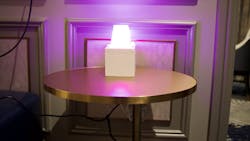
The MotionAware implementation on Philips Hue includes two detection modes – standard mode, represented by purple lighting in Ivani’s demonstration, uses WiFi mesh detection with a three-minute hold time; and an enhanced mode, called R-squared, that provides increased sensitivity by applying additional intelligence algorithms to maintain detection during minimal movement.
MotionAware requires the Philips Hue Bridge Pro – its smart home hub – paired with a subscription. The feature was unveiled in September 2025 as part of an expanded security and smart home portfolio that includes 2K cameras, a wired video doorbell, and smart chimes.
About the Author
 Paul Rothman
Paul Rothman
Editor-in-Chief/Security Business
Paul Rothman is Editor-in-Chief of Security Business magazine (www.securitybusinessmag.com) and has been covering the security industry for various outlets since 2001. Email him your comments and questions at [email protected].