Legal Brief: When Evading the Surveillance State Goes Too Far
Key Highlights
- A license plate frame that can obscure a plate via smartphone app — spotted at CES 2026 — highlights a growing trend of technologies designed to evade traffic cameras and law enforcement, prompting a wave of new state laws cracking down on so-called "ghost plates."
- States including Florida, California, New York, and Tennessee have recently passed or strengthened laws against plate-obscuring devices, with penalties ranging from misdemeanor fines to felony charges for use during criminal activity.
- The debate over surveillance versus privacy has a clear limit: dodging tolls, traffic cameras, and law enforcement isn't a civil liberties issue — it's just lawbreaking with a tech upgrade.
This article originally appeared in the February 2026 issue of Security Business magazine. Don’t forget to mention Security Business magazine on LinkedIn or our other social handles if you share it.
The famous line, “Give me liberty or give me death,” was uttered on March 23, 1775, during a speech by colonist Patrick Henry, imploring a revolution against Great Britain. The line became a rallying cry for the American Revolution, encapsulating the determination for independence. This famous phrase, “Live Free or Die” – officially the state motto of New Hampshire – was first voiced by General John Stark, New Hampshire’s most distinguished hero of the Revolutionary War.
Both statements seem a little drastic. Can’t we find a happy medium between liberty and death? Really? How about “give me some regulation, but not too much!”
In real life, governments have to regulate citizens. The issue is whether they do so fairly, proportionately, and without abrogating our fundamental rights.
Sometimes, citizens do not appreciate being regulated, and they fight back. For Patrick Henry and General Stark, that meant war. For modern-day Americans, it can mean more mundane resistance.
One recent example is the use of ghost plates. These are altered, obscured, or fake license plates designed to evade detection by traffic cameras (like ANPR) and law enforcement. They often use reflective coatings, clear covers, or manipulated characters to disappear under infrared light or become unreadable.
The goal is to avoid tolls, tickets, and hide illegal activities.
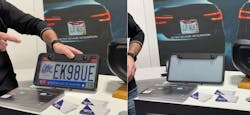
During Paul Rothman and Pierre Bourgeix’s “6 hours of security technology startups in 30 minutes at CES 2026 Eureka Park” video, they encountered an entrepreneur promoting one of these devices on the CES show floor. It was a license plate frame that could be toggled remotely (via app) to completely obscure a license plate so it cannot be read at all.
In his examination of the technology in the video, Bourgeix points out that there has been a rise in technologies to enable the average citizen to fight back against the “surveillance state.” And while none of us want to be surveilled everywhere we go, avoiding detection by toll, traffic, or law enforcement cameras is NOT as noble as the resistance of the 18th century. Actually, it is sinister.
That entrepreneur should be careful, as bringing it to states like California (see below) could be a crime in and of itself.
In his examination of the technology in the video, Bourgeix points out that there has been a rise in technologies to enable the average citizen to fight back against the “surveillance state.” And while none of us want to be surveilled everywhere we go, avoiding detection by toll, traffic, or law enforcement cameras is NOT as noble as the resistance of the 18th century. Actually, it is sinister.
State Laws Vary
Laws requiring license plates to be clearly visible and legible are common and not new. They exist in all 50 states; however, given the increasingly sophisticated initiatives taken to avoid digital surveillance, some states are strengthening their laws.
In Florida, a new law targeting license plate obscuring technologies took effect on Oct. 1, 2025, making it illegal to use any substance, reflective material, spray, coating, or covering that interferes with the legibility, angular visibility, or detectability of a license plate. The new law elevates the use of ghost plates from a non-criminal traffic infraction to a second-degree misdemeanor. Violators face up to a $500 fine, up to 60 days in jail, or both.
Of course, the penalties are worse if you use a plate-obscuring device while committing or fleeing from a crime. That is a third-degree felony, punishable by up to five years in prison. It is also criminal to manufacture, sell, or distribute such devices.
Other states are also proposing or passing laws against license plate obscuring devices:
California: As of Jan. 1, 2026, the manufacture and sale of license plate "flippers" (manual or electric devices that hide or swap plates) is a crime. Violators face fines of $1,000 per device.
New York: As of Sept. 1, 2024, it was illegal to sell products specifically designed to hide or obscure license plates from cameras. New rules in New York City effective April 16, 2025, also explicitly prohibit glass or plastic covers, reflective coatings, and even dirt or rust that obstructs plate readability.
Tennessee: As of July 1, 2024, the purchase, sale, possession, and manufacture of plate flippers is prohibited. Buyers face up to six months in jail, while sellers can face nearly a year of jail time and $2,500 in fines.
Pennsylvania: A recent ban on plate flippers imposes a $2,000 penalty for use or sale.
Illinois: Recently banned obscuring devices.
Some form of regulation has also been proposed in Massachusetts (the seat of liberty) and New Jersey (which has a lot of tolls).
Are these laws depriving us of liberty? Yes. Arguably, all laws do that. Should we be able to thwart the modern surveillance state by avoiding paying tolls, driving recklessly, or committing crimes without detection? No.
We need laws. We need regulation. Patrick Henry and General Stark demanded liberty. But they did not demand stupidity. Our laws must keep pace with technology. As to ghost plates, they are…and that is good. Give me laws or give me chaos.
About the Author
 Timothy J. Pastore, Esq.
Timothy J. Pastore, Esq.
Timothy J. Pastore Esq., is a Partner in the New York office of Montgomery McCracken Walker & Rhoads LLP (www.mmwr.com), where he is Vice-Chair of the Litigation Department. Before entering private practice, he was an officer and Judge Advocate General (JAG) in the U.S. Air Force and Attorney with the DOJ. [email protected] • (212) 551-7707
Meet Timothy J. Pastore
Timothy J. Pastore, Esq., is the newest columnist to join the Security Business magazine family. He is a Partner in the New York office of Montgomery McCracken Walker & Rhoads LLP (www.mmwr.com), where he is Vice-Chair of the Litigation Department.
Before entering private practice, Mr. Pastore was an officer and Judge Advocate General (JAG) in the U.S. Air Force and a Special Assistant U.S. Attorney with the U.S. Department of Justice. As a JAG, in particular, Mr. Pastore was legal counsel to the Air Force Security Forces and Air Force Office of Special Investigations.
Mr. Pastore has represented some of the largest companies in the security industry, including Protection One, Comcast, Charter, Cox, Altice, Mediacom, IASG, CMS and others. He regularly provides counsel on risk management, contracting, operations, licensing, sales practices, etc. Mr. Pastore also has served as lead counsel in courts throughout the country in dozens of litigation matters involving the security industry.
Among other examples, Mr. Pastore led the successful defense at trial of cable giant Comcast in a home invasion case in Seattle, Washington. The case received significant press attention and was heralded by CVN as a top-ten defense verdict.
Mr. Pastore is a graduate of Bucknell University and Boston College Law School.
Reach him at (212) 551-7707 or by e-mail at [email protected].