Ambarella Doubles Down on Edge AI for Drones Ahead of CES, Citing Growing Demand for Autonomous Aerial Systems
Key Highlights
- Ambarella is investing in high-performance, low-power edge AI chips to enable autonomous drone capabilities such as obstacle detection and scene analysis.
- Their CVflow AI architecture combines advanced imaging with deep learning inference to enable real-time processing directly on the drone.
- The company’s chips are widely used in applications such as infrastructure inspection, agriculture, public safety, and industrial monitoring.
- Ambarella’s demonstration at CES 2026 will showcase the CV5 AI SoC powering the Antigravity A1 drone with 8K imaging and 360-degree capabilities.
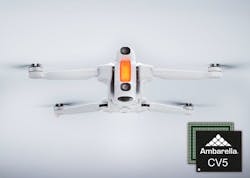
Ambarella Inc. is sharpening its focus on the rapidly evolving drone market, positioning its edge AI system-on-chips as a foundation for the next generation of intelligent, autonomous aerial platforms.
Ahead of CES 2026, the Santa Clara, Calif.-based semiconductor company said it is expanding investments in high-performance, low-power SoCs that combine advanced video processing with on-device artificial intelligence—capabilities increasingly required as drones take on more complex, real-time decision-making tasks without relying on cloud connectivity.
Long known for its work in video compression and image signal processing, Ambarella has played a formative role in modern aerial imaging, with its chips widely used over the past decade in camera-centric devices requiring stabilized, high-resolution video and efficient power consumption. That imaging heritage, the company says, now underpins its push into edge AI-driven autonomy, where computer vision and deep learning inference are embedded directly on the drone.
“As drones evolve from flying cameras into intelligent edge aerial robots, every millisecond and every milliwatt matters,” said Fermi Wang, Ambarella’s president and CEO. “Our heritage in high-quality imaging, combined with our CVflow AI roadmap, allows drone makers to push more autonomy and insight onto the drone itself.”
Across the drone industry, on-device—or “edge”—AI is becoming central to improving safety, reliability, and responsiveness. By processing data locally, drones can perform functions such as subject tracking, obstacle awareness, scene understanding, and event detection with lower latency and reduced bandwidth demands, enabling operation in environments with limited or unreliable connectivity.
Ambarella’s CVflow AI architecture, now in its third generation across the company’s CV family of SoCs, is designed to deliver computer vision and deep learning performance within the tight power and thermal constraints of airborne systems. The architecture pairs AI acceleration with advanced imaging pipelines, allowing manufacturers to integrate perception and intelligence into compact drone designs.
The company is seeing growing interest across commercial, consumer, and prosumer drone segments as regulations mature and organizations look to deploy drones for infrastructure inspection, construction, surveying, agriculture, energy, utilities, public safety, and industrial monitoring. In these use cases, customers increasingly want real-time detection and classification at the point of capture, alongside premium video and photo capabilities for documentation and situational awareness.
One recent example is Antigravity’s A1 drone, which the company describes as the world’s first 360-degree drone. Antigravity uses Ambarella’s CV5 AI SoC to support 8K imaging and leverages the chip’s integrated CVflow accelerator for on-device AI inference.
“The Antigravity A1 reflects our ambition to push drone imaging forward,” said Antigravity CEO Michael Shabun. “By leveraging Ambarella’s CV5 SoC for high-quality imaging and on-device AI acceleration, we can deliver intelligent capabilities at the edge while maintaining efficiency and performance.”
Ambarella said its drone-focused roadmap emphasizes cinematic, compute-driven imaging; low-latency, on-device AI; scalable autonomy from Level 1 to Level 4 robotics; and strong AI performance per watt to support longer flight times and simpler thermal designs. The company is also developing a scalable SoC roadmap to enable higher levels of drone autonomy over time.
During CES in Las Vegas, the week of January 5, Ambarella plans to demonstrate its CV5 AI SoC through hands-on trials with the Antigravity A1 drone at an invitation-only exhibition.