Detectify Introduces Agentic Tooling to Verify AI-Driven Security Findings
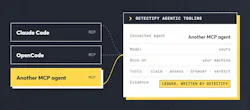
Detectify's Agentic Tooling provides security teams with evidence-backed AI vulnerability investigations.
Detectify has introduced Agentic Tooling, a set of tools that enables organizations to use their own AI agents to investigate suspected vulnerabilities and test whether they can be exploited in running applications.
The Swedish application security platform said the offering gives AI agents access to its security testing capabilities while allowing them to operate within customers’ own environments. A new Security Ledger provides security teams with objective evidence of the agents’ testing activities and findings, helping organizations distinguish verified vulnerabilities from unsupported AI-generated conclusions.
The tools address growing challenges for DevSecOps teams as AI increasingly contributes to software development. Engineering teams can move code from commit to production in minutes, and AI-generated code is entering those same pipelines. As a result, vulnerabilities can move through development environments at the same speed as the code itself.
Detectify customers report that approximately 80% of findings from their AI-driven static application security testing (SAST) tools are noise. The company said AI agents can produce convincing reports without necessarily performing the tests they claim to have completed, creating challenges for security teams that need to validate findings before taking action.
Built for DevSecOps teams, Agentic Tooling gives AI agents access to Detectify's testing engines, which the company has developed over more than a decade. These capabilities include payload assessments sourced from its ethical hacker community, Alfred AI and Surface Monitoring data.
The tools operate through a Model Context Protocol (MCP) server and command-line interface (CLI) within customers’ own environments. Organizations can use their own AI agents and models, with the tools operating only on data customers provide.
Agentic Tooling supports what Detectify calls loop engineering, an approach that uses AI agents in automated, repeating workflows rather than requiring manual prompts at each step.
In this process, a continuous integration (CI) run or scheduled job initiates an automated workflow. Findings from code scans, bug bounty reports, red teams and Detectify's attack surface data become tickets for investigation. An AI agent then reviews the relevant code and uses Detectify's tools to test the live application externally to determine whether the reported issue can be exploited.
Each cycle takes a finding from initial identification through verification before moving to the next ticket. Detectify calls the resulting continuous process a verification factory, which operates alongside software factories to help security teams keep pace with development.
The company's Security Ledger provides visibility into each investigation by recording the agent's testing sessions, including requests sent, payloads used and results returned. It also connects the testing evidence to the original ticket, allowing engineers to review the agent's actions, conclusions and supporting evidence within a single timeline.
Because Detectify's tools write the ledger rather than the AI agent, and the record is append-only, security teams can distinguish findings supported by actual testing from conclusions generated without evidence. The company said this approach allows organizations to scale security investigations while maintaining visibility into how decisions are reached.
“Ask an agent to write your code, then ask the same agent whether it’s secure. If it says yes, you don’t actually know. There are plenty of examples of agents fabricating proof because they want to succeed and please the person asking,” said Rickard Carlsson, CEO and co-founder of Detectify.
Carlsson also pointed to the growing volume of code requiring review as a challenge for security teams.
“Code review used to mean a colleague reading a page or two. Now it’s 50 pages that nobody can get through, and it goes to production anyway. We’re building proof that an agent can’t fabricate, so teams can ship at that speed and know what was actually tested,” he said.
The announcement comes as organizations continue to face challenges addressing existing vulnerabilities and managing security alerts. Detectify's H2 2026 Cyber Hygiene Index found that nine in 10 open critical and high-severity vulnerabilities had remained exposed for more than 90 days.
Additionally, a 2026 study by researchers at Fudan University and Tencent found that 76% of the static-analysis alerts examined were false positives. Developers spent between 10 and 20 minutes reviewing each alert, according to the study.
Agentic Tooling builds on Detectify's MCP Server, released in May 2026, which provided AI agents with access to the company's security findings and scanning capabilities.
Detectify plans to expand the information available to its automated investigation workflows with data from across its platform. For example, the discovery of a newly opened port could automatically trigger an AI agent investigation.