How AI Is Reshaping Healthcare Security in 2026
Key Highlights
- Smarter access control at the front door: AI-enabled visitor management and cameras replace manual check-ins, flag high-risk individuals in real time, and extend visibility across entire facilities.
- Real-time safety intelligence: Computer vision detects slip-and-falls, wandering patients, and emerging hazards instantly shifting response from after-the-fact investigation to immediate intervention.
- Built-in compliance and documentation: Automated PPE detection, incident logging, and audit-ready records reduce regulatory risk while saving staff time.
- Security that works within existing operations: Modern AI tools integrate with current workflows and infrastructure, helping healthcare security teams do more with fewer resources in an increasingly volatile threat landscape.
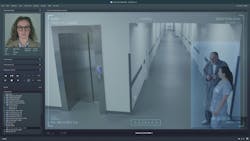
Hospitals, aged care facilities, and medical clinics are complex operations. On any given day, these environments manage the security and safety of patients, physicians, nurses, caregiving staff, visitors, first responders, and contractors, all moving through facilities on varying schedules with different levels of access and risk.
The security challenges facing healthcare providers right now are well-documented: 15,000 nurses just walked off the job at some of New York City’s largest hospitals, citing security concerns; one of San Francisco’s largest hospitals reported it was averaging six physical assaults with injury each month across five high-risk areas; and a hostage situation in a Pennsylvania hospital killed a responding officer and injured five others. These aren't isolated incidents, and healthcare security leaders are navigating this threat landscape with limited resources and aging infrastructure.
For many security leaders in the healthcare space, the prospect of overhauling systems or adding "AI" to the mix sounds like another complex, expensive project that their already-stretched teams don't have bandwidth for. But here's what's changed: AI-powered security tools are no longer experimental add-ons that require dedicated data science teams or wholesale infrastructure replacement. They're becoming practical, integrated capabilities that work within existing workflows to give resource-constrained teams the intelligence they need to move from reactive response to proactive prevention.
The question today isn't whether healthcare facilities should adopt AI-powered security; it's understanding where these tools can have an immediate impact without adding operational burden. Here are three areas where I’m already seeing healthcare providers integrate AI into their security operations, and why adoption is accelerating in 2026.
Intelligence at the Front Door
Data from the Harris Poll and Verkada show that more than 80% of healthcare workers report their organizations rely on manual systems for guest check-in, and 76% report their ID checks are manual, creating far too many opportunities for prohibited individuals to enter undetected.
Smart systems can significantly improve efficiency and provide real-time intelligence to front-desk staff checking visitors in. These smart visitor management systems can scan an ID and immediately verify that person against an organization’s approved and denied lists. This means that high-risk individuals, like individuals with active protection orders or prior threatening behavior, are automatically flagged at the door – before a situation can escalate.
One powerful example a healthcare provider shared with me involved a mother who was admitted to deliver her baby. She had informed staff about an active restraining order against the child’s father, which, when the person was flagged at the visitor check-in, ultimately prevented unauthorized access and avoided a potentially dangerous confrontation for both her and the staff.
When healthcare providers use smart systems instead of pen-and-paper, visitor information relevant to security teams can be integrated with other systems, such as AI-enabled cameras, to extend protection beyond the front desk. This means that in the event of an incident, responding security teams can quickly identify a threat and reconstruct a person’s movements across multiple cameras and floors, providing a clear, chronological view of the incident in seconds rather than hours. These systems let providers focus their resources on patient care.
Real-Time Alerting
In healthcare settings, especially among older patients, slips and falls are common and can cause serious harm. It can be challenging for healthcare workers to maintain consistent oversight as new patients move through facilities every day. AI-enabled cameras can immediately detect and alert staff of incidents like slips and falls in real time, or even notify staff when conditions like “person near wet floor” are met to prevent an accident from happening. Whether it’s for prevention or real-time response, computer vision models that alert for these scenarios improve safety, reduce liability, and strengthen documentation.
Over time, these systems can also surface patterns for security and safety teams, identifying factors such as high-risk locations and environmental hazards. They can then take action to improve safety by adjusting layouts, lighting, flooring, or staffing to minimize harm.
Large, campus-style facilities pose an even greater challenge when some patients have more autonomy than others. AI-powered alerts can also be configured to notify staff, for example, when a patient flagged with a condition such as dementia wanders beyond a safe area. In the event of a missing patient, these systems can quickly identify and map the patient's movements across the campus in a clear, unified timeline, helping staff understand the resident's location and take prompt action.
When investigations and incident resolution take significantly less time with these AI tools, healthcare workers feel supported to focus on what they do best: providing care.
Keeping Compliance In Check
AI-powered tools can also make compliance drastically simpler for healthcare providers. AI-powered cameras can be configured to alert staff when required PPE is not in use, enabling them to take immediate action. If a smart system automatically documents these alerts, healthcare providers will always have access to the records needed for any required safety audits. For healthcare providers I’ve talked to that use tools like these, they’ve been able to rapidly speed up response and greatly reduce vulnerabilities – and importantly, avoided significant fines by providing clear proof of compliance.
There’s also another side of compliance, ensuring that the security system itself meets the high standards of security and privacy in the healthcare setting. AI-powered camera systems can help healthcare providers protect the privacy of patients and staff by creating privacy zones near sensitive areas, where cameras do not record data or use face blurring to obscure identities. Modern systems can also provide tiered, role-based permissions, enabling leaders to easily assign users an appropriate level of access to the security system. Importantly, every action taken by those users is recorded in an audit log, enabling teams to identify potential misuse. For cloud-based systems, ensuring data is encrypted in transit and at rest is another way to remain compliant and safeguard footage and data against unauthorized access.
What This Means for Healthcare Providers
The healthcare security challenges we're seeing today aren't going away, and the resource constraints that prevent many facilities from adequately addressing them aren't changing either.
What is changing is the technology available to healthcare security teams. AI-powered systems are shifting security from a reactive cost center to a proactive intelligence capability. When a visitor management system can instantly flag a high-risk individual, when cameras can alert staff to a fall in real-time rather than hours later during footage review, and when compliance documentation happens automatically rather than through manual audit trails, security teams can finally get ahead of incidents instead of just responding to them.
For healthcare providers evaluating these systems, the question isn't whether to adopt AI-powered security – it's how quickly you can implement it before the next incident on your campus.
About the Author
 Derek Gunny
Derek Gunny
product specialist at Verkada,
Derek Gunny is a product specialist at Verkada, where he focuses on building smart visitor management tools.