Infographic Snapshot
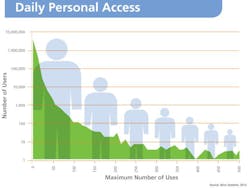
To get a top-level view of this population analysis, we looked at an event sample for roughly 4 million anonymized users for a single day. We then produced a frequency distribution of number of times each user accessed one or more doors in their facility. This tells us the level of activity for the day. We found that the single largest group—slightly over 1 million—were those who never used their cards at all on the date analyzed. There were also a handful of people who went through a door an astonishing 400+ times in a single day. (It’s hard to see how they got any work done, but that’s another question.)
It’s easy to see how facility owners and others can benefit from this type of data. For example, knowing that roughly one quarter of the people don’t show up on any given day means that you might be over-allocating office space or other building resources. Perhaps it’s time for hoteling instead of assigned office space. Similarly, facilities that show lower or higher activity levels than this norm may have special security or maintenance requirements. At a municipal level, this type of data also has a lot to say about traffic, parking, and city planning.