GC&E Summit Brings Physical and Cyber Worlds to the Same Table
Key Highlights
- GC&E Systems Group hosted its ninth annual Converged Security Summit at Mercedes-Benz Stadium in Atlanta, gathering security and IT leaders around a program centered on the convergence of physical and cyber security.
- John Eversole, Chief Security Officer of Madison Square Garden, made the case for proactive, intelligence-driven security built on empowered people, describing how MSG's unified physical-cyber team develops a custom threat profile for every single event it hosts.
- An IT leadership panel drove home that technology and security professionals can no longer operate in separate lanes, urging organizations to align IT strategy directly to business outcomes.
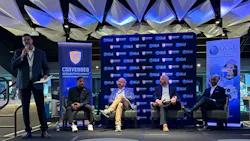
ATLANTA — GC&E Systems Group marked the ninth consecutive year of its Converged Security Summit on Sept. 29 at Mercedes-Benz Stadium in Atlanta, bringing together integrators, end-users, technology partners, and IT executives for a daylong program built around a central argument: physical security and cybersecurity belong under the same roof.
The venue itself set the tone. Hosted in the stadium's club-level suites along the 50-yard line, the summit drew a crowd that Rob Hile, GC&E's Senior Director of Sales, described as exactly the kind of cross-disciplinary gathering the event was designed to produce. "Find a partner and tell them what your problem is," Hile said during his welcome remarks. "Somebody else in this room is experiencing the same challenges."
GC&E, founded in 1999, has grown from a structured cabling firm into a full-service security and IT integration company with locations in Atlanta, Charlotte, Texas, and Huntsville, Ala.
Keynote: Intelligence-Led Security at MSG
The keynote came from John Eversole, Chief Security Officer for Madison Square Garden, who oversees security and technology strategy across MSG's portfolio – Madison Square Garden, Radio City Music Hall, the Beacon Theatre, the Sphere in Las Vegas, and a forthcoming Sphere in Abu Dhabi.
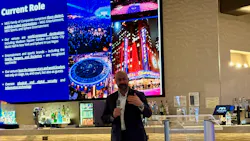
Eversole, a Marine Corps veteran and former federal law enforcement officer with more than 25 years of experience, built his talk around a single conviction: complacency is the enemy. "Complacency, whether in cyber IT or physical security, is what we're fighting against," he said. "Chaos – while scary at times – is truly the only way to grow."
At MSG, that philosophy translates into a daily threat-assessment process that treats no two events as alike. Eversole's team builds a unique risk profile for each show, game, or corporate event, factoring in the artist or athlete, the expected audience, and current intelligence. The reactive approach common at many organizations – setting up a SOC and responding to what comes in – strikes him as a fundamental misread of the mission.
"There's an appetite for reactive security," he said. "That is probably one of the lazier ways to run a security team. We should be actively hunting for the threat that's coming at us today."
MSG's security structure is itself somewhat unusual: Eversole oversees both physical and cyber security under one reporting line, with SOC operators, intelligence analysts, HR, law enforcement liaisons, and EMS all working from the same room. "All threats now come in as a mix of physical and digital," he said. "Nothing is really siloed anymore."
He drew particular attention to the growing tactic of threat actors targeting physical credentials to bypass digital defenses. "If they can get your credentials and you have two-factor authentication, they don't have to worry about getting past all the really advanced layers of security you put in place – because now none of it matters."
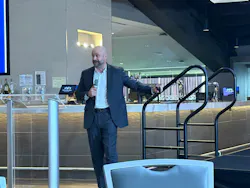
On the technology vs. people question, Eversole was careful to note the role of humans: "People are the critical layer of a security program. Anyone who says different is wrong. You have the best technology in the world, but human intervention, human design, and our ability to be flexible and scalable is where your decision-making has to rest."
That conviction shapes MSG's Security Officer Academy, an in-house training program operating on a genuine pass-fail basis – well above New York state requirements – with officers rotating posts deliberately to prevent familiarity from breeding complacency.
IT Panel: Bridging the Language Gap
A four-person panel moderated by RC Woodson, an IT security expert and veteran executive, explored the operational and strategic dimensions of IT-security convergence, with perspectives drawn from nonprofit administration, professional sports, data center development, and law enforcement.
Gary Flowers, CIO of Year Up United, framed the core challenge immediately: IT priorities and business priorities are the same priorities, and organizations that treat them as separate are building in their own friction. "Everything my department does is focused on ensuring that our constituent journey is as seamless as possible," Flowers said. "IT just happens to be supporting business priorities."
Josh Barney, CEO of the SEAT Conference and a former 12-year IT veteran with the NBA’s Utah Jazz, pointed to language as the most persistent barrier to alignment. "IT operations folks talk about tickets and incidents. The executive side talks about revenue," he said. "Tying those two conversations together – helping people see what they do through someone else's eyes – is probably the hardest thing we do."
Barney described telling the Jazz's president that the organization was really a technology company that happened to play basketball. "It didn't go over well," he said. "But that's where we need to put our effort."
Woodson pushed the room on a pointed question: how many executive-level leaders in attendance had actually seen their organization's IT strategy tied to its overarching business plan? Few hands went up. "If that's not happening in your organization," he said, "go back and put it in place. It would probably alleviate 99% of your problems."
On cybersecurity risk, Robert Field, CEO of Framework, described a months-long insider threat investigation. His takeaway: relationships built before an incident are the asset that matters most when one occurs. "Leave your title at the door,” he said. “Make friends with your vendors, your suppliers, your counterparts – because when it's all hands on deck, those are the people you lean on."
Tempe, Ariz. Police Chief Kenneth McCoy reinforced that point from a law enforcement angle. "That phone call to the FBI shouldn't be the first time you've talked to your counterpart," he said. "Build those relationships before the threat arrives."
McCoy also traced his leadership philosophy back to his time as a 19-year-old Army second lieutenant placed in charge of soldiers old enough to be his father. "I learned very quickly that rank alone didn't make me the smartest person in the unit. If I took care of my people, they would take care of the mission."
The panel closed with a round of perspectives on AI's near-term impact. Flowers said the disruption is already underway and accelerating. "It's not AI that's going to take people's jobs,” he said. “It's the person who can interact with and use AI as a skill, combined with critical thinking, who will take your job."
Field offered a compact definition he applies across organizations: AI stands for "applied imagination." "If you don't apply your imagination to how you use AI, companies will displace you at a much faster rate than you've ever seen before."
Barney added a caution on data governance: it has to come before AI adoption, not after. "Make sure you're very cognizant of what you're putting into these models," he said. "Oftentimes the model you're using is a shared model. You may be putting your own proprietary data or IP out into the world."
McCoy called on IT leaders to own the trust-building problem that surrounds AI. "There are many people who are terrified. As IT leaders, you need to step up and build that trust – trust in the technology, trust that it will be used responsibly."
The summit's format – pairing a physical security keynote with an IT-focused panel, under one roof, for the same audience – drew explicit recognition from panelists, who noted that only a handful of events around the country attempt that kind of integration. "We love the fact that GC&E saw fit to bring physical security and cybersecurity together so we can talk," Woodson said. It was a sentiment that landed on both sides of the aisle.
About the Author
 Paul Rothman
Paul Rothman
Editor-in-Chief/Security Business
Paul Rothman is Editor-in-Chief of Security Business magazine (www.securitybusinessmag.com) and has been covering the security industry for various outlets since 2001. Email him your comments and questions at [email protected].