Alarm.com executives highlighted continued growth in commercial video, residential ARPU expansion and EnergyHub’s grid management platform as key drivers behind the company surpassing $1 billion in annual revenue.
Alarm.com (Nasdaq: ALRM) closed out 2025 with record results, surpassing $1 billion in annual total revenue and delivering broad-based growth across residential, commercial and energy markets — a performance CEO Stephen Trundle described during an earnings call as validation of the company’s long-term, partner-driven model.
“We are pleased to report fourth quarter and full year results that exceeded our expectations,” Trundle said, noting fourth-quarter SaaS and license revenue of $180 million, up 8.8% year-over-year.
A device-driven SaaS model built for the channel
For security integrators and service providers, a key takeaway from the call was Alarm.com’s continued emphasis on a device-based revenue model rather than seat-based SaaS pricing.
“Our SaaS revenue is driven by each connected device that is installed by our service provider partners,” Trundle explained. “Once these connected devices are installed at a customer site, they typically remain in service for nearly a decade.”
He underscored that partners “already use our back-end software essentially for free if they install our customer sites with IoT devices in our ecosystem” and that the company has “no material seat-based pricing models.”
For integration firms, that structure reinforces the long-term recurring value of device attach rates — particularly in video — and aligns platform growth with installation volume and system expansion.
Residential: ARPU expansion and premium video
Alarm.com’s core residential business in the U.S. and Canada continues to benefit from ARPU growth, particularly through video analytics and remote video monitoring offerings.
Trundle said growth is “driven primarily by ARPU expansion,” with service providers finding success in residential video solutions, including analytics and “increasingly remote video monitoring that is augmented by the central station.”
Recent product introductions — including a premium video doorbell with 24/7 onboard recording and a new battery-powered camera designed for flexible installations — are intended to drive adoption of higher-tier video subscriptions and AI-based deterrence features.
The company also released new AI capabilities aimed at improving automation and personalization. “Over time, we believe it will help support increased retention and adoption of premium video subscriptions,” Trundle said.
Notably, management pushed back on broader market concerns about AI disrupting SaaS economics. “We will continue to leverage AI for both internal productivity gains, and to augment our capabilities,” Trundle said, adding that the company does not see AI “driving a change to our fundamental business model structure.”
Commercial: Platform consolidation and video attach rates
Alarm.com’s commercial security and energy businesses together represented 25% of SaaS revenue in 2025 and grew approximately 25% year-over-year.
The commercial segment serves SMB and enterprise customers with integrated intrusion, video and access control. Despite economic uncertainty that slowed some larger deployments, Trundle said “the underlying demand environment in the commercial market remains solid.”
A major strategic focus is deeper platform integration. The company has “continued to enhance the platform to fully integrate video, access control and intrusion protection to enable our service providers to standardize on Alarm.com for the full range of commercial subscribers that they serve.”
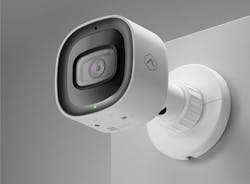
Alarm.com introduced a new Prism Series lineup of commercially targeted cameras, designed to strengthen SMB and mid-market offerings, including AI-driven proactive deterrence and integrated central station remote video monitoring.
The installed commercial video base continues to expand. “Today, more than 2 million active video cameras and devices are deployed across our commercial property base,” Trundle said, adding that growth has been driven by increasing attach rates.
EnergyHub: Grid demand creates tailwinds
Beyond traditional security markets, EnergyHub remains a significant growth driver. In 2025, the number of connected devices under management increased by more than 50%, and utilities increased the number of times they called on EnergyHub virtual power plants by 25%, reflecting the growing importance of its programs to grid stability.
Trundle characterized EnergyHub as “the clear market leader” in distributed energy resource orchestration.
The late-2025 acquisition of Resideo Grid Services is intended to accelerate scale and expand device diversity within utility programs.
CFO Kevin Bradley highlighted the role hardware plays in Alarm.com’s financial model. In the fourth quarter, gross profit from hardware sales offset approximately 55% of GAAP sales and marketing expense.
“When it is one of our products… that sale contributes to our highly efficient subscriber acquisition model,” Bradley said.
Full-year 2025 SaaS and license revenue grew 9.2% to $689.4 million, while adjusted EBITDA reached $206 million, up 16.9% year-over-year.
Looking ahead to 2026, the company expects SaaS and license revenue between $743 million and $745 million, reflecting continued organic growth and contributions from recent acquisitions.
*This article was created with the help of generative AI tools and edited by our content team for clarity and accuracy.