What Integrators Need to Know From the 2026 Genetec Report
Key Highlights
-
Modernization demand remains strong, with organizations replacing legacy systems and expanding unified, cloud-enabled architectures.
-
AI and IT influence are reshaping projects, driving new expectations around cybersecurity, cloud strategy and system intelligence.
-
End users increasingly prioritize long-term partners, valuing expertise, stability and solution designs that deliver lasting operational value.
Security integrators should expect continued demand for modernization projects in 2026 as end users accelerate upgrades, expand cloud adoption and seek help navigating artificial intelligence (AI)-driven tools, according to the newly released State of Physical Security 2026 report from Genetec.
The survey of more than 7,300 security professionals highlights a market shifting quickly toward unified platforms, hybrid-cloud architectures and data-driven operations, all areas where integrators play a central role.
The report also emphasizes that physical security has evolved into a more enterprise-focused function as organizations rely on unified systems and operational insights to support broader business goals.
Survey findings further show that demand for modernization remained strong in 2025, with 91% of channel partners and manufacturers reporting that customers either increased or maintained interest in adding new technologies to existing platforms.
Legacy replacements fuel demand
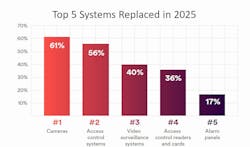
Integrators report that customers continue to replace aging platforms primarily to integrate systems into new technologies (60%) and gain access to new capabilities (51%). Cameras were the most commonly replaced component in 2025 at 61%, followed by access control systems at 56%.
Video management systems (VMS) accounted for 40% of replacements, while 36% of respondents said they updated access control readers or cards, and 17% replaced alarm panels. Genetec notes that more than 70% of organizations now operate unified or integrated video/access systems, underscoring the demand for modernization and interoperability and highlighting key integrator strengths.
Hybrid cloud momentum continues
Integrators should anticipate ongoing project requests related to cloud migration. Nearly half (48%) of end users report operating hybrid-cloud systems, a number that has steadily risen year over year, with hybrid adoption favored across all organization sizes.
Hybrid-cloud adoption increased from 45% in 2024 to 48% in 2025, reflecting growing comfort with mixed deployment models. Automatic updates and new feature rollouts ranked as the top benefit of cloud adoption for the second consecutive year, followed by ease of deployment and reduced maintenance burdens.
Going into 2026, 71% of channel partners expect new cloud deployments, with only 3% expecting any slowdown. End users cite automatic updates, easier maintenance and streamlined multi-site scalability as the top drivers behind cloud adoption.
Rising AI demand and higher expectations
For the first time, end users ranked AI alongside access control and video surveillance as a top 2026 project priority. However, integrators should be prepared to guide customers, as the report shows significant uncertainty around implementation, risk and practicality:
- 70% of end users have concerns about how AI is used or understood;
- Customers want AI tools that reduce alarm noise, accelerate investigations and automate repetitive tasks, but many lack clarity on what is realistic.
End users also identified several operational objectives they hope to achieve with AI-enabled systems. Fifty-five percent said they are looking for support with searching and investigating incidents, while 48% want solutions that can automate repetitive tasks.
Another 46% cited goals such as automatically filtering or classifying events and generating transcriptions or reports. A smaller share — 34% — expressed interest in forecasting future threats or events. This gap places system integrators in a consulting position, according to Genetec’s findings.
IT’s expanding role is affecting integrator sales cycles
According to the report, IT departments now play a larger role in physical security purchasing decisions, and their priorities around cybersecurity tools and cloud-based strategies are shaping how projects move forward.
As a result, integrators are increasingly engaging with technical stakeholders and aligning deployments with IT-driven requirements. Key data points from the survey reinforce this shift:
- 47% of IT end users identify cybersecurity tools as a top priority;
- IT teams lead more cloud-first strategies than their security counterparts.
The report also notes that closer alignment between IT and physical security is now essential for organizations to deploy technology more effectively and respond faster to emerging threats.
Staffing and skills shortages remain a barrier
Channel respondents listed installation technicians (52%), systems engineers (36%) and technical support roles (35%) as the most difficult positions to staff, directly contributing to slower deployments.
While the share of integrators expecting hiring delays has decreased from 44% to 32%, 97% still believe staffing challenges will persist or worsen in 2026.
The report shows that channel partners and manufacturers are responding by taking a more strategic approach to workforce development, from expanding technical training and adopting skills-first hiring to integrating IT-focused talent and using AI to streamline processes. They are also investing in workplace flexibility and employee well-being to help strengthen retention and manage remote work expectations.
End users prefer long term partners over vendors
End users increasingly value stability, open architecture and long-term viability when selecting integrators and technology providers, the report states:
- 73% prioritize open architecture;
- 45% value pricing transparency and total cost control;
- 39% cite vendor stability as a key decision factor.
The report concludes that integrators who position themselves as strategic partners — offering modernization guidance, cybersecurity alignment, hybrid-cloud expertise and realistic AI adoption planning — will be best positioned in the year ahead.
As the report states, “End users increasingly seek strategic partners who can provide not just technology, but expertise, trust and stability in a dynamic industry.”
The complete report can be downloaded here.
About the Author
 Rodney Bosch
Rodney Bosch
Editor-in-Chief/SecurityInfoWatch.com
Rodney Bosch is the Editor-in-Chief of SecurityInfoWatch.com. He has covered the security industry since 2006 for multiple major security publications. Reach him at [email protected].