Industry Leaders See Tailwinds, Tariff Uncertainty, and a Talent Imperative at PSA-TEC 2026
Key Highlights
- The security integration industry is flush with capital and optimism -- Raymond James has completed nearly 100 transactions since 2021, deal valuations are up roughly 1.5x over prior periods, and the North American TAM is on track to more than double by 2030.
- AI is moving from product feature to business tool, with integrators like Unlimited Technology deploying agents across sales cycles and back-office functions -- but internal change management around workforce displacement fears is as important as the technology itself.
- Two regulatory threats demand attention: a wave of state-level AI restriction proposals that could hamstring facial recognition and workplace deployments, and the NextNav 900 MHz FCC proceeding that -- if granted -- could interfere with alarm systems, access control, and dozens of other wireless security devices.
This article originally appeared in the May 2026 issue of Security Business magazine. Don’t forget to mention Security Business magazine on LinkedIn or our other social handles if you share it.
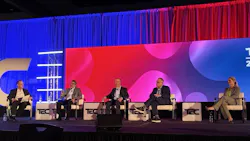
DENVER – The annual PSA-TEC State of the Industry panel painted a picture of an industry flush with capital, navigating regulatory complexity, and racing to put AI to work – not just in products, but inside the businesses that sell and service them.
Moderated by PSA CEO Matt Barnette, the panel brought together Alper Cetingok, Group Head of Diversified Industrials at Raymond James; Don Erickson, CEO of the Security Industry Association; John Petruzzi, CEO of Unlimited Technology; and Heather Torrey, outgoing head of Honeywell’s Americas commercial security business and incoming Americas leader for dormakaba.
Bullish on the Business
The opening tone was unambiguous. Cetingok, who has covered the security and safety sector for 26 of his 28 years as an investment banker, said the industry stands at a healthy and advantageous moment.
“The secular trends in the markets are very much in support of security in general and certainly in this segment of the market,” he said. “There are lots of tailwinds, there’s a lot of interest, there’s a lot of capital inflows coming into the marketplace.”
Erickson echoed that sentiment, pointing to ISC West as a reliable barometer. Attendance returned to near pre-pandemic levels across exhibitors, show floor, and conference participation, with new entrants and startup companies among the fresh faces. SIA’s own CEO/president survey – roughly 100 respondents – found 92% expressing optimism about Q1 and the quarter ahead, with projections for increased marketing spend, R&D investment, and hiring.
Petruzzi offered ground-level confirmation: Unlimited Technology posted a record first quarter in bookings and carried that momentum into Q2. He also noted a shift in customer behavior worth watching. “The needle is moving where customers are getting smarter,” he said. “You’re seeing less procurement engagement to drive to the bottom and look at overall value.”
Torrey saw the same dynamic from the manufacturer side. “Two years ago at ISC West, it was all AI,” she said. “Now it’s more around outcomes, and it’s exciting to see that because it really is adding value for end-users, which helps the whole ecosystem.”
Capital Markets: Security Remains a “Darling”
Cetingok’s formal presentation made the investment case in concrete terms. The North American systems integration market, roughly $20 billion in total addressable market as of 2019, is on track to more than double by decade’s end. The market remains highly fragmented – approximately 70% of it composed of smaller regional providers – which Cetingok sees as a structural opportunity, not a weakness, as consolidation accelerates.
“The scaling of the industry is happening at a much more rapid pace than ever before,” he said. “And I think that’s a point that’s going to serve the industry well.”
Private equity is a central engine of that activity. Cetingok displayed a slide of well-known integration companies now backed by outside investors – each representing a bet on 3x-plus returns over roughly five years. He framed that as straightforwardly good news for the industry.
“Capital inflows are coming in, giving you more investment capital with which to accomplish your objectives,” he said.
When asked why security has become such an attractive destination for capital, Cetingok pointed to the industry’s resilience. “Market dislocations do not affect the industry nearly in the same way as others that are more highly indexed to macro factors,” he said. “As a consequence, when investors think about where they’re going to park capital for the next five to seven years, this industry rises to the top of their list.”
Regulatory Watch: AI Restrictions and a 900 MHz Threat
Erickson used his time to pivot to a regulatory concern – a spreading wave of state-level proposals seeking to restrict or ban AI use in security applications.
“We’re continuing to see a proliferation of regulatory proposals across all 50 states that will restrict the use of AI for security purposes,” he said, specifically calling out facial recognition bans and California’s proposed “workplace surveillance” legislation – effectively a broad prohibition on AI in the workplace. “Any time something starts in California, it becomes a model for other states,” Erickson added.
Petruzzi chose to frame the regulatory environment as manageable. “There are two things that move the security industry: geopolitical events drive security incidents, which drive security regulations,” he said. “We’re seeing that at an all-time high. So while you need to be cognizant of those things, there’s great opportunity right now.”
Erickson then flagged what he described as potentially the industry’s most consequential regulatory threat: the NextNav 900 MHz spectrum proceeding before the FCC. A company called NextNav has petitioned the FCC to use a lower band of 900 MHz spectrum to build a backup GPS system. The problem is the proposed petition would also remove the interference protections that currently safeguard dozens of wireless security devices operating in the same band.
“[It could impact] alarm systems, carbon monoxide detectors, personal response systems, wireless cameras, access control systems – it goes on and on,” Erickson said. “It’s a very profound impact.”
SIA, working with ESA and TMA, has persuaded the FCC not to open a formal rulemaking docket so far. “Integrators are going to start getting questions bubbling up: What’s happening with my systems, with my devices?” Erickson said. “We need more PSA members involved.”
AI Inside the Business, Not Just the Product
Barnette steered the conversation toward how integrators can use AI to improve their own operations – not just the solutions they install.
Petruzzi laid out Unlimited Technology’s two-phase approach. Phase one, now underway for roughly a year, involves general AI tools, including Microsoft Copilot and enterprise ChatGPT subscriptions to drive internal efficiency. Phase two, launching in late Q2, deploys AI agents across the sales cycle – supporting field salespeople and back-end engineering – and into functional areas including HR, recruiting, accounts payable, and accounts receivable.
“We’re going to the really scary side, which is business enablement – that ability to scale,” Petruzzi said. “There’s always a human touch on it, but some of that menial-scale task is now being done by agents, which is good.”
Petruzzi also addressed the internal communication challenge that accompanies AI adoption. “There is a massive fear, uncertainty, and doubt when you start talking transactional agents within your environment,” he said. “The person sitting there thinks, ‘They’re going to replace me.’ We built a whole communication strategy internally around that – to let folks know this is not about replacing you. This is literally taking some meaningless tasks off your table every day.”
Tariffs: Still in Flux
An audience question about tariffs prompted candid responses. Torrey, still representing Honeywell at the panel, acknowledged the uncertainty directly. “Every company handled it differently – some incorporated it into price, some applied surcharges,” she said. “This is going to have to be a good collaborative conversation.”
She also noted that supply chain lessons from COVID – manufacturer diversification, in particular – that faded during the recovery period are back on the strategic agenda. “Many manufacturers are thinking about the way they deliver solutions in a very different way.”
Erickson noted that the tariff refund process opened just days before the panel, making it too early to gauge how effectively manufacturers will be able to recover costs. “It’s truly – to be fair to manufacturers – too early to tell if that rebate process is going to work.”
Five-Year Forecast: Talent, Stickiness, and Strategic Clarity
In the panel’s final round, each participant addressed what integrators must do to remain competitive over the next five years.
Petruzzi reduced it to a single word, repeated for emphasis: “Talent, talent, and talent.” He credited programs like FAST (Foundation for Advancing Security Talent) for creating pathways into the industry for people who previously had no idea the career existed, and pointed to military veteran recruiting as another productive channel. But talent alone is not enough.”
His prescription: monthly and quarterly business reviews, transparent communication, and a shift from time-and-material agreements to multi-year service contracts with embedded technicians. “When you just kind of button up and don’t address the elephant in the room, retention’s going to suffer,” he said.
Torrey emphasized education – and the specific need to leverage the full ecosystem of resources available. “It can seem like you’re out on an island by yourself, just kind of figuring it out. There are resources there. We’re trying to do a better job of making them more accessible.”
Erickson stressed cyber hygiene as a foundational, ongoing priority alongside AI literacy – and called for industry associations including PSA, ASIS, and SIA to collaborate on a roadmap for AI education that can move as fast as the technology itself. He also highlighted SIA’s Spark community, which produces peer benchmarking reports for practitioners – including a recent report on improving integrator-to-end-user communication with concrete KPI and SLA frameworks.
Erickson also pointed to Security Business magazine’s April cover story, “The Integrator of 2030,” as a useful lens for thinking differently about workforce development. “We tend to acknowledge in a lot of these discussions that workforce is the number one business issue, et cetera, et cetera,” he said. “I think we have to accelerate what we’re doing – and think about workforce development differently.”
PSA Award Winners
PSA-TEC also features several annual award presentations, including its Integrator of the Year awards and its vendor appreciation awards. Here's the list of this year's recipients:
- Bill Bozeman Overall Integrator of the Year: scDataCom
- Small Integrator of the Year: ATS Integrated Solutions
- Medium Integrator of the Year: SecurAlarm
- Large Integrator of the Year: SAGE Integration
- Customer Service Individual Excellence: Beth Taylor, Scansource
- Customer Service Team Excellence: Altronix
- Business Solutions Provider of the Year: ALC Consulting
- Rising Star Vendor: Velasea
- Nova Vendor: Software House
- Technology Partner Boldness Award: Windy City Wire
- Technology Partner Integrity Award: Gallagher Security
- Technology Partner Passion Award: Hanwha Vision
- Technology Partner Service Award: ASSA ABLOY
About the Author
 Paul Rothman
Paul Rothman
Editor-in-Chief/Security Business
Paul Rothman is Editor-in-Chief of Security Business magazine (www.securitybusinessmag.com) and has been covering the security industry for various outlets since 2001. Email him your comments and questions at [email protected].