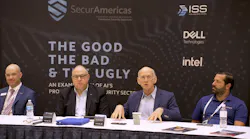
AI’s Role in Integration Takes Center Stage at SNG
Key Highlights
- Most speakers agreed that AI won’t eat integration.
- Panelists predicted robots will be installing security systems within five to eight years.
- Genetec’s Pierre Racz said hallucinations are built into how AI works.
- Axis Communications’ Fredrik Nilsson said video AI must move to the edge to scale affordably.
- SIA CEO Don Erickson told Security Business the association will stand by Flock and work to correct public misperceptions of the industry.

NEW YORK — Hundreds of the top executives from across the security industry came together in New York City, Oct. 20-21, for Securing New Ground (SNG), participating in a day and a half of learning and thought leadership guided by the Security Industry Association’s (SIA) Megatrends research.
The conference agenda featured full panels mixed with one-on-one interviews, including sessions featuring Netflix VP of Enterprise Security MJ Carbonell, Flock Safety Senior VP of Sales Sean Kay, Acre Security CEO Kumar Sokka, and Genea CEO Michael Wong, as well as keynote interviews with former U.S. Ambassador to Russia John J. Sullivan and Curtis Dubay, chief economist for the U.S. Chamber of Commerce.
Although the conference covered a ton of ground, such as the cloud, identity, access control, video surveillance, GSOCs, and data centers, AI dominated many of the discussions, especially how integrators are leveraging it and what the future of systems integration looks like in the age of AI. Privacy and the public backlash against video surveillance was another thread running through the event.
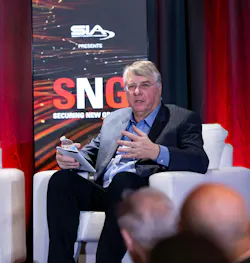
Will AI Eat Integration?
Everybody knows AI eats data like nobody’s business, but SNG asked one of the more provocative questions of the entire conference: Does AI eat integration?
The answer, which came from Genetec CEO Pierre Racz in the opening Megatrends session on day one, was a definitive no. AI, Racz argued, will not be ready anytime soon to do the type of thinking and reasoning that is needed, such as with creativity, imagination, empathy, nuance, and ingenuity in the form of engineering and technology innovation that the top integrators have spent decades honing.
Later that morning, the “Megatrend: Does AI Eat Integration?” panel took up the question directly, and the integrators on stage split in an interesting way. Eric Yunag, EVP of products and services at Convergint, sided firmly with Racz.
“AI eats data. And at the end of the day, integration feeds that data. I mean, that’s what integration in the end does,” Yunag said.
He pointed to the gap between writing software and working in the physical world, using the example of vibe coding, or building software through AI prompts.
“If I gave any one of you in this room a laptop and said, vibe code a VMS or something, there’s a good chance you would hack together something terrible, but it would be viable in 30 minutes,” Yunag said. “And if I hand that same person a box of access control parts and said, put one door of access control in the back of this room, on this door, integrated into the building, it would take dramatically longer than 30 minutes … So, for all the integrators in the room and in the world who feel threatened by this, I think this is the most exciting opportunity that any of us have ever had to say the things that we do every day bring new value.”
Alex Rohweder, SVP and head of the building security business at Siemens USA, was the lone panelist to answer yes, and he welcomed it. In his view, AI is already commoditizing the coding behind integration, and the integrator’s real value has moved elsewhere.
“Is the value of an integrator today really the integration? And to be honest, if I look at our company and looking at the industry, I don’t think that our key value is integration anymore,” Rohweder said. “I also see a lot of companies coming to the market, serving the market with more and more plug and play systems. And I’m not scared of that because I don’t think it’s a problem.”
Rohweder sees that value in serving as a trusted advisor in an increasingly complex technology environment and in building custom applications on top of standard products. “With the power of AI, we as integrators, we can move up and we should move up, not being just the integrator of systems, but actually starting to build those applications,” he said.
Yes, AI can be a force multiplier, helping make sense of and correlate massive amounts of data across an enterprise, run predictive analysis, and see things in real time that would otherwise take far longer. But whether it comes in the form of AI agents or AI-powered robots, most speakers agreed that integrators’ jobs are safe for the foreseeable future.
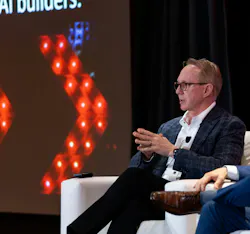
What is interesting, though, is that when session moderator Steve Van Till, president and CEO of Brivo, asked the panelists whether robots will ever install security systems, two said yes and the third said maybe, with timelines ranging from five to eight years, a prediction that drew some skepticism from speakers in a later session. I guess we will have to wait and see.
The integrators on the panel also talked about how they are already putting AI to work beyond administrative tasks. MC Dean’s Eric Dean described starting with the alarms and events operators typically never see, having AI triage them, and then reporting accuracy, precision, recall, and F1 scores to customers, “which is a little new for this business,” he said. Rohweder noted that AI now handles much of the basic coding behind integration, freeing his teams to focus on architecture, application engineering, testing, and field engineering.
Van Till framed the discussion around how AI raises the ceiling on what integrators can deliver. “When we all started out doing this many years ago, I think the traditional profile of what integrators did was very installation oriented…so all of the risk analysis, the benefits, the value engineering, all those kinds of things were kind of the top end of the spectrum of the things that integrators provide,” he said. “I think that what we have now with AI tools at their disposal is an entirely different top end to what the integration community can deliver to customers. And I’m calling that business logic and orchestration. And that can take many different flavors.”
AI’s Limitations
AI has emerged as one of the hottest topics in security, but Racz is the first to point out that while it is a useful tool, it has limitations. “And unfortunately, the lay press is not giving us good information about what are the limitations and how do those things break,” he said. “And as I will repeat what I said last year, that as executives we should be held liable for providing factually incorrect information to our users that costs some time, money, reputation, physical damage.”
Racz explained that the fundamental problem is that AI is good at sifting through data and finding correlations, “but it has no way of knowing causality,” he explained. “If I do X, is Y caused by X or X caused by Y? Unless it’s in its training data, it can’t figure that one out.”
He also argues that the technology is lowering the quality of what it produces. “The new tool, AI … produces a lot more stuff, but lower quality than before AI,” Racz said. “You must have noticed the quality of software in the last five years has gone down. So, it’s not that we won’t be able to fix it, but we have to first of all acknowledge that there is a problem.”
Racz also explained why errors are built into the technology, comparing large language models to the lossy compression used in video. “Prediction and compression are part of the same algorithm, so what are we doing with these LLMs? We are making a lossy compression of their training data,” he said. “And so, when we are decompressing, it does predictions, but actually we are decompressing what it learned … therefore hallucinations are inevitable.”
On the video side, Fredrik Nilsson, VP of the Americas for Axis Communications, argued in a separate session that more AI processing needs to happen at the edge, in the camera itself, for these models to scale realistically.
“We talked a lot about AI before and one challenge we have as an industry is the scalability challenge when it comes to AI,” he said, pointing to the cost of tokens, the units AI models use to process and price data. “For the sake of numbers, if you analyze short text, it costs you 10 tokens. If you analyze an image, one image, it takes 300 tokens. And if you do a little video snippet, it’s 10,000 tokens. And if you do a full day worth of camera from one camera, it’s 25 million tokens. So, it’s going to be a little costly to do it, right? So, everyone is excited about it … and there’s great demos out there, but to make it scale, we need to be able to scale those models down to the edge so we can make use of all this great AI we’re talking about. Otherwise, we’re just fooling ourselves and designing something that won’t scale.”
Backlash Against Video Surveillance
In an off-the-record session that emphasized the industry’s concern over the public outcry against video surveillance and ALPR cameras, SIA CEO Don Erickson interviewed Flock Safety’s Sean Kay.
“People looking at our industry are reading every day about Flock, and rightly or wrongly forming different opinions, and they think the industry is about mass surveillance, which it’s not,” Erickson told Security Business. “So, we need to work together to correct the perception of the industry. What’s interesting is that you have a lot of former and current law enforcement speaking out about the effective use of the technology. It is a tool, but we need guardrails. So, LPR providers need to be transparent about how technology works and who has access to the technology. You’ve got to have mechanisms in place for audits, and police departments must have policies preventing abuse and unauthorized access. I think we all agree on that.”
He continues, “I think SIA needs to do more of educating policymakers about how the technology actually works – separating myth from fact, talking about the databases and not selling data and things like that. The second thing I think we’ve got to do, and we’ve talked about this internally a lot, is talk about the positive aspects of technology – the use cases, both on the commercial side and the public safety side. So, for example, focusing on the public safety side right now with ALPR [and its use in] finding missing kids, sending out AMBER Alerts, solving murder investigations, human trafficking, basic robberies … the list goes on and on.”
Erickson said the stakes reach beyond Flock to how the entire industry is perceived. “It’s how we present the industry,” he said. “I think we can get ahead of this. We need Flock to be successful, and SIA is not going to cut and run from Flock. We’re going to help them and we’re going to be involved in the regulatory piece.”
About the Author
 Paul Ragusa
Paul Ragusa is senior editor for Locksmith Ledger International, an Endeavor Business Media Security publication.