15 Years In, Z-Wave's Fingerprints Are All Over the Modern Security Platform
Key Highlights
- Z-Wave helped transform professionally installed security from intrusion-only systems into connected home platforms — reducing churn and expanding RMR opportunities for dealers.
- A mandatory certification model and the 2017 introduction of S2 security set the encryption baseline professional security providers needed to meet compliance requirements.
- With 100 million-plus devices deployed globally, Z-Wave enters the multi-protocol era with an installed base most emerging standards can't match.
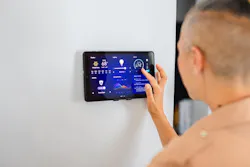
Fifteen years ago, the typical professionally monitored security system did one thing well: detect intrusion. It armed, it disarmed, and when something went wrong, it triggered an alarm.
What it didn’t do was give users a reason to interact with it on a daily basis.

For the dealers and integrators who built their businesses around these systems, that was a problem hiding in plain sight. Most customers bought in after a break-in, a neighbor’s close call or a news story that hit close to home. Once the initial anxiety faded, so did the sense of value — and in a business built on recurring monthly revenue (RMR), a customer who forgets why they’re paying is a customer who eventually cancels.
At ISC West 2026, members of the Z-Wave ecosystem will gather for a networking event on March 25 to mark the technology’s 15-year presence in the professional security channel. The occasion is worth more than a raised glass; it’s a reasonable moment to examine how an interoperability standard quietly rewired the economics of an entire industry.
From the keypad to the connected home
In the early 2010s, the security panel was functionally a keypad on the wall. Interaction was transactional: arm when you leave, disarm when you return. Mariusz Malkowski, CTO and founder of Trident IoT, a specialized semiconductor and engineering firm focused on accelerating Z-Wave device development, puts it plainly: the systems of that era were “functional and effective, but narrow in scope.”
Z-Wave changed the nature of what a security system could be by giving it something to do when nothing was going wrong.
Thermostats, it turns out, were the unsung entry point — less dramatic than connected locks, but more impactful in terms of daily engagement. Environmental controls gave customers a reason to open the app, adjust a setting and stay in the habit of using the platform. Locks followed, weaving access management directly into the security experience. Additional sensors extended the system’s awareness and created new data layers providers could build services around.
“Z-Wave brought interoperability and an ecosystem of devices into the professional channel,” Malkowski says. “The end result was a shift from a reactive, event-driven solution to a daily-use platform.”
Vivint’s trajectory illustrates the point. The company started as APX Alarm Security Solutions — a traditional monitored security provider — and evolved into a full smart home platform, a transition Malkowski cites as a direct example of what Z-Wave made possible within the professional channel.
Z-Wave Networking & Happy Hour
The Z-Wave Alliance is bringing together dealers, integrators, manufacturers and security industry leaders at ISC West 2026 to mark 15 years of Z-Wave in the professional security channel.
When: Tuesday, March 25, 5-7 p.m.
Where: Cañonita Mexican Restaurant, The Palazzo Las Vegas, 3377 S. Las Vegas Blvd.
Registration is available here.
The business case came into focus fast
The commercial logic wasn’t complicated, but it took platforms like 2GIG and ADT Pulse to make it tangible.
Before those systems arrived, professionally monitored security was, as Avi Rosenthal, chairman of the Z-Wave Alliance board, describes it, largely a “one-trick pony.” Dealers sold perimeter protection. Customers paid a monthly fee. If they stopped perceiving value in that arrangement, they left.
“Security was no longer just about perimeter protection,” Rosenthal says. “The conversation evolved to include convenience, comfort, safety and automation.”
For dealers, the ripple effects were significant. Connected devices created upsell opportunities, deepened customer engagement, and — critically — made the platform itself harder to walk away from. A customer using a system to manage their thermostat, lock the front door remotely, and check who came and went during the day has a fundamentally different relationship with that service than one who only interacts with it twice a day on the way in and out.
Gustaf Lonaeus, director of product management at Alarm.com, has watched the retention data bear this out over time. Customers who adopt automation interact with their systems more frequently, rely on a broader range of features, and stay on service longer.
“As customers add capabilities, retention improves rather than declines,” he says. “The reason for this is that as automation expands what the system can do, customers’ perception of its value grows faster than the incremental cost to them.”
In short, the system becomes hard to live without.
Standardization as a competitive advantage
Scale changes everything. What works for an independent integrator deploying dozens of devices a year becomes something else entirely when a national provider needs to deploy reliably across millions of installations sourced from hundreds of manufacturers.
Ray North, part of the original ADT Pulse implementation team, recalls what set Z-Wave apart during the evaluation process: where competing technologies required custom integrations for each individual device, Z-Wave defined standardized command classes for entire device categories.
“Once you implemented support for a class — lighting control, door locks, garage door controllers — devices within that category simply worked as intended,” North says. “That level of standardization significantly simplified development and ensured a more predictable experience when integrating devices across different manufacturers.”
Tim Rader, vice president of product engineering at ADT, frames the ongoing value in operational terms. “For companies operating at scale, interoperability has always been a massive hurdle,” he says.
When a Z-Wave product reaches ADT for evaluation, it has already cleared the Alliance’s certification process — defined command classes, structured testing, documented behavior. “That dramatically improves efficiency on our side, reducing testing time, accelerating time to market and ultimately delivering more reliable solutions for customers,” Rader explains.
He also points to how the certification process has evolved. Recent additions to the command class structure benefiting the lock category demonstrate that the Alliance can “review, approve and implement changes in a smooth and efficient way” — balancing rigor with the practicality manufacturers need to stay engaged with the process.
Security as infrastructure, not afterthought
When Z-Wave entered the market, encryption in the connected device space was largely nonexistent. That was simply the state of the industry. But as Z-Wave embedded itself deeper into professionally installed systems — particularly those tied to life-safety applications — the absence of robust security became untenable.
At ISC West 2017, the Z-Wave Alliance announced that the S2 security framework would be mandatory for certification. Every new device entering the ecosystem would be required to implement stronger key exchange, authenticated inclusion and more robust encrypted communication. The mandate didn’t wait for the market to force the issue.
“Rather than wait for the market to force change,” Malkowski says, “the Z-Wave Alliance built enhanced encryption directly into the standard before further expanding into professional deployments.”
The evolution hasn’t stopped. A next-generation update to the S2 framework has already completed its internal specification approval and is currently in implementation through the Alliance’s open-source working group. Z-Wave Long Range (ZWLR) is now being adopted across major security deployments, extending the standard’s reach into larger-scale sensor networks.
“When it comes to professionally installed systems,” Malkowski says, “security is never fully done.”

The professional channel wrote the DIY playbook
The story of Z-Wave in consumer smart home markets doesn’t begin at retail. It begins in professionally installed systems, where the interoperability requirements and certification structure of the security channel stress-tested the technology before it ever reached a big-box store shelf.
“The professional market served as the proving ground,” says Bill Scheffler, vice president of sales at Trident IoT. Early connected lock offerings from Schlage and Kwikset, lighting modules from Leviton and Cooper — these products entered retail having already been validated in demanding professional environments. “Once those devices were available at retail,” Scheffler says, “the cycle accelerated.”
Telecom providers recognized the opportunity as well. Verizon Connected Home and AT&T Digital Life both moved to pair connectivity services with smart home and security devices, drawing on the infrastructure the professional channel had already established. Ring’s later rise, Scheffler notes, was built on groundwork already laid.
“Z-Wave’s professional roots helped establish the framework that made DIY smart home adoption possible at scale,” he says.
A crowded ecosystem and an installed base that matters
Today’s connected home runs on multiple protocols. Z-Wave shares the landscape with Zigbee, Wi-Fi, Bluetooth and the emerging Matter standard, among others. Rosenthal doesn’t frame this as a threat.
With more than 100 million Z-Wave devices deployed globally and a certified product ecosystem exceeding 4,500 products, the technology enters the multi-protocol era with something most new entrants lack: an installed base already in the field, already trusted, already working.
“New Z-Wave products don’t enter the market in search of a platform,” Rosenthal says. “They plug directly into one that already exists.”
For dealers and integrators, the practical implications of that maturity are significant. Adding a Z-Wave device to an existing system doesn’t require re-evaluating compatibility or bracing for callbacks.
“Security professionals do not have to wrestle with the ‘should I or shouldn’t I’ question when evaluating compatibility within Z-Wave,” Rosenthal says. In professionally installed systems where life safety is on the line and the industry tends toward conservative technology choices, that matters. “Z-Wave just works,” he adds, “and it has for well over 15 years.”
What the next decade will ask of the standard
As AI works its way deeper into residential platforms, the demands placed on the standards underneath will shift. Rosenthal points to data reliability and security as the factors that will define which technologies remain relevant.
“AI systems are only as effective as the data they receive,” he says. Without consistent, reliable and encrypted data streams from the device layer, intelligent home systems fall short. Z-Wave’s position in that stack — providing structured, certified, secured sensor data — is where Rosenthal sees the technology’s next chapter taking shape.
“The standards that will succeed will be those that combine reliability, strong cybersecurity and seamless integration,” he says. “As I see it, those attributes have defined Z-Wave within the professional security channel for years.”
About the Author
 Rodney Bosch
Rodney Bosch
Editor-in-Chief/SecurityInfoWatch.com
Rodney Bosch is the Editor-in-Chief of SecurityInfoWatch.com. He has covered the security industry since 2006 for multiple major security publications. Reach him at [email protected].