The Perimeter Has Evolved From a Line Into a System
Key Highlights
- The perimeter has expanded from a physical fence line into a layered system spanning airspace, sensor data and operator decision-making.
- Sensor fusion (LiDAR, thermal, AI analytics, digital twins) is closing the gap between coverage and real situational awareness, with one vendor citing a drop from 178,000 alarms to five after switching to a fused approach.
- Practitioners cautioned that more technology isn't automatically better. Deterrence works best as a byproduct of good design, not a strategy in itself, and systems should match a facility's actual risk profile and maintenance capacity.
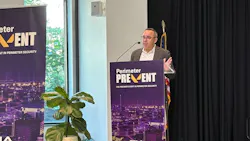
WASHINGTON — For most of the security industry's history, "perimeter" meant a fairly simple thing: a fence, a gate, maybe a guard shack. At the Security Industry Association's Perimeter PREVENT conference, held June 24 at the National Housing Center, that definition didn't survive the morning keynote, let alone the rest of the day.
Across sessions ranging from a fireside chat with a retired three-star general to vendor panels on sensor fusion, one idea kept resurfacing in different forms: the perimeter has stopped being a place and started being a process, extending into the sky above a facility, the data feeding a control room and the seconds an operator has to make a decision before a threat reaches something that matters.
From Fences to Systems
The day opened with retired Gen. William J. Walker, now vice president and corporate security director at Allied Universal Security Services, in conversation with Rachelle Loyear, the company's vice president of integrated security solutions. Walker's career, spanning embassy security in the Bahamas during the height of the Pablo Escobar-era cocaine trade, dignitary protection, and command of the District of Columbia National Guard during the George Floyd protests and the Jan. 6 Capitol response, doubled as a four-decade case study in how perimeter thinking has evolved.
His central argument: of the classic deter, detect, deny, delay and defend framework, detection now matters most. "What I look for in security infrastructure: what are we trying to protect, who are we trying to protect it from, what capabilities do they have, and how far out does that electronic perimeter have to be for detection," Walker said, describing a layered model in which physical fencing marks only the final, visible edge of a much deeper protective zone.
Loyear pushed the framing further, arguing today's perimeter is "soft and hard" at once – information, human behavior and technology layered ahead of any physical barrier. COVID pushed the corporate perimeter into employees' homes, she noted, and global supply chains mean many organizations now rely on third parties to protect assets they don't directly control.
Seeing Past the Sensor
If the keynote established the thesis, a midday panel on sensor convergence supplied the mechanics. Moderated by Octave's Bill Eckard, the panel brought together specialists in LiDAR (Quanergy's Gerald Becker), thermal imaging (FLIR's Rob Millar), video analytics (Pelco's Eric J. Taylor) and digital twin visualization (3-D Security's Colin Travis), and arrived quickly at a shared diagnosis: most perimeter failures trace back to visibility gaps rather than sensor failures themselves.
"It's not a sensor problem, it's mostly a coverage problem, a visibility problem," Becker said. "There's not a single technology that can solve all problems." Taylor agreed, distinguishing between coverage and genuine situational awareness, which he said only emerges when LiDAR, thermal and AI analytics converge into a single operational picture rather than running as separate, disconnected feeds.
The panel's most concrete illustration of why that convergence matters came from Becker, who described a data center client that logged more than 178,000 alarms over a 33-week stretch using a patchwork of disconnected systems – only two of which turned out to be real. After switching to a fused sensor approach, the same facility generated five alarms in a comparable window, all genuine.
Travis made the case for digital twins as the next layer past sensor fusion: full three-dimensional, to-scale replicas of a protected environment that let operators track moving threats spatially rather than jumping between flat camera tiles. He cited a 64-LiDAR deployment at the Oregon State Penitentiary as an example at scale. Asked how attendees should picture the perimeter of the future, panelists converged on similar language: intelligent, predictive and, increasingly, agentic, with AI systems handling more of the early-stage triage work currently done by human operators.
Judgment Still Matters Most
A separate practitioner panel, featuring Gallagher Security's Andriy Tsinyk, Trinity Consulting & Design's Daniel Brown and Solid Security USA's Thomas O'Brien, grounded the technology discussion in risk-assessment fundamentals. The panel's consensus: the biggest five-year shift isn't any single sensor, it's that the perimeter now extends upward. Drone incursions, once a novelty, have become routine enough that one state correctional facility official reportedly described his nighttime monitoring duties as watching "an Amazon launchpad."
The panel also flagged a quieter but consequential shift in vehicle-borne threats, from standoff-distance design against vehicle-borne explosives toward treating the vehicle itself as the weapon in ramming attacks at parades, museums and other queue-forming public events. And in a point worth filing away for any integrator drafting a proposal: one panelist argued forcefully that deterrence is not a sound design goal in itself, but the natural byproduct of good detection and delay design. Lean too hard into visible deterrents like oversized cameras, he warned, and a facility can end up with a false sense of security and new liability exposure, while doing nothing to address an attacker who simply moves on to a softer target next door.
The panel closed with a caution that cuts against the day's general technology enthusiasm: more sensors and more layers are only as good as a facility's ability to actually run them. Systems built beyond what a facility's actual risk profile and in-house maintenance capacity can support, one panelist noted, tend to fall short precisely when they're needed most.
Bringing It Together
The closing keynote, delivered without an audience Q&A, offered a tidy if largely familiar synthesis: visibility, decision and resilience as the three functions any modern perimeter program needs to deliver, with the now-familiar warning against alarm fatigue restated in blunt terms. "A system that detects everything but tells you nothing is not a security upgrade," the speaker said. "It's just more noise."
The speaker's closing advice doubled as a useful framework for SIW's integrator and end-user readers evaluating any new perimeter technology: does it improve visibility, does the resulting data lead to better operator decisions, and is there an actual defined workflow for when the alarm goes off. A buyer who can answer all three, he argued, is acquiring a solution. Anything less is technical debt.
Taken together, the day's sessions produced broad agreement rather than debate, and that consensus may be the most useful finding of all. From a retired general's account of perimeters in war zones and embassies to vendors selling LiDAR and digital twins to consultants auditing real client risk, the conclusion held steady across every session: the fence still matters, but it now marks the last line of a system that begins well beyond it, above the facility and inside the data that tells operators what's actually happening.
About the Author
 Paul Rothman
Paul Rothman
Editor-in-Chief/Security Business
Paul Rothman is Editor-in-Chief of Security Business magazine (www.securitybusinessmag.com) and has been covering the security industry for various outlets since 2001. Email him your comments and questions at [email protected].