How to Secure Holiday Markets While Preserving Emergency Access
Key Highlights
- Give each vehicle access point a designated owner and a schedule that accounts for vendor deliveries and emergency access.
- Monitor barrier status from the command post, log each change and check the perimeter before opening and at every staff handover.
- Ask suppliers for evidence that the crash rating applies to the planned barrier configuration, and coordinate emergency gate operation with the local fire code official.

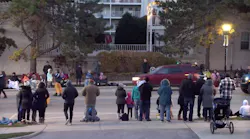
Two years ago this December, a driver entered the Christmas market in Magdeburg, Germany, through an emergency access point. Six people were killed and more than 300 were injured. According to a leaked copy of the market’s security plan reported by German newspaper Bild, the access point was supposed to be 13 feet wide and blocked at all times by a large vehicle and a steel chain. On the evening of Dec. 20, 2024, the gap was about 20 feet wide and no vehicle was in place.
On paper, that opening was closed. On the street, it was open. A state parliamentary inquiry later found that inspections by police, the organizer and the city had failed to identify the gap.
Holiday markets, parades and other outdoor events in the U.S. face the same challenge. Vendors need delivery windows, and emergency crews need a way in. Where the International Fire Code applies, fire apparatus access roads generally must have at least 20 feet of unobstructed width. Event security teams need to decide when each vehicle access point may open and who is responsible for securing it again.
A door with no access control
In a well-run building, an access-controlled exterior door has an owner, a schedule, a status and a log. If the door is propped open, the system raises a held-open alarm. Few security directors, integrators or event security managers would accept a controlled door that nobody owns and nobody monitors.
A vehicle opening in a temporary perimeter is that door. In practice it often has few of those controls:
- No single owner. The organizer, the city’s traffic department, police, fire and private security can each place part of the line, often late in setup and without a shared site plan.
- No schedule. Delivery windows, vendor setup and emergency access change the state of each opening through the day, and few plans say which openings may be open, and when.
- No status. A vehicle parked across a street is not a tested barrier, and when it is moved, the change in the opening’s state often goes unrecorded.
- No log. After an incident, it is often unclear who opened the gap, when and on whose authority.
Running vehicle openings like doors
Six practices carry door discipline over to a vehicle perimeter.
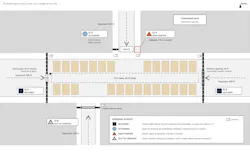
- Write an opening schedule. List every place a vehicle can pass, including sidewalks and the space around parked vehicles. For each, record its width, its purpose (fire lane, deliveries, ambulance), the hours it may be open, the state it should be in at each hour and the named person who owns it.
- Define the states. Four cover most events. Secured means a crash-rated barrier spanning the roadway and both sidewalks, with no clear gap over about 4 feet. Attended means open, or blocked by something untested such as a parked vehicle, with a named person in control. The other two are unattended, meaning open or blocked with nobody in control, and out of service, and both are alarm conditions. Attended is a short-term control, not protection: a person can raise the alarm but cannot stop a vehicle. An out-of-service closure, such as a barrier that will not deploy, stays an alarm until a crash-rated temporary measure covers it.
- Close behind every authorized vehicle. The person at the opening controls it from start to finish and watches the gap behind an ambulance or fire engine, not the emergency vehicle itself, because a hostile driver can follow an authorized vehicle through.
- Make status visible in the command post. Give every opening camera coverage. Bring active barrier status into the same platform: deployed, stored, in motion, fault, and open past its time limit, which is the barrier’s held-open alarm. Wire position switches as supervised inputs so a cut or shorted cable reports a trouble condition, not a secure one, and keep raise and lower commands with an operator who can see the lane. Add timed radio check-ins for openings held by people.
- Log every change. Record who changed the state, when and why. After an incident, that log answers investigators’ first questions.
- Walk the line before the event opens each day and at every staff handover. Take the opening schedule and look for any vehicle path that is not on the list.

What to ask of the hardware
Procedures do not replace tested barriers; they keep them where the plan says they are. Ask the supplier and installer of any temporary or active barrier four questions:
- Is the system rated as it will be deployed? Look for a crash rating under ASTM F2656 or ISO 22343-1 (or its predecessor, IWA 14-1) for the configuration being used, including ballast, connections, spacing and the surface it sits on. An ASTM F2656 M30 P1 rating, for example, means the system as tested stopped a 15,000-pound truck at a nominal 30 mph with no more than approximately 3.3 feet of penetration past its leading edge. A different layout is a different system and needs its own test evidence or a documented engineering assessment.
- Does the rating cover the speed a vehicle can reach and the space behind the barrier? Speed comes from the approach. A car accelerating steadily at 0.35 g from a stop reaches about 30 mph in 85 feet and 40 mph in 150 feet, and at 40 mph it carries about 1.8 times the energy it has at 30 mph, because kinetic energy grows with the square of speed. Ask for a rating covering the largest vehicle that fits and the speed it can reach, with a penetration distance shorter than the clear space between the barrier and the crowd.
- What closes the fire lane? A security gate across a fire apparatus access road needs the fire code official’s approval and an approved means of emergency operation, kept working at all times. Before the event, agree with the fire code official on the gate, its width, its position on power loss and who opens it, so the lane opens for fire trucks in seconds and closes behind them.
- Who operates it, and how are they trained? A tested barrier left open by an untrained operator is an opening.
Cameras, license plate readers and video analytics show the command post a vehicle approaching an opening. They cannot stop it.
One question, every hour
Ask the command post one question every hour the event is open: Which openings are not in the state the schedule says they should be, and who is fixing each one?
A command post that can answer quickly is running its perimeter. One that has to send someone to look is running it on paper.
These practices are a starting point; what a given perimeter needs is settled in a site-specific assessment. CISA’s Vehicle Ramming Action Guide and Vehicle Ramming Self-Assessment Tool are useful places to begin.
About the Author
 Pedram Hesam
CTO of PNH Security Engineering Consultants
Pedram Hesam, PhD, PSP, is Chief Technical Officer of PNH Security Engineering Consultants, an independent protective design and hostile vehicle mitigation firm that does not make, sell or install security products. He has 17 years of protective design experience and is a voting member of ASTM Committee F12 on Security Systems and Equipment. Reach him at [email protected].