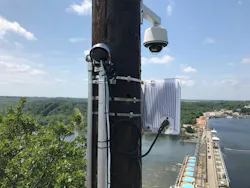
GroundAware radar systems provide wide-area surveillance and threat detection for water and wastewater infrastructure.
Water and wastewater utilities face growing physical security challenges as critical infrastructure assets remain vulnerable to unauthorized access, vandalism and potential attacks. O.W.L. is positioning its GroundAware® radar systems as a solution for detecting and tracking potential threats before intruders reach facility perimeters.
Water infrastructure supports a range of critical national functions, including drinking water supplies, sanitation, agricultural irrigation, thermoelectric power generation and industrial manufacturing. Disruptions to these operations can also affect firefighting capabilities, hospital operations and supply chains.
However, protecting these facilities presents unique challenges. The U.S. water sector consists of tens of thousands of independent local and municipal facilities, making it difficult to establish uniform security protocols across the industry. Large utilities may operate hundreds of geographically dispersed assets, including reservoirs, dams, treatment plants, pump stations, remote wells, chemical storage areas and critical pipeline infrastructure.
Limited funding and staffing further complicate security efforts. Many utilities lack sufficient personnel to monitor the areas surrounding their facilities, particularly at remote locations. Traditional security measures often rely on perimeter fencing, gates, cameras, motion sensors and periodic patrols.
According to O.W.L., cameras and human patrols alone may not provide adequate wide-area detection. Cameras may not capture an intruder until the individual reaches a fence, while patrols leave gaps in physical surveillance and monitoring.
O.W.L.'s GroundAware family of 2D and 3D Digital Radar Systems aims to address these challenges through long-range detection, tracking and classification capabilities. Depending on facility requirements, the systems can detect and classify humans, vehicles, animals and other targets, with integration capabilities for cameras, video management systems (VMS), access control, physical security information management (PSIM), alarms and deterrence systems.
The technology can monitor both land and water surfaces, including reservoirs and dams, to identify people approaching open areas, vehicles entering restricted areas, boats crossing exclusion zones and trespassers approaching water intake structures. It can also help identify suspicious activity around dams, potential vandalism and wildlife activity.
GroundAware's classification capabilities are intended to distinguish between humans, vehicles and animals, helping reduce nuisance alarms at facilities where employees, contractors, maintenance vehicles and wildlife may regularly move throughout the property.
The systems also support low-altitude airspace awareness, with O.W.L.'s 3D radar products designed to detect and track drones and other low-altitude aircraft alongside ground-based targets. Additional applications include perimeter intrusion detection and beyond visual line of sight, detect and avoid, and drone for first response (BVLOS/DAA/DFR) operations.
Rather than requiring continuous monitoring of hundreds of camera feeds or full-time security personnel at every location, O.W.L. describes an event-based monitoring approach in which radar detects and classifies potential security events before triggering alerts and the appropriate camera or security response.
The approach allows radar to identify where an event is occurring so that designated cameras and other security systems can be used to verify and respond to potential threats in real time. According to the company, this can reduce the number of cameras and personnel needed for monitoring while increasing overall 360-degree detection coverage.
Alabama Power Company Senior Vice President of Power Delivery Scott Moore offered feedback on the technology's surveillance capabilities, saying GroundAware radar surveillance "gives us a perspective we've never had."