The Smart Money: The Evolution of Residential Access Control
Key Highlights
- Smart lock and garage door opener adoption has each hit 11% of U.S. internet households — steady growth tied to housing cycles, renovations, and life events rather than impulse upgrades.
- Security system households own smart locks at eight times the rate of non-monitored homes, making residential integrators a prime distribution channel for access control upsells.
- Matter and Aliro are solving the fragmentation problem — standardizing device communication and digital credentials across platforms, clearing the path for broader mainstream adoption.
This article originally appeared in the April 2026 issue of Security Business magazine. Don’t forget to mention Security Business magazine on LinkedIn or our other social handles if you share it.
Smart access control solutions, including smart door locks and smart garage door openers, extend the value of home security by enabling remote access, credential management, and integration with smart home platforms. As adoption grows, access control is evolving from a convenience upgrade into a foundational element of the residential security ecosystem.
The category continues to expand, though growth remains steady rather than explosive. Access control products are closely tied to home infrastructure, meaning adoption follows housing cycles, renovation activity, and integration with broader smart home systems. At the same time, technological innovation, new interoperability standards, and ecosystem partnerships are reshaping offerings and how households manage entry and security.
Steady Growth in a Structural Market
Smart access control is widely recognized among consumers and has become one of the more visible segments of the smart home market. Devices such as smart locks and smart garage door openers offer a clear value proposition centered on convenience, security, and remote visibility into home activity.
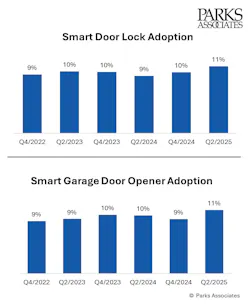
According to Parks Associates’ research, ownership of smart door locks reached approximately 11% of U.S. internet households in Q2 2025, and smart garage door openers have reached the same adoption levels following several years of gradual growth.
While adoption continues to expand, the category grows differently than many consumer electronics markets. Doors and garage systems are durable household infrastructure and are replaced infrequently. As a result, purchase timing is often triggered by specific life events rather than discretionary upgrades.
Moving into a new home or completing renovations significantly increases interest in smart access solutions. More than half of households planning to move within the next six months indicate an intention to purchase a smart door lock, and nearly half expect to buy a smart garage door opener.
Access control devices are well-positioned to be marketed as home improvement upgrades for new residents and homeowners.
Security Ecosystems Driving Adoption
One of the strongest drivers of smart access control adoption is integration with residential security systems. Devices deliver greater value when combined with cameras, alarms, and monitoring services.
Households with security systems adopt access control devices at significantly higher rates than those without security services; in fact, 25% of security system households report owning a smart lock compared to just three percent of households without security systems.
Security platforms provide a unified experience that simplifies installation, onboarding, and ongoing use. Consumers can manage entry, monitoring, and alerts within a single interface. This integration also enables additional features, such as automated disarming when authorized users unlock the door.
For manufacturers and service providers, this ecosystem model also supports bundled offerings and recurring service relationships. Residential security integrators are an important distribution channel for access control devices, beating online-first retailers and reinforcing the value of a multi-channel strategy for smart access control sales.
Interoperability Standards Expanding the Access Ecosystem
Industry standards are playing an increasingly important role in the evolution of smart access control. Interoperability frameworks reduce fragmentation and enable devices to operate across multiple smart home platforms.
The Matter standard has become the primary foundation for interoperability in the smart home. Matter enables devices from different manufacturers to communicate across ecosystems such as Apple Home, Amazon Alexa, and Google Home, enabling consumers to control devices through their preferred platform without being locked into a single vendor environment.
Within the access control category, Matter support is becoming a baseline expectation for new smart locks. The standard simplifies device integration into broader smart home systems and helps extend product lifecycles by reducing platform dependence.
Alongside Matter, the Connectivity Standards Alliance has introduced Aliro, a complementary standard designed specifically for digital access credentials (read more on page 44 of this issue). While Matter focuses on communication between smart home devices, Aliro standardizes unlocking methods.
Aliro creates a common framework that allows smartphones, smartwatches, and other wearable devices to function as secure digital keys across different lock brands and platforms. The standard defines both the credential format and the communication methods between the device and the lock, enabling features such as tap to unlock using NFC or hands-free entry using ultra-wideband technology.
The initiative is supported by major technology companies, including Apple, Google, and Samsung, along with leading lock manufacturers. By aligning digital credentials with mobile wallet ecosystems, Aliro creates a seamless access experience that works across devices and platforms.
Matter and Aliro are the industry's solution to smart home fragmentation, an attempt to increase the value of the smart home to both veteran users and the uninitiated alike. Future buyers and adopters will be able to buy into the smart home with the promise that their devices will work with the platform of choice, and that smart locks in particular will open with the method of their choosing.
New Features Expanding Access Methods
Hardware innovation is expanding the range of access experiences available to consumers. Smart lock manufacturers are introducing new authentication technologies designed to simplify entry while maintaining strong security. Biometric capabilities now extend beyond fingerprint sensors to include facial recognition and palm scanning. Gesture-based unlocking and touchless entry are also emerging in new products.
Ultra-wideband technology is another area of innovation. UWB enables precise location detection and allows locks to unlock automatically when a user approaches the door with an authorized device.
Digital credentials are also becoming more common. Smartphone-based access, wearable credentials, and digital wallet integration allow consumers to unlock doors without traditional keys.
Despite these innovations, everyday usage patterns remain focused on reliability and simplicity. Keypads and biometrics remain among the most used unlocking methods because they replicate familiar interactions while adding digital convenience.
The Growing Role of the Garage
The garage is emerging as a key entry point for smart access control solutions, and several market trends are increasing the relevance of garage access. Package delivery has become more frequent in many households, and consumers are looking for secure ways to receive deliveries while away from home.
At the same time, most consumers remain hesitant to grant delivery personnel access directly inside the home. Instead, the garage is viewed as a secure intermediate space.
Among households that allow delivery access, the majority prefer the garage as the entry point. Smart garage door openers and related access technologies allow deliveries to be placed inside the garage while keeping the interior of the home protected.
This delivery use-case highlights how access control devices are expanding beyond traditional security functions. These technologies are increasingly supporting interactions between households and external services.
Barriers Limiting Adoption
Despite the value of smart access control, Parks Associates research shows several barriers continue to limit faster adoption by consumers. The most significant barrier is the perception that existing locks and garage door systems work well enough and do not require replacement. Because entry hardware lasts many years, consumers often delay upgrades until a device fails or a renovation occurs.
Cost is another consideration. Average selling prices for both smart locks and garage door openers have increased in recent years as both categories are still emerging; new releases include differentiating features, and the category lacks a distinct value tier for most brands. Tariffs also added pressure to average selling prices in 2025.
Installation complexity also influences purchase decisions, particularly for garage door openers that often require professional installation. In addition, some consumers remain concerned about battery life, reliability, and security of connected locks.
Connectivity challenges can also affect the user experience. Entry points such as front doors or detached garages may have weaker Wi-Fi signals, which can complicate device setup or operation.
Addressing these barriers will be important for expanding the category beyond early adopter households. Future growth will depend less on standalone hardware innovation and more on ecosystem integration and service experiences. Access devices will increasingly function as part of unified platforms that combine security monitoring, automation, and identity management.
This article is based on insights from the Parks Associates Market Assessment Study: Access Control in the Smart Home: Locks and Garage Door Openers.
About the Author
 Daniel Holcomb
Daniel Holcomb
Daniel Holcomb is Senior Analyst for Parks Associates, which covers the security and smart home market extensively within its research practice. Visit www.parksassociates.com to learn more.