The Smart Money: Alarm Response Gives Way to Intelligent Prevention
Key Highlights
- As AI becomes capable of understanding context and coordinating across connected devices, consumers will expect intelligent assistance as a standard feature of the connected home – and the security industry is already moving to meet that expectation.
- Monitoring providers are deploying AI for prevention and verification rather than post-event response, with SimpliSafe's Active Guard and Brinks' Cresta integration illustrating how AI is becoming a core service component rather than a product add-on.
- Parks Associates data shows 79% of U.S. internet households value at least one AI-powered home assistant capability – with cybersecurity monitoring, voice-activated emergency requests, and unknown-person identification among the highest-priority features.
This article originally appeared in the August 2026 issue of Security Business magazine. Don’t forget to mention Security Business magazine on LinkedIn or our other social handles if you share it.
OpenAI's reported plans to introduce a portable, screenless AI companion have renewed discussion about the future of voice-enabled devices. While the company has not officially announced the product, Bloomberg reports suggest it is designed to deliver more natural conversations, contextual awareness, and personalized assistance throughout the day.
For the home security industry, the significance is less about a new consumer device and more about the direction of the market. As AI becomes increasingly capable of understanding context and coordinating information across connected devices, consumers will expect intelligent assistance to become a standard feature of the connected home experience.
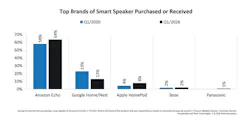
The security industry is already moving in that direction – and has been for years. Parks Associates research finds that 49% of U.S. internet households own a smart speaker or smart display, creating a substantial installed base for AI-enabled services. Two-thirds of consumers already use a voice assistant on at least one device, demonstrating that voice has become a familiar interface for interacting with technology throughout the home. The opportunity now is to make those interactions more intelligent and to create value from this interface, especially with specific market segments.
AI Is Expanding the Definition of Professional Monitoring
For years, professional monitoring focused primarily on responding to alarms after an event occurred. AI is enabling providers to shift toward prevention, verification, and proactive engagement – helping to reduce false alarms and creating new opportunities to deliver more value.
Rather than replacing professional monitoring, AI is improving the quality of monitored services by providing additional information, reducing unnecessary dispatches, and helping customers manage increasingly complex connected homes.
This evolution is already visible in the market. SimpliSafe has expanded its Active Guard Outdoor Protection service by combining AI with professional monitoring. When outdoor cameras detect activity, AI evaluates whether the event involves a person before escalating it to a monitoring agent. Agents can review live video, communicate through two-way audio, activate a siren or spotlight, and contact emergency responders when necessary. The objective is to deter crime before a break-in occurs rather than respond after an alarm is triggered.
Brinks has reported significant reductions in truck rolls using Cresta AI and a digital self-service platform for dealers, creating cost savings and an improved dealer experience. Although these approaches differ, both companies illustrate the same market trend: AI is becoming a core component of the service experience, not simply another product feature.
Consumers Value AI That Delivers Practical Benefits
Parks Associates research shows consumers are interested in AI when it solves real household problems. Nearly four in five U.S. internet households – 79% – identify at least one AI-powered home assistant capability as valuable. Interest is even stronger among existing security customers and smart home device owners, where more than 80% identify at least one AI-powered safety or home management capability as valuable.
Among all U.S. internet households surveyed, 41% value the ability to request emergency assistance using only their voice; 40% value AI that can identify an unknown person approaching the home; 37% value AI that monitors the home network for cybersecurity threats; and 33% value assistance setting up new smart home products.
These findings, from the firm's quarterly survey of 8,000 U.S. internet households, closely align with where the security industry is investing today. Rather than replacing professional monitoring, AI is improving the quality of monitored services by providing additional information, reducing unnecessary dispatches, and helping customers manage increasingly complex connected homes.
The Opportunity Extends Beyond Security
Many of the AI capabilities consumers value extend well beyond intrusion detection. Parks Associates research finds consumers are also interested in AI that monitors home networks for cybersecurity threats, helps configure connected devices, creates home automation routines, and optimizes household systems. Interest in these capabilities increases significantly as households own more smart home devices.
This creates opportunities for security providers to expand beyond traditional monitoring – and it draws in new competition. ISPs are actively seeking revenues and value-added services to reduce churn and deliver value beyond connection speed. Security providers and ISPs already manage many of the connected devices throughout the home, including cameras, sensors, locks, lighting, and environmental controls. AI can simplify installation, recommend automations, troubleshoot technology issues, and personalize services based on household behavior. As connected homes grow more complex, reducing friction may become just as valuable as adding new devices.
Software Convergence
The home security market has historically competed through hardware innovation, professional monitoring, and installation models. Increasingly, differentiation will come from software and intelligence.
Consumers are not asking for more sensors or additional cameras. They are looking for systems that better understand what is happening in and around the home and provide meaningful assistance when it matters. OpenAI's reported hardware plans reinforce this broader market direction. Whether AI is delivered through a smart speaker, a wearable, a smartphone, or a security platform is becoming less important than the intelligence behind the experience.
AI represents an opportunity to strengthen professional monitoring, improve customer engagement, and expand recurring services. The companies that combine AI with monitoring, automation, cybersecurity, and connected home management will be better positioned to differentiate their offerings as consumer expectations continue to evolve.
About the Author
 Elizabeth Parks
Elizabeth Parks
Elizabeth Parks is the President of market research firm Parks Associates. For more information, visit www.parksassociates.com