The Emerging Cloud-Based Physical and Cybersecurity Solutions for Schools

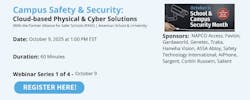
As the line between physical and cyber threats continues to blur, schools are reevaluating how they manage safety and compliance across their campuses. Risk analysis platforms are being woven into modern GSOCs (Global Security Operations Centers) to give districts a unified view of threats, hazards, and data privacy obligations. But how are schools actually navigating the landscape of security convergence?
Moderator Steve Lasky, joined by guests Antoinette King, Founder, Credo Cyber Consulting LLC; Daniel R. Young, Founder & Chief Innovation Officer, Circadian Risk Inc.; and Tyler Brown, Product Manager, Pavion, explores what the rise of the GSOC means for schools, including:
- The benefits of risk analysis and compliance tracking for K-12 schools,
- The importance of accountability for both protecting data and breaking silos,
- And the evolving role of integrators as technology bridges and trusted advisors.
Schools, risk analysis, and the modern GSOC
“GSOCs are an evolving infrastructure for all organizations, including schools,” opened Young. “In the beginning, they were monitoring centers for access controls and cameras. Today, GSOCs are more like intelligence operations centers.”
As intelligence operations centers, Young explained, GSOCs gather immense amounts of information that can be used to fuel more proactive decision-making. Teams can examine the unique problems facing specific locations—such as areas with higher crime rates or those more likely to be affected by severe weather—and mitigate those issues in advance. That shift, he argued, makes risk analysis the hinge of any GSOC.
Combining these disparate data streams into a coherent risk intelligence framework, however, is a tall order for cash-strapped schools without dedicated security or IT departments.
Where IT meets security
Many districts, King explained, rely on a small team of educators and administrators to carry out these functions. In institutions that have a GSOC, the financial and technical resources to integrate advanced risk analysis tools exist, but they are the exception rather than the rule. For districts without these resources, King noted partnerships with law enforcement as a practical solution. “They’re utilizing some of the analysts from the local PDs or even the FBI to have more of that proactive approach to risk,” she said.
A significant trend King highlighted is the transition of security functions into IT. “The person who used to be responsible for knowing how technology like smart boards worked is now also responsible for understanding risk, cybersecurity, data, privacy, and the principles of physical security,” she explained. This convergence, although necessary, creates a steep learning curve for many districts that are still defining their governance frameworks.
Automated, proactive risk solutions offer a path forward. By integrating threat analysis into school security operations without the need for large teams of analysts, these platforms enable districts to adopt modern security practices, even when staffing and budget constraints remain in place.
Too much data, not enough clarity
GSOCs take in massive quantities of data to better inform incident response. However, this data quickly becomes noise without proper ways to filter it.
“Between access control, alarms, IoT devices, and cloud-based analytics, the information coming into GSOCs is constant,” Young said. “The trick is figuring out what’s actionable: schools don’t need more alerts; they need clarity.”
This is where risk analysis comes in. By evaluating severity, likelihood, and context in real time, Young explained, GSOCs can become control towers that inform rather than distract. “If there’s a weather alert near a field trip location or a cyber breach that could impact student data, the system should flag it for the right person immediately,” he said.
King also emphasized the importance of tearing down departmental silos when making data-driven decisions. “IT, facilities, emergency management—they’re all working in different silos,” she said. “And nobody is talking until something goes wrong. Even modest campuses now rely on connected door controllers, AI-driven surveillance, and digital visitor logs, all of which sit on the same network as student data. One compromise can cascade across systems.”
Tracking risk with compliance
An unexpected advantage of risk analysis, Young said, is the ability to track compliance. “A GSOC can now show you not just threats but compliance gaps,” he said. “If your visitor management logs don’t meet privacy laws, or if your audit trails are incomplete, it’s visible right there.”
That transparency, King added, helps schools stay accountable. “Parents expect privacy. Regulators expect accountability,” she said. “These systems make that visible.”
Compliance, King said, is difficult for educational institutions—especially as regulations shift and threats continue to evolve—but extremely necessary. “Privacy laws keep coming, and vendors have to be transparent about how they’re protecting student and faculty data.”
Accountability must also extend to AI-based technologies. While AI security systems have their benefits, such as noise reduction and incident prediction, they require human oversight.
“In education, especially K-12, there’s a fine line between automation and responsibility,” King said. “You can’t let AI make safety decisions. It can assist, but not replace, judgment.”
Bridging gaps with integrators
A major aspect of this accountability is the integrator, a role that has expanded significantly in recent years. “They’re not just installers anymore,” Young said. “They’re the ones explaining to school boards why a GSOC matters, why data-sharing agreements need to exist, and how physical and cyber risks connect.”
“Integrators have become trusted advisors,” King agreed. “They help schools understand that systems aren’t separate; they’re part of one risk posture.”
The expectation now is that integrators can speak the language of both facilities and IT, aligning them into a single operational strategy. This is especially important for educational institutions without dedicated security or IT staff, who may not even know what questions to ask, given the rapid evolution of technology.
“They’re the connective tissue,” Young said. “If we expect schools to make informed risk decisions, someone has to help them understand the whole picture.”
Today’s integrators are now guiding conversations, helping clients map out data privacy policies, creating vendor risk frameworks, and designing governance plans that satisfy both security and compliance requirements. In smaller districts, where they are likely to be the only party with a comprehensive understanding of the full security ecosystem, they can train staff to interpret the data they generate into actionable items.
This heightened level of collaboration is necessary in a world where new technologies, threats, and regulations crop up almost too quickly to adapt to. “This space keeps moving,” Young concluded. “Risk isn’t static. Neither can we be.”
Speakers

Antoinette King is the founder of Credo Cyber Consulting, LLC, and has 21 years of experience in the security industry. Beginning her career as a field technician responsible for the installation, design, and implementation of integrated security solutions, Antoinette has worked on projects that include the protection of one of our nation’s most treasured monuments, the Statue of Liberty. Antoinette has held roles within the security industry that include Engineered Systems Specialist, Operations Manager, Regional Sales Manager, and Key Account Manager in both integration and manufacturing.
Drawing on her more than two decades of experience, Antoinette founded Credo Cyber Consulting in 2020 to provide her clients with a holistic perspective on a cyber-physical security program with a focus on data privacy and protection. Antoinette is a Board-Certified Physical Security Professional (PSP), as well as a certified Data Privacy Protection Specialist (DPPS). She has an associate degree in Criminal Justice, a Bachelor of Science in Managing Security Systems, and a master’s degree in Cybersecurity Policy and Risk Management.
Her book, The Digital Citizen’s Guide to Cybersecurity: How to Stay Safe and Empowered Online hit the Amazon Best Seller’s list for all its categories in the first 48 hours of release.

Daniel Young is the Founder and Chief Innovation Officer at Circadian Risk Inc., a provider of Software as a Service Solutions for risk analysis to allow a company to understand their True Risk Score™ for an undesirable event daily. He has been a security and risk advisor for over 20 years. Mr. Young is also a Co-Founder of the CSO Risk Council, a think tank for security professionals working to create a proactive culture of risk and disrupt the security and risk industry.
Previously, Mr. Young served as the Regional Bioterrorism Coordinator for District 1 in Michigan. As the regional coordinator, he was instrumental in providing leadership to District 1 organizations and the State of Michigan in preparing communities for incidents, whether terrorist-based or naturally occurring. As a result, the District 1 Regional Medical Response Coalition (D1RMRC) developed a systems improvement plan that provided recommendations to help hospitals, public health, and emergency management prepare for all types of incidents.
Mr. Young taught Private Security and Risk Analysis at Michigan State University and served as the Private Security Liaison for the City of Lansing’s Critical Infrastructure Team. This team identified and documented deficiencies in the city’s critical infrastructure. The Local Planning Team then approved the countermeasures to improve the resilience of those targets. He also assisted MITRE and DHS/Federal Protective Service in shaping their risk analysis methods and theories.

With over a decade of experience in the security industry, Tyler Brown is a Product Manager specializing in the development and positioning of solutions that meet the evolving needs of today’s security landscape. Tyler’s work has centered on creating clear, scalable commercial offers—particularly in the areas of video surveillance and artificial intelligence—by aligning product capabilities with customer expectations and market demands. His current focus is on helping organizations navigate the shift toward smarter, more proactive security solutions powered by AI and analytics.
Register to view the October Campus Safety & Security Web Events here.