How to Build the Business Case for Campus Safety & Security Technology Initiatives

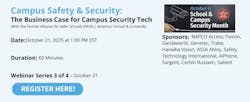
When schools have little budget to spare for security concerns, demonstrating its value is critical. Prevention is a difficult commodity to price, so administrators must learn how to effectively communicate the way new technology initiatives can protect their campus while delivering measurable ROI.
Join moderator Steve Lasky, Pavion Senior Account Executive Luke Brown, PASS Chair and ASSA ABLOY National K-12 Director Guy Grace, and Secure Our City Founder & CEO Geva Barash to learn:
- How to find the ‘champion advocates’ of your security initiatives,
- Why teams need to present security as a value-add in more ways than safety,
- And how to manage—and avoid—implementation risk.
Understanding the many sides of campus safety
When schools and universities look to build a business case for safety and security investments, the first challenge is understanding who is at the table. Administrators, faculty, student services, parents, staff, and campus law enforcement all have different perspectives on safety.
“Administration will often see risk management and liability. Faculty will see disruptions to the learning environment. Parents see trust and assurance that their kids are safe,” said Grace.
For facilities, the focus might be on maintainability and code compliance, while police and SROs are more centered on risk and response. Boards and superintendents think about brand and reputation. With these perspectives in play, according to Grace, the only way forward is to “listen before proposing.”
“You have to listen to every stakeholder group and uncover their pain points to create interoperability between these groups,” Grace explained.
Flexibility is crucial to maintaining this interoperability. Project delays, changes in faculty, and emerging threats can all cause priorities to shift, noted Barash, but constant recalibration is part of the job.
Finding your champions
Bringing more voices into the security discussion is necessary but requires dedicated communication. Security priorities must be translated and communicated in a way that the party in question can understand: technical jargon, noted Brown, can easily alienate non-security personnel. Instead, stakeholders should be “painted a picture” to see how each solution can address their specific pain points.
“When you’re talking with administrators, focus on risk management, compliance, and institutional reputation,” said Brown. “For faculty, it’s minimizing classroom disruptions. For parents, it’s visibility and transparency.”
Including everyone in the conversation is the best way to find the advocates your security initiative needs to survive, according to Grace. “You can gain a lot of champions from different verticals within and outside the district.”
Some of these champions, Grace added, may become future board members who campaign on safety and security issues. “Safety and security should be a brand of a school district,” he said. “Not turning the school into a prison but doing the best possible with the resources available.”
Resistance is an inevitable part of this process, however. Faculty, IT, or unions may raise concerns about cost, privacy, or culture changes. According to Barash, the key is to understand where these objections come from and adjust accordingly. Nearly every campus has a limited security budget, so prioritizing early and visible wins is vital.
Another method is linking security to the overall success of the institution when speaking with decision-makers. Persuasive evidence of preparedness and compliance with privacy regulations can strengthen a school’s reputation.
“Visible security builds trust and reduces anxiety,” said Brown. “Investing in safety technology can have a massive impact on student retention, faculty recruitment, and enrollment growth. Safe and confident students are more likely to stay and thrive. Staff feeling secure inherently leads to teacher retention. Parents will feel more confident dropping their kids off.”
Security as a value-add
Technology investments, while important, are not enough on their own. New systems, Barash noted, should be embedded into daily operational workflows to communicate to stakeholders that the new solutions add measurable value. “If you install something but don’t use it, you have no ROI,” he said.
Framing ROI for threat prevention can be a difficult sell, however; according to Grace, “prevented incidents don’t show up on your balance sheet.” One method is comparing pre-implementation metrics, such as vandalism reports or overtime hours, to post-implementation outcomes.
“When you show results in dollar terms, plus reduced downtime and liability exposure, you’re not talking theory anymore; you’re showing fiscal responsibility,” Grace explained.
Cost confidence can also be built through peer benchmarking, pilot data, and vendor SLAs. The time spent manually reviewing footage, for example, can be reduced by AI analytics that automate the process. These are measurable efficiency gains that resonate with decision-makers.
To Barash, the ROI is less numerical. “You cannot put a price on prevention,” he said. “If you install a camera and something happens to it, the ROI is irrelevant. If nothing happens, it could be called a waste of money.”
Instead, the focus should be on safety and well-being. Questions about ROI should center on whether faculty and students feel safe and if their learning outcomes are supported.
Managing implementation risk
Implementing any new technology or system comes with risks. Some issues can be addressed preemptively by incorporating procedures, training, and system integration into the project bid. Future-proofing can be achieved through pilot programs, with small-scale deployments helping districts understand how a new technology might function and scale before making a commitment.
Privacy is another concern, especially for student data. Advanced video technologies and analytics can be powerful prevention tools but require transparency and clear communication to implement without raising fears.
“People don’t know what they don’t know,” Brown said. “You need to have conversations with administrative staff to help them build a case for the technology they are investing in. Frequently ask questions and work with them to create policies. Helping them communicate that technology is for safety—not surveillance—is important.”
Finally, standards like those championed by ASIS and PASS provide benchmarks for safety technology and interoperability. While not legally binding, these standards help guide best practices and reduce liability exposure, thereby setting a foundation for consistent and effective campus safety programs.
“These guidelines set a fantastic benchmark for standardization,” concluded Grace. “They foster the interoperability between the folks in the industry, our law enforcement partners, our mental health professionals, and our hospitals that is absolutely necessary right now.”
Speakers

Guy Grace is currently serving as the chair for the Advisory Council for Partner Alliance for Safer Schools (PASS) and has served as the director of Security and Emergency Planning for Littleton Public Schools in Denver, Colorado, for more than 30 years. His outstanding contributions earned him the 2020 Campus Safety Director of the Year award, and he has received numerous other national and security industry accolades, including from the Association of School Business Officials International, Security Technology Executive magazine, American Red Cross, Security Industry Association (SIA), and NSCA.
Guy currently serves as the K-12 National Security Program Manager for ASSA ABLOY. Grace is a regular speaker at school safety conferences and a commentator for various trade magazines and media outlets. He possesses hands-on experience in school safety technology and processes and emergency response, providing valuable insights on deploying life safety technology in K-12 schools.

Luke Brown is a progressive professional with a proven record of leading innovative teams and driving impactful results in both education and sales. With over two decades of experience in education, including serving as a High School Principal, Luke developed a strong foundation in leadership, communication, decision-making, and relationship building. Under the leadership of Dr. Lynn Moody, he became adept at implementing new initiatives, developing staff, and creating positive change within his school community.
In April 2024, Luke transitioned to Pavion as a Senior Account Executive, where he leads strategic initiatives in safety, security, and technology solutions. At Pavion, he focuses on building strong client partnerships, delivering tailored solutions, and ensuring measurable outcomes that align with organizational goals. His ability to combine consultative sales strategies with a deep understanding of client needs has positioned him as a trusted advisor and contributor to business growth.
Luke thrives on identifying innovative approaches and delivering creative solutions to business challenges, guided by his core values of observation, inspiration, and determination. His unique blend of educational leadership and sales expertise positions him as a collaborative team player who consistently imparts valuable insights, fosters growth, and drives results. His passion for fresh perspectives and innovative techniques allows him to contribute meaningfully to organizational success.

Geva Barash has worked in the physical security industry for 30 years. Before launching Secure Our City, he managed a security systems integrator and other companies that developed security products and solutions utilizing the latest digital technologies. Geva has worked with companies that introduced new technologies into the security market, including RFID technology. Having the manufacturers' and integrators' perspectives enables Geva to provide customers with the most balanced and comprehensive security solutions. Geva served nine years in the Israeli military, reaching the rank of Major in the Israeli Intelligence Services, and has been an active volunteer leader in several nonprofit efforts.
Register to view the October Campus Safety & Security Web Events here.