Judge Rejects Criminal Charges in Richneck Teacher Shooting Case
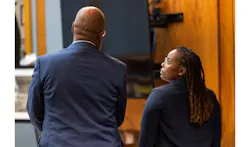
A Newport News, Va., judge on Thursday granted a motion to strike the criminal case against a former Richneck Elementary School assistant principal, tossing all eight pending felony charges against her.
Circuit Court Judge Rebecca M. Robinson ruled that Ebony Parker’s actions or inactions on Jan. 6, 2023, do not amount to a criminal act under Virginia law, with the judge ending a jury trial that was already three days in.
In a case that made national headlines, a 6-year-old boy brought his mother’s handgun into school that morning, then used it to shoot his teacher, Abby Zwerner, during an afternoon reading class.
The prosecution accused Parker of failing to take action after hearing of concerns that the boy might be armed — asserting that she alone was in position to stop the shooting. Parker’s lawyers, on the other hand, sought to cast blame on other teachers — including Zwerner — for failing to prevent it.
In the end, the prosecution’s case wasn’t enough, the judge determined, saying such charges against a school administrator were “unprecedented.”
“The court finds that what has been presented to it is a mash-up of legal theories,” Robinson said in explaining her decision. “It is not clear based upon the plain meaning of the statute that these facts are crimes.”
When the judge announced a few minutes later that “these charges are dismissed,” Parker leaned over at the defense table, made a quick, audible wail, and broke down in tears.
Robinson’s ruling stunned those in the courtroom who were ready for a full fourth day of the trial that has been broadcast nationally on CourtTV.
Robinson granted the motion after two days of the prosecution’s evidence — before the defense began its case. It’s extremely rare that judges grant motions to strike at this phase of a jury trial, though statistics on that couldn’t be immediately located on Thursday.
The judge — wearing a lace collar of the style favored by the late U.S. Supreme Court Justice Ruth Bader Ginsburg — read prepared remarks, saying she made her decision after listening to the evidence the past several days and attempting to pinpoint the criminal act.
Legal questions surround criminal liability
Parker was charged under a section of Virginia’s felony child abuse and neglect statute. It reads that anyone with responsibility for a child “whose willful act or omission in the care of such child is so gross, wanton and culpable as to show reckless disregard for human life is guilty of a class 6 felony.”
Though the prosecution asserted Parker wholly failed to act on concerns the boy had a gun with him in school that day, Robinson ruled that what she did didn’t make her a felon.
Is the crime, Robinson asked, that Parker failed to follow Newport News Public Schools policy on the search? (She noted that the policy requires two people to search a child’s “person,” but that a second administrator and school security officer weren’t available at the time in any event).
Or is the crime, she asked, that Parker didn’t direct a search of the child’s person after being informed that the boy’s book bag was clear of a firearm? (It was later determined that he had moved the gun to his jacket and taken it to recess).
Were the eight counts based on the number of children in Zwerner’s classroom when the gun went off? Were they based on the number of rounds in the firearm? (“Under established case law,” Robinson said, such rounds “would need to be discharged.”)
Robinson also alluded to testimony on Wednesday from parents of children who were in school that day.
“Is the delayed reunification (between children and their families) the reckless disregard for human life?” Robinson asked. “Is it the emotional trauma of the exposed child who was in the classroom? … Is it the fearfulness, bed wetting, the hypervigilance of all the children in school that day?”
Or is that Parker didn’t expel the student for his prior misbehavior?
“The court is unclear, and … those legal theories do not fit the plain meaning of the statute,” Robinson said. “Therefore, I do grant defense motion to strike, in whole, on all eight counts.”
One of Parker’s lawyers, Curtis Rogers, said that while she might have “made a mistake” and had a “lapse in judgment” on Jan. 6, 2023, she did not commit a crime. Rogers said that many people were praying for Parker, and “those prayers were answered.”
Parker declined to say much, but cracked a broad smile as she got into an SUV with her father. “I just want to go home,” she said.
Revisiting the events leading to the Richneck shooting
Headlines were made across the world when the 6-year-old shot his teacher in the first-grade Richneck classroom on Jan. 6, 2023.
The boy had climbed onto his mother’s dresser that morning and removed the firearm from her purse and taken it to school in his back pack.
During an afternoon reading class, the student removed the gun from his hoodie pocket and fired it at Zwerner from about 10 feet away. The bullet shattered Zwerner’s left hand, with a large bullet fragment lodged in her chest.
“I thought I had died,” she testified at a jury trial last fall. “I thought I was on my way to heaven or in heaven.”
Parker kept a low profile and did not testify at her civil trial. On Wednesday, prosecutors played a recorded Zoom call of Parker speaking to the Newport News Public Schools human resources department about the day’s events.
In that video, Parker said she didn’t order a search of the boy because it was getting so late in the afternoon, and she thought it was better to simply wait until his mother arrived to pick him up.
“His mom is due to come here soon,” Parker explained at the time. “We’ll let her go through the rest of his things and check it.”
Also in the interview, Parker got emotional when saying that Zwerner never told her that she felt unsafe with the student who shot her.
Former Newport News Commonwealth’s Attorney Howard Gwynn asked a judge a few weeks after the shooting to appoint a special grand jury to investigate the matter. That grand jury investigated the case, to include talking to witnesses and gathering documents, and indicted Parker on the eight felony counts in August 2024.
After Gwynn lost a bid for re-election last November, Joshua Jenkins — who was handling the Parker prosecution for the office — left for a job working for Hampton Commonwealth’s Attorney Anton Bell.
Before he stepped down from office, Gwynn asked a judge to appoint Bell as special prosecutor to the Richneck case, with Bell assigning Jenkins to stay on the matter.
After Robinson’s ruling Thursday, Jenkins deferred any questions on the case to Bell.
“From the outset, this case carried significant importance to the community,” Bell said in a statement Thursday. “It was the citizens of Newport News, through the grand jury process, who determined that indictments against Ebony Parker were appropriate based upon the evidence presented.”
Bell said he hoped the citizens on the jury would have a chance to weigh the evidence, but that Robinson concluded the matter as she “deemed appropriate under the law.” Bell said his office would continue to pursue justice with integrity, “while continuing to honor the role that citizens play in our justice system.”
Zwerner won a $10 million jury verdict against Parker last fall, but she has not yet been paid as the matter is under appeal. On Thursday, Zwerner’s attorneys said any arguments the School Board’s insurance pool might use to deny coverage for Parker on account of criminal wrongdoing is now moot.
“Today that is no longer an excuse,” said attorneys Dianne Toscano, Kevin Biniazan and Jeffrey Breit.
©2026 Daily Press. Distributed by Tribune Content Agency, LLC.