The Moment Workplace Incivility Became a Critical Threat Assessment Priority
Key Highlights
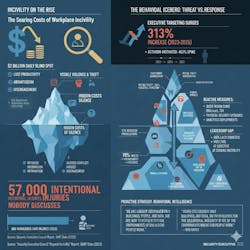
- Executive Targeting Surges 313%: Attacks against corporate executives exploded from 2023 to 2025, with activism-motivated incidents spiking 463%. The pattern accelerated long before the December 2024 healthcare CEO shooting captured headlines and shows no signs of slowing.
- The Hidden Cost of Silence: Beyond visible violence and theft lies an equally damaging response: employees withholding information, avoiding conflict, and disengaging from decision-making. Organizations track the incidents but miss the erosion happening in the silence that follows.
- 57,000 Intentional Injuries that Nobody Discusses: While 800 annual workplace homicides dominate headlines, DART data reveals 57,610 workplace injuries in 2022 severe enough to require time off or job transfers — all from intentional acts. The iceberg below the waterline is bigger than anyone realizes.

The numbers don't appear to be a security issue at first glance. Americans experience roughly 200 million acts of incivility every day. The aggregate cost of lost productivity, absenteeism, and workplace disengagement runs close to $2 billion per day. But for Bob Hayes, CEO of the Security Executive Council, the pattern was unmistakable. What began as cultural observation became something far more concrete when he and his team started connecting disparate research across industries.
"We started seeing news stories about Little League teams that couldn't get umpires because parents were treating them so badly, and high schools that couldn't get referees because parents were coming out of the stands after them. We said, 'Wow, is it just us noticing this as a trend?’ So, we wanted to see if our perceptions were accurate," Hayes says. And unfortunately, they were.
A chief security officer from a Fortune 500 company approached Hayes with a story that crystallized the shift. The executive's CEO, who had spent 30 years helping build a small town, was considering relocating.
"He said, 'We don't feel safe here anymore. We'll be out for dinner, and people will come up to our table. We'll be in a movie, and people will be talking about us behind our backs. Something has changed. We're not comfortable anymore," Hayes said. And that level of discomfort wasn't isolated within the U.S. Hayes heard similar accounts from Belgium, Ireland, the U.K., France, and Canada.
For over two and a half years, the Security Executive Council compiled 70 statistics from 39 independent sources into a comprehensive trend report titled "Beyond Incivility." At one point, the research reached 120 pages, and Hayes and his team made a strategic decision: document the problem first, then debate the causes and solutions.
"The next evolution of security leadership will not be driven solely by better hardware or more intelligent AI. It will be defined by how effectively we understand, measure, and influence human behavior. We are no longer defending only buildings, people, and data. We are now responsible for the behavioral integrity of the environments where our people work."
- Bob Hayes, SEC
The findings document a measurable shift from rudeness to risk. What was once dismissed as an HR issue has crossed into the domain of enterprise security, workplace violence prevention, and threat assessment. The research framework divides the problem into four categories:
- Perceptions and reactions to incivility
- Documented acts of incivility and their workplace costs
- Social disorder indicators, and
- Threatening behaviors and violence
The breakthrough came when the Society for Human Resource Management (SHRM) released its research. The society surveyed 1,000 companies quarterly for two years, tracking workplace civility with dedicated scores for both the society and the workplace. When Hayes showed these numbers to security executives, they took the data to their HR departments, often at the director or vice president level.
"Not one of them had seen it or read it. Nobody reads anything anymore," Hayes says. The gap between research and awareness became part of the problem itself.
The Hidden Costs of Silence
The SHRM data confirmed what many security professionals had been seeing anecdotally, but it also revealed something else: a business opportunity. Fifty-eight percent of U.S. workers believe society has become fundamentally uncivil. Seventeen percent of Americans admit to behaving uncivilly toward a business in the past year. SHRM developed books and training programs on civil discourse, conflict resolution, and managing workplace incivility complaints. Hayes suspects the organization can now measure the extent of workplace incivility and offer remediation services. The research wasn't just academic. It was market development.
But while SHRM's research quantified visible incivility, Michael Lee, director of the Civility Initiative and Professor of Communication at the College of Charleston, saw a parallel threat that's harder to measure. Lee's work focuses on teaching civil discourse and debate to build capacity for productive friction.
"They really put some numbers to fight response," Lee says, referencing the Security Executive Council's report. "Now the question is, how are we going to expand on their findings and start talking about how flight costs time and money as well? People's unwillingness to engage, people's unwillingness to speak up, decision-making suffers as a result."
Lee frames the issue through the lens of the nervous system: fight, flight, freeze, fawn. The Security Executive Council's report documents the "fight" behaviors—such as theft, confrontations, and workplace violence. Lee argues that the "flight" response incurs the same organizational cost. Employees withhold information. They avoid conflict. They disengage. Productivity doesn't just drop from visible incidents. It erodes from the silence that follows.
"I have not seen a single study as comprehensive as the Security Executive Council’s that talks about incivility in the workplace and doesn't talk about it exclusively through the lens of politics," Lee says. "Everything is downstream of the culture. Folks have gotten collectively more uncomfortable having disagreements."
Lee's Civility Initiative is developing workforce-facing civility training programs, similar to diversity training but focused on viewpoint diversity. The goal isn't to eliminate disagreement. It's to restore the capacity for healthy debate at all organizational levels. "We need better capacity building around debate and dialogue," Lee says. "Humanizing the fact that reasonable people can disagree about things."
The organizational data support Lee's framework. Workers who endure sustained incivility are more than twice as likely to leave their jobs within a year. Two-thirds report reduced productivity. Nearly 60% say morale suffers. More troubling, over 70% of employees believe their manager could have done more to prevent or address incivility, yet only one in four thinks their organization is effective at curbing it. That leadership gap, Hayes argues, is precisely where the modern CSO must step in.
The behavioral shift isn't confined to employee-manager dynamics or customer service interactions. Hayes and his team tracked indicators they categorize as social disorder and behaviors that suggest a broader collapse of civic norms.
Speeding violations have surged. Porch piracy exploded. Red light running became commonplace. "I was seeing people running stop signs, disregarding traffic lights, and turning left from the right-hand lane. People were acting aggressively in the grocery store parking lots. I was getting flipped off all the time," Hayes says. "I know my driving was never great, but it's not that much worse now."
These aren't security incidents in the traditional sense. They're indicators of a society where consequences feel distant, and self-regulation has weakened. For security executives, social disorder matters because it predicts escalation. Disrespect rarely stays static. What begins as rudeness can evolve into harassment, intimidation, and violence.
Directly Eroding Earnings Across all Sectors
The behavioral breakdown isn't contained to office parks and conference rooms. It's showing up in every industry where employees face the public.
Retailers report sharp increases in theft, organized retail crime, and customer aggression, much of it accompanied by violence. In one major survey, the number of retailers citing violence as a top concern rose more than 70% in a single year. Nearly 45% of stores have reduced hours due to crime. More than a quarter of locations have closed due to safety concerns.

Walmart and TJX have begun issuing body-worn cameras to frontline workers, an expensive countermeasure that underscores the severity of their experience. "Do you know how expensive body cameras are? How bad does it have to be to do that?" Hayes asks. "That's a big deal."
Healthcare facilities face similar pressures. Transportation workers face acute risk. Hayes interviewed Uber and Lyft drivers and DoorDash couriers to learn about their experiences. "A lot of them told me, 'I don't drive at night anymore. I don't go into certain areas. I just won't pick up there. I'm too afraid.' One woman said, 'But it's not an area thing anymore. I've had all sorts of people just scream at me and do stuff that I've never seen,'" Hayes says.
Service workers in restaurants, home healthcare, and home repair face similar threats. One anonymous security director at a Fortune 500 company told Hayes their workplace violence cases are 18 times higher than they were in 2018. The anecdotes point to something larger, but quantifying the full scope of workplace violence requires looking beyond what makes headlines.
What's Below the Surface
Hayes describes the current environment as an iceberg. Customer confrontations, employee disputes, and theft represent just the points above the waterline. Below the surface lies a much larger structure that could sink organizations that are unprepared for what's coming.
The statistics validate what frontline employees already know. According to federal data, there were 57,610 DART (Days Away, Restricted, or Transferred) injuries in 2022. These workplace injuries were severe enough to require time off, job restrictions, or transfers, all resulting from intentional acts of violence. These are OSHA-reportable incidents. By comparison, roughly 800 workplace homicides occur annually in the U.S. The gap between those two numbers reveals how much violence falls below the threshold of national attention.
"When I saw that number, I about fell out of my chair. People talk about the 800 homicides in the workplace. Look at 57,000 DART injuries," Hayes says. "In the U.S., we only keep score of everything on homicides. That's not the right currency. Imagine half of leadership not knowing whether the company has a fire evacuation plan."
DART injuries are OSHA-reportable incidents resulting from intentional acts. They represent violence that doesn't make national news but compounds daily across organizations. Hayes hasn't been able to locate historical DART data to establish a trend line, but given that resisting arrest, assaults on law enforcement, and other measurable indicators of violence are climbing, he assumes DART numbers are rising as well.
Despite years of high-profile workplace violence incidents and mounting evidence of escalation, organizational preparedness lags dangerously behind the threat environment. Sixty-five percent of companies still lack a formal domestic violence prevention policy. In a recent HR survey, 55 percent of professionals were unsure whether their organization had a workplace violence prevention program.
The gap between threat and response suggests that security leaders haven't successfully translated the data into executive action. Part of the challenge is that incivility feels softer than traditional security metrics. But the numbers tell a different story.
What Should Security Leaders Do?
Some organizations are responding with body-worn cameras for retail staff, expanded physical security, and analytics deployments. But Hayes argues most responses remain reactive. True risk reduction requires behavioral intelligence to identify early warning signs and intervene before conflict escalates into a crisis.
The Security Executive Council recommends immediate actions:
- Review employee and supplier codes of conduct to address civility explicitly
- Strengthening internal social media policies
- Evaluate communication plans to promote respectful engagement
- Update threat assessment criteria to capture early warning indicators
- Hold departmental meetings to assess whether metrics show behavioral changes
- Share the incivility data with HR, legal, operations, and executive leadership
But tactical adjustments alone won't address the root issue. Lee argues organizations need to build capacity for productive friction and the ability to disagree respectfully and debate constructively.
"Better capacity building around debate and dialogue at all levels of the organization," Lee says. "Humanizing the fact that reasonable people can disagree about things."
Hayes frames the CSO's expanding role more directly. Security leaders are no longer defending only buildings, people, and data. They're now responsible for the behavioral integrity of work environments. That means moving beyond hardware and AI into behavioral climate management.
"The next evolution of security leadership will not be driven solely by better hardware or more intelligent AI. It will be defined by how effectively we understand, measure, and influence human behavior," Hayes says. "We are no longer defending only buildings, people, and data. We are now responsible for the behavioral integrity of the environments where our people work."
The Question That Matters
Hayes believes the iceberg metaphor holds, but the visible incidents represent multiple points above the waterline.
"It's not an even iceberg; there are lots of points drifting by, but it's this massive thing that could sink a huge ship," Hayes says. "This is a pattern that no one should ignore. I think we're at the warning signs, but the trend isn't improving. Over the five years we've reviewed it, every data point has worsened. As security professionals, we can either deal with reality now or deal with it when it becomes a crisis."
Hayes deliberately avoids prescribing causes or demanding specific solutions. "As soon as you say, 'This is the cause,' somebody wants to debate with you. I just want to put the facts up there and say, 'You decide.'"
But if the $2 billion daily cost and 57,000 intentional workplace injuries don't capture executive attention, perhaps the Security Executive Council's forthcoming research will. Working with Mercyhurst University's intelligence laboratory, Hayes analyzed two decades of data on executive targeting. The findings show a 313% increase in attacks against corporate executives from 2023 to 2025. Incidents in 2025 alone doubled the 2024 total. Activism-motivated attacks surged 463%. The December 2024 healthcare CEO shooting wasn't an outlier. It was part of a documented pattern that most organizations are unaware of. The executive targeting research, slated for publication in early 2026, may finally move this conversation beyond security departments into boardrooms. But Hayes's most effective message isn't about solutions. It's about uncertainty.
"If I haven't made my case now, look at these numbers and ask yourself, what else are you missing? Executives hate not knowing what they don't know. And CSOs are the same way," Hayes says. "If you think you know everything, check this out, because you don't know this, and you don't know what it means for your business if you're not paying attention."
The full "Beyond Incivility" report is available on the Security Executive Council's website. The executive targeting research will be published in early 2026 by the Security Executive Council and Mercyhurst University.
About the Author
 Howard Carder
 Howard Carder
freelance writer specializing in the physical security and professional audio/video industries
Howard Carder is a seasoned freelance writer specializing in the physical security and professional audio/video industries. With over 30 years of experience, including a long tenure at a large, global video security company, Howard has crafted compelling content for leading brands and publications across the industry. His expertise spans video security and Pro AV technologies, allowing him to distill complex topics into engaging narratives. Howard's work includes hundreds of case studies, white papers, and thought leadership articles. When not writing, he enjoys playing music and exploring healthy cooking. Learn more at www.hcwriter.com.