Ten Social Media Policy Failures Putting Organizations at Risk
Key Highlights
- Employee social media activity is increasingly judged as a reflection of corporate values and leadership
- Poorly defined rules leave employees guessing and companies exposed
- Heavy-handed or uneven discipline can escalate crises instead of containing them
- Regular review, legal oversight and crisis planning turn policies into real risk controls
Following the 2025 assassination of Charlie Kirk, a significant volume of online commentary emerged across major social media platforms expressing support for the shooter or celebrating the act itself. Many found these posts offensive, inflammatory or morally indefensible. What initially appeared to be isolated posts quickly escalated into a broader public relations crisis for many companies.
In many cases, those who posted such content were easily identifiable. Some used their real names, while others included their employer’s name, corporate branding or role descriptions in their profiles. Even individuals who attempted to obscure their identities were identified by friends, acquaintances or colleagues who recognized the accounts and alerted employees about the content.
The public backlash was swift and severe. Companies linked to the individuals involved were named and criticized online, often within hours. Many received emails and phone calls from angry members of the public demanding explanations, apologies or immediate disciplinary action. For some organizations, the volume and intensity of the response escalated into a full-scale reputational crisis.
News organizations soon picked up the story and reported on the controversy as it unfolded. Media coverage further amplified public scrutiny and, in some cases, tied employees directly to corporate values and leadership. As a result, the reputations of both businesses and individuals were damaged, sometimes permanently, and often without the opportunity for careful internal review before public judgment was rendered.
In response, some companies stated they had social media policies in place that would guide disciplinary decisions. While such statements were intended to demonstrate corporate responsibility, they also raised an unavoidable question. If these policies existed and were effective, why did employees publish content that cost them their jobs and brought both personal and corporate reputations into disrepute?
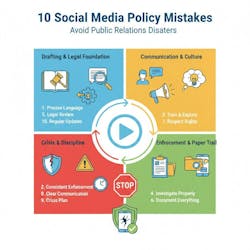
In many instances, the problem was not the absence of a social media policy but rather how poorly such policies were written, communicated, understood and enforced. The following checklist outlines 10 common social media policy mistakes and explains how all organizations, including physical security companies, can avoid them.
1. Perils of Using Vague Language
Employers cannot reasonably expect employees to determine what language is acceptable on social media when policies rely on vague or undefined terms. Many policies prohibit “disparaging comments,” “false or misleading statements,” or content that may “harm the company’s reputation,” yet fail to explain what those phrases mean in practice or in context.
Vague language creates ambiguity and invites inconsistent interpretation. An employee may believe a post is acceptable while a manager or member of the public could view it as a violation. When that happens, employees may face termination or discipline based on standards they did not clearly understand or anticipate, while employers may be forced to manage an avoidable public relations crisis.
The problem is compounded by the widespread use of vague and undefined legal and ethical terms. Phrases such as “bringing the company into disrepute,” “harassing behavior,” “offensive material,” and “confidential information” appear in most policies but are rarely explained. Without clear definitions and examples, employees are left to guess where boundaries lie.
2. Inconsistent Policy Enforcement Brings Confusion
Once social media policies are approved, they must be enforced consistently and without favoritism. Treating similar violations differently creates perceptions of unfairness and undermines trust in management. It can also damage morale and expose companies to legal risk, including claims of disparate treatment.
Inconsistent enforcement also includes overreacting to certain posts. Not every violation warrants termination. Some infractions may justify suspension, counseling or a formal warning, particularly when intent is unclear or mitigating circumstances exist. Immediate termination, especially in ambiguous cases or for first-time offenses, increases the likelihood of unfair-dismissal claims and public backlash.
These disputes can quickly move into the public domain, particularly when employees pursue legal action. Media coverage of inconsistent or heavy-handed enforcement can further harm a company’s reputation and raise questions about leadership judgment.
3. Poor Policy Understanding Kills the Message
A social media policy is ineffective if employees do not fully understand it. That understanding does not come from emailing a document or posting it on an intranet. It comes from structured training and ongoing engagement.
Companies must invest time in explaining how policies apply in real-world situations. Employees want clarity, context and the opportunity to ask questions. Workshops, scenario-based discussions and guided explanations reduce misunderstandings and eliminate the common defense that guidelines were unclear.
Training should not be a one-time exercise. Employees should receive annual refresher sessions, and additional training should follow any substantive policy update. Even when changes are in the minority, employees should be formally notified of any revisions. New employees should not begin work until they complete a comprehensive social media policy training session.
4. Not Managing Violations Properly Muddies the Waters
Effective enforcement requires a clear and documented process for identifying, reporting, investigating and resolving alleged violations. Companies should designate qualified investigators before policies are rolled out and ensure those individuals are trained to conduct objective reviews.
In many cases, involving external legal counsel during investigations is prudent, particularly when termination is a possible outcome. Legal oversight helps ensure that decisions are defensible and consistent with labor law requirements.
An accessible appeal process is also essential. Employees must be able to respond to allegations, present evidence and appeal decisions. Processes perceived as opaque or one-sided are more likely to result in legal challenges and reputational harm.
5. Not Obtaining Legal Review Leads to Litigation
Drafting a social media policy without independent legal review is risky. Policies must account for labor law, state law, privacy considerations, and sector-specific regulations, particularly in highly regulated industries such as health care, finance, government, and education.
Additional complexity arises in sectors involving physical security, defense and law enforcement, where confidentiality and operational security are critical. The National Labor Relations Act, along with First Amendment precedents, must also be considered.
Legal advisors involved in policy development should have expertise in labor law. Ongoing legal guidance during enforcement further reduces exposure to costly errors and litigation.
6. Poor Violation Documentation Weakens Policy
Comprehensive documentation is a cornerstone of effective policy enforcement. Failure to maintain detailed records weakens a company’s position if an employee challenges disciplinary action through legal or mediation channels.
Employees are likely to document their own version of events. If their records are more complete than the employer’s, the company is at a disadvantage.
Documentation should include what was communicated, on which platform, by whom and when; how the post was discovered and by whom; how the violation was addressed; and what warnings were issued. Screenshots, engagement metrics, and post analytics, such as likes, shares, and reach, should be retained.
All discussions, reports, decisions and communications should be logged with dates and times.
7. Not Respecting Employee Rights Pollutes Culture
Employees accused of violating social media policies must be given a fair opportunity to respond, present facts and correct the record. They must also have access to an appeal process.
Failure to observe procedural fairness can result in claims of unfair dismissal, violations of legal rights or disciplinary decisions being overturned on technical grounds. These outcomes can compound reputational damage and increase legal costs.
Every interaction with the employee and every response received should be carefully documented.
8. Poor Stakeholder Communication is Damaging
When a potentially damaging post is discovered, stakeholder communication is essential. This is not the moment for speculation, blame-shifting or vague statements designed to deflect responsibility.
Companies should communicate consistently with internal and external stakeholders using factual, measured language. Messaging should avoid naming the employee and should state that the matter is being addressed through established processes.
Once a decision has been reached, the outcome should be communicated appropriately. Companies are often judged more on how they manage a crisis than on the crisis itself.
9. Absence of a Social Media Crisis Plan is Risky
Social media crises remain a persistent reputational risk, yet many organizations remain unprepared. Every company should maintain a social media crisis communications plan as part of its broader crisis strategy.
Such plans should identify crisis team members, define roles and responsibilities, outline engagement strategies, specify when to involve external advisors and include preapproved holding statements. A clear plan provides structure and discipline during periods of intense pressure.
Not including a social media crisis plan in a crisis communications plan will likely lead a company to respond reactively and waste valuable time, potentially causing reputational damage.
10. Failure to Review Policies Regularly Dooms Repeating Past History
Social media policies require regular review. Legal developments, emerging platforms, changes in company culture and evolving risk profiles may necessitate updates.
Organizations should also learn from others' crises. External events often highlight vulnerabilities that internal reviews overlook.
Having a social media policy does not, by itself, protect a company or its stakeholders. Policies must be carefully drafted, clearly communicated, consistently enforced and routinely reviewed and updated.
When done correctly, security companies can significantly reduce the likelihood of policy violations, limit reputational and legal exposure, and create an environment in which employees can engage responsibly on social platforms. Treating social media policies as a checkbox is a risky practice. It is, in fact, a solid risk-mitigation tactic to guide employees and partners to do the right thing on any social platform. This significantly helps protect a company’s reputation.
About the Author
 Evan Bloom
 Evan Bloom
CEO of Fortress Strategic Communications
Evan Bloom is the CEO of Fortress Strategic Communications, a public relations consultancy focusing on physical security, law enforcement, homeland security, public safety, and enterprise risk management. He is an expert at advising companies that cannot mention the names of their clients in the media and devising PR campaigns linked to breaking news and market issues. Contact Evan at [email protected]