“Waymo” Than We Bargained For?
“You're traveling through another dimension — a dimension not only of sight and sound but of mind. A journey into a wondrous land whose boundaries are those of imagination.
Your next stop… The Twilight Zone.”
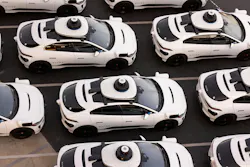
Except in this case, there never was a stop. Simply a never-ending cul-de-sac parade of wayward Waymo self-driving vehicles circling the residents of Battleview Drive in this northwest Atlanta neighborhood like Lakota Sioux and Northern Cheyenne warriors snaring General George Custer. Now you had to wonder if these neighbors might have thought these confused self-driving cars would become sentient, turn against humanity, and recreate scenes from The Terminator. I mean, it is not every day that suburban soccer moms and baseball dads are surrounded by 30 driverless cars rotating from cul-de-sac to cul-de-sac for almost four hours before the cavalry arrived.
“It’s almost every little cul-de-sac in our area, so I think it’s a problem,” one neighbor, on Battleview Drive, told the local television station. “I think yesterday morning, we had 50 cars that came through between 6 and 7.”
Residents on Battleview Drive first noticed the autonomous vehicles two months ago. Then, a few weeks ago, something changed. The cars began appearing in groups, circling the neighborhood over and over again, as if summoned by some unseen force from a dimension not only of sight and sound, but of questionable navigation software.
One resident described a scene that sounded less like the future of transportation and more like a robotic remake of Lord of the Flies.
The vehicles weren't carrying passengers, making deliveries, or accomplishing much of anything, apparently. Instead, they spent their time circling, hesitating, and second-guessing themselves like a convoy of teenage drivers who had just missed the entrance to the DMV.
“At one point, we had eight Waymos stuck in the neighborhood trying to figure out how to turn around,” the neighbor said.
The vehicles weren't carrying passengers, making deliveries, or accomplishing much of anything, apparently. Instead, they spent their time circling, hesitating, and second-guessing themselves like a convoy of teenage drivers who had just missed the entrance to the DMV.
For local families, the spectacle was more than just annoying. Residents say the empty robotaxis have turned quiet streets into an autonomous vehicle support group.
“We've got families, pets, kids waiting for the school bus,” one neighbor said. “It's hard to feel comfortable when a fleet of driverless cars is endlessly wandering the neighborhood like they're searching for the meaning of life.”
Waymo did respond to the concerned neighborhood HOA with the following statement: “At Waymo, we are committed to being good neighbors. We take community feedback seriously and have already addressed this routing behavior. With over 500,000 weekly trips across the country, our service is proven to significantly reduce traffic injuries and improve road safety. We value our relationship with Atlanta residents and remain focused on providing a seamless, respectful, and safe experience for riders and residents alike.”
But are they? There were 1,429 Waymo accidents reported to the NHTSA between July 2021 and November 2025. These incidents involved, but were not necessarily caused by, a Waymo vehicle. Here in Atlanta this past May, the Waymo autopilot exhibited the same intelligence as a drunken NASCAR fan who figured that a city parkway flooded by five inches of rain in less than a half hour was a manhood (or robo) challenge and not a disaster in the making. Plunging headlong into more than four feet of floodwater, the Waymo stalled, leaving a passenger stranded in a locked car as the water rose. The good news was that smarter humans prevailed and rescued that shaken robo fare.
Over the last several months, autonomous taxi leader Waymo has managed to transform portions of San Francisco, Phoenix, Austin, and Los Angeles into a rolling beta test where the cars occasionally behave like tourists who missed the last page of the driver’s manual.
One minute they’re calmly transporting passengers to dinner reservations; the next, they’re honking at each other in parking lots at 2 a.m. like a fleet of socially awkward Roombas having a territorial dispute. Federal regulators have investigated incidents involving low-speed collisions with gates and chains, while software recalls have addressed issues ranging from barrier-detection problems to school bus stop violations.
Critics see evidence that the robotaxi revolution has arrived half-baked; supporters counter that human drivers still text, road-rage, and drive directly into lakes with astonishing frequency. Either way, the self-driving future has officially arrived, and so far it appears to have inherited all the strengths, weaknesses, confusion, indecision, and occasional public meltdowns of the species that created it.
My grandfather drove a Checker cab in NYC for 40 years, and I’m proud to report he was never confounded by a cul-de-sac nor tested a flooded Roosevelt Parkway.
About the Author
 Steve Lasky
Steve Lasky
Editorial Director, Editor-in-Chief/Security Technology Executive
Steve Lasky is Editorial Director of the Endeavor Business Media Security Group, which includes SecurityInfoWatch.com, as well as Security Business, Security Technology Executive, and Locksmith Ledger magazines. He is also the host of the SecurityDNA podcast series. Reach him at [email protected].