Battery Visibility in Security Systems: Site Checks to Central Monitoring
Key Highlights
- LiTime offers battery-monitoring approaches for different security maintenance needs.
- The Smart Shunt enables convenient on-site battery-status checks via Bluetooth.
- CAN and RS485 communication enables battery-data integration with compatible management systems.
- Centralized monitoring helps identify abnormal battery conditions across multiple security sites.
- Better battery visibility supports informed maintenance decisions and efficient resource allocation.


LiTime provides Smart Shunt monitoring for on-site battery checks and communication-enabled batteries for centralized monitoring across distributed security installations.
In security systems, equipment can appear to be operating normally while the condition of its backup battery remains unclear. As security deployments expand from individual sites to distributed, unattended locations, maintenance teams need different ways to access battery information—from quick on-site checks during routine visits to centralized monitoring across multiple sites. Security battery solutions equipped with monitoring tools and communication capabilities can help technicians identify potential issues earlier and plan maintenance more effectively.
Why Battery Visibility Matters
In security systems without battery-monitoring capabilities, maintenance teams may have limited visibility into remaining battery capacity, charging and discharging behavior, temperature conditions, and battery-management-system (BMS) events. The normal operation of a camera, access-control panel, alarm system, or mobile surveillance unit does not necessarily confirm that its backup battery is healthy.
Access to data such as state of charge (SOC), voltage, current, temperature, and BMS status can help technicians assess battery condition and determine whether further inspection, maintenance, or replacement is needed. Battery monitoring should complement—not replace—physical inspections and electrical safety procedures.
On-Site Checks for Standalone Systems
In standalone security applications, such as access control, alarm systems, and small surveillance installations, technicians often conduct scheduled on-site inspections to assess backup-battery condition. Traditional checks may involve opening equipment enclosures or battery compartments and using instruments such as multimeters or clamp meters to measure electrical parameters.
A Bluetooth-enabled battery shunt monitor offers another option. When installed with a compatible battery, the LiTime Smart Shunt can measure electrical parameters and provide battery-status information. For example, it can be paired with a 12V 50Ah LiFePO₄ battery to collect operating data such as voltage and SOC. Technicians can review charging and discharging conditions through a mobile app while on site and determine whether further testing or maintenance is necessary.
For existing security installations that use batteries without built-in communication capabilities, adding a shunt monitor—where electrically compatible and properly installed—can enable local battery-status checks without replacing the battery solely to obtain status information. The LiTime Smart Shunt supports 8–120 V DC input, 0.05–500 A current measurement, and 0.01–6500 Ah capacity measurement.
Centralized Monitoring for Distributed Sites
For security equipment deployed across roads, campuses, perimeters, parking facilities, and other distributed locations, inspecting every site individually becomes increasingly demanding as the number of installations grows. Batteries equipped with CAN or RS485 communication interfaces can exchange operating data with compatible external systems, passing information such as voltage, current, temperature, SOC, and BMS status to site controllers, edge gateways, network video recorders, building-management systems, or a customer’s existing monitoring platform.
For example, the LiTime LiHeat™ 12V 320Ah ComFlex LiFePO₄ Battery features a Smart T5.0 BMS and CAN and RS485 communication interfaces, supporting data exchange with compatible external equipment. When integrated with compatible communication hardware and management platforms, these capabilities can support centralized battery monitoring across multiple security installations.
CAN and RS485 interfaces provide a means of exchanging data; they do not by themselves constitute a complete remote-monitoring system. A practical deployment may also require compatible gateways or controllers, protocol integration, alarm rules, and appropriate security measures such as network segmentation, access control, and monitoring for communication loss. With these elements in place, maintenance teams can use battery-status information to identify abnormalities, prioritize inspections, and dispatch technicians where on-site intervention is most needed.
Application Example: Mobile Security Systems
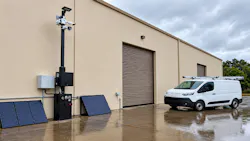
In a U.S.-based mobile security monitoring project, LiTime worked with a customer transitioning from Interstate AGM lead-acid batteries to LiFePO₄ batteries with CAN/RS485 communication and battery-status monitoring capabilities.
The customer has installed multiple LiTime 24V 230Ah Communication Self-Heating LiFePO₄ Batteries across its mobile surveillance equipment. The batteries support the project’s power requirements while providing communication capabilities for integration with compatible monitoring systems, helping maintenance teams access battery-status information and plan service visits more effectively.
For security operators, the right monitoring approach depends on site scale, existing infrastructure, and maintenance priorities—and can help teams identify sites needing attention, prioritize technician dispatch, and reduce backup-power risks during critical security events.