Body-Worn Cameras Drive a New Era of Trust and Transparency in Transit
Key Highlights
- BWCs offer a first-person perspective that captures incidents across dynamic transit environments, providing critical context for investigations and accountability.
- Studies show a significant reduction in assaults on transit workers when BWCs are implemented, boosting morale and rider confidence.
- Recorded footage supports investigations, legal proceedings, and operational audits, enhancing transparency and efficiency.
- LTE-enabled BWCs facilitate real-time streaming and AI analytics, enabling proactive responses and continuous safety improvements.

Statistically, you may be safer taking a bus, train, or plane than driving your car, but public perception can strongly influence attitudes and behaviors. In recent years, frequent reports of passenger and operator harassment, theft, assault, fare evasion, and equipment malfunction have eroded trust in our mass transit systems. At the 2025 American Public Transportation Association conference, the Federal Transit Administrator delivered a blunt message about waning public confidence, urging transit leaders to “figure it out” because, if people don’t feel safe, they won’t ride.
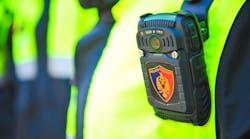
To turn the tide, technology promises to play a central role – with body-worn cameras (BWCs) leading the charge. The proven value of BWCs extends far beyond deterring misconduct. This mobile technology provides a first-person record of events, supports investigations, enforces compliance, and delivers visible assurance that passenger and employee safety are management’s top priorities throughout the entire journey.
Why Body Cams?
Unlike fixed cameras, which provide wide-area coverage, body-worn devices offer a first-person perspective that follows the employee wherever they go. A camera-wearing transit police officer breaking up and capturing all on a subway platform, a bus driver addressing an unruly passenger, a light rail conductor confronting a fare evader, or an airline ground worker moving baggage on the tarmac can all capture events that fixed systems would miss.
Mobility is key. When an incident shifts from inside a bus to the curb, when a fare dispute escalates from the platform onto a moving train, or when a mechanic crawls into a confined aircraft compartment, these cameras follow the action. Video from bodycams also provides investigators with critical context such as subjects’ tone of voice, proximity, and the sequence of events. BWC technology ensures that what happened isn’t lost because it occurred outside the field of view of a static, mounted surveillance camera. Such capabilities make body-worn technology uniquely valuable in the porous, high-traffic environments that define transportation, where safety and accountability depend on seeing incidents from the vantage point of the people directly involved.
Beyond capturing incidents, body-worn video can be reviewed to assess how frontline staff de-escalate conflicts, document compliance with safety protocols during track or aircraft maintenance, or provide real-world training scenarios for new employees. In operations and maintenance, recordings can verify that critical procedures are followed, creating both accountability and a living archive of best practices. For agencies under constant pressure to do more with less, this dual role, strengthening security while driving operational insight, makes BWCs an ideal solution.
Protecting Passengers and Personnel
Frontline employees are the lifeblood of any transit system. Unfortunately, they are also frequent targets for harassment and assault.
In the U.S., the Federal Transit Administration has reported a steady increase in assaults on operators, with incidents ranging from verbal abuse to physical violence. Some cases have even led to fatalities.
In today’s always-connected world, public awareness of even minor incidents rarely stays confined to the vehicles or stations where they occur. Passengers capture them on their phones and share them across social media, amplifying their visibility and fueling the perception that transit systems are unsafe. Dangerous conditions, real or perceived, impact employee morale, absenteeism, and rider confidence. When operators don’t feel safe, service quality suffers. When passengers witness disorder, they’re less likely to come back.
BWCs have proven to deliver immediate impact. Studies from the U.K.’s Rail Delivery Group and the University of Cambridge demonstrated a 47% reduction in assaults on railway workers once cameras were introduced. The same research reports that attorneys found BWC video valuable evidence in more than 60% of prosecutions, underscoring its value in securing convictions. By signaling accountability through visibility, these devices discourage bad behavior before it escalates and provide an objective record when disputes arise.
Consider the bus operator confronted by an irate passenger refusing to pay the fare, or the train conductor dealing with an intoxicated rider. A blinking red “recording” light on their chest can dramatically alter the behavior of everyone involved. For many frontline workers, having that added layer of protection can make the difference between feeling vulnerable and feeling supported.
Supporting Investigations and Incident Response
While the most visible benefit of body-worn technology is deterrence, its value is also realized after incidents occur. In practice, most footage is not monitored in real time but recorded and used to reconstruct events, validate reports, and determine next steps. First-person video evidence accelerates investigations and lends credibility to decisions that might otherwise hinge on conflicting accounts.
For transit agencies, such objectivity is crucial. A passenger’s cellphone clip might capture only part of an incident, sometimes out of context, while body-worn footage provides the complete sequence from the staff member’s perspective. This makes it far more reliable for disciplinary decisions, insurance claims, or legal proceedings.
Plus, with LTE-enabled connectivity, the fastest-growing segment of the BWC market, agencies are beginning to explore how streaming from the field to a command center can improve situational awareness. Seeing events in real time through staff's eyes enables supervisors to allocate resources more quickly and coordinate responses more effectively. While post-event applications remain the primary use today, the steady growth of connected devices points to a future where body-worn technology supports both forensic investigations and live security decision-making. In fact, some manufacturers already include LTE streaming as a standard feature in their BWC lines.
Operational Efficiency and Compliance
Security may be the most obvious driver for body-worn technology, but it’s not the only one. Transit systems are also discovering that cameras can streamline operations and strengthen compliance, directly impacting the bottom line.
In aviation, for example, mechanics must follow strict maintenance procedures on everything from the aircraft’s frame to its engines. In many cases, inspectors are required to be physically present to verify work, creating bottlenecks and adding cost. With LTE-equipped BWCs, mechanics can now live-stream a view of their work, reducing the need for on-site supervisory staff. The same approach applies to rail operators maintaining track switches and other “safety-critical” infrastructure. Plus, recorded video evidence becomes a verifiable record for auditors, documenting that procedures were completed correctly and safely while eliminating the need for time-consuming paperwork.
Beyond a tool for procedural compliance, BWC video can create a valuable training library. Recordings of routine tasks or unusual field conditions can be repurposed into onboarding modules for new employees or refresher courses for seasoned staff. Instead of relying on written manuals, agencies can show employees what “good” looks like in practice. For teaching procedural and conceptual tasks, research consistently finds that well-designed video improves learning comprehension and retention compared to text-based instruction. In the safety-critical transportation industry, the benefits of a better-trained and more competent workforce are invaluable.
For today’s decision-makers who are facing rising costs, labor shortages, and pressure to do more with less, body-worn cameras deliver clear, quantifiable ROI.
Growing Acceptance and Expanding Use
When body-worn cameras first appeared in law enforcement, many agencies resisted their adoption. Officers viewed them as tools to monitor rather than protect, and were concerned about privacy, disciplinary implications, and the policies governing who would have access to the video. Over time, that perception has flipped. Today, most departments won’t send officers into the field without an operational camera. The technology has proven its worth as a safeguard for employees as well as passengers.
That growing trust is helping to expand adoption beyond law enforcement and transit police. Workers understand that footage can clear them of a false complaint or verify how they handled a situation. And, from the public’s perspective, BWCs have become symbols of accountability and professionalism rather than an expansion of “big brother” surveillance tactics. When people know the technology is there to protect everyone equally, it changes the tone of every interaction.
Best Practices for Deployment and Integration
When an organization decides to implement BWCs as part of its security program, the first step is to define policies and procedures that govern the technology’s use. When and how will the cameras be deployed? How will data be stored? Who will have access to the video? What are the retention policies? How will privacy be provided to uninvolved individuals captured on video? All of this, and more, must be determined before a single unit hits the field.
Foundational polices extend to training. Operators, supervisors, and investigators need to understand the technology's purpose and limitations. Consistent training ensures that video is captured correctly, handled securely, and used appropriately.
Best practices for physical deployment emphasize integration with existing systems – including security and operational platforms. The goal is to make body-worn video a seamless extension of the agency’s overall technology ecosystem rather than a standalone silo. And, as with any security or operational platform, data must be encrypted end-to-end.
Transit agencies typically lead this process internally, with manufacturers and systems integrators supporting technical compatibility and regulatory compliance. The most effective deployments result from strong partnerships between all stakeholders. Technology alone is not enough; real success comes from how well it is implemented, managed, and trusted.
 According to a new study, which examined eight police forces in both the U.K. and U.S., assaults against officers were 15 percent higher when body cameras were worn.
Looking Forward
Just as AI analytics applied to standard surveillance video help security teams proactively identify risks and help operations teams refine workflows and allocate resources, the same potential exists for body-worn video – especially as LTE-enabled cameras become the norm. With always-on connectivity, footage no longer needs to wait for review. Instead, it can be analyzed in real time, feeding operational dashboards, safety alerts, or workflow assessments while an event is still unfolding.
Always-on connectivity doesn’t mean every camera will stream constantly—bandwidth, storage, battery limitations, and oversight demand still apply. The real advantage of LTE is flexibility: the ability to activate live viewing or data transmission when conditions warrant it, ensuring critical video is seen quickly without overwhelming systems or staff. AI will enable those cameras to be activated more rapidly than an officer could – sensing danger they haven’t yet perceived and ensuring essential events are captured in real time.
We’re moving toward a future where BWCs will help predict, not just record, events – where their video becomes an intelligent layer of situational and operational awareness that helps transportation agencies learn, adapt, and continuously improve safety and efficiency. As they refine these capabilities, their experience will serve as a blueprint for others. Sectors like logistics, utilities, and manufacturing face the same challenges: protecting people while keeping complex systems running smoothly. What’s proven effective today in public transit will inform us how a broad spectrum of industries leverages body-worn cameras to create safe, more accountable workplaces.
About the Author
 Anthony Incorvati
Anthony Incorvati
Anthony Incorvati leads the Transportation market segments for Axis Communications in the Americas, overseeing business strategy, opportunity development, technology planning, marketing input, and ecosystem and end-user engagement & development. His focus spans Aviation, Rail, Maritime, Public Transport, ITS/Traffic, and Cargo & Logistics. Since joining Axis in 2010, Anthony has brought over 20 years of transportation industry experience, including leadership roles at NAVAIR (U.S. Department of the Navy), SAE International, Marconi Communications/Ericsson, and Bombardier Transportation.
He represents Axis on key industry committees within APTA, AAPA, ACI-NA, and ACC, and chairs the SIA Transportation Working Group. Anthony holds a B.S. in Industrial Engineering from The Pennsylvania State University.