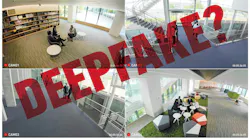
The Push to Make Surveillance Video Verifiable
Key Highlights
- Starting Jan. 1, 2028, California will require new video cameras sold in the state to embed provenance data by default.
- ONVIF’s Media Signing Add-on lets cameras cryptographically sign video at the moment it’s recorded. The standard is expected to be finalized at the end of 2026.
- Courts, insurers, and investigators will drive adoption, and they’ll increasingly expect footage to be signed.
This article originally appeared in the November 2026 issue of Security Business magazine. Don’t forget to mention Security Business magazine on LinkedIn or our other social handles if you share it.
Beginning January 1, 2028, California’s AI Transparency Act – expanded through AB 853, signed into law in October 2025 – will require new video capture devices sold in California to embed provenance data by default: a machine-readable record identifying the device manufacturer, the device itself, and the time and date the content was created.
The law is primarily aimed at helping consumers distinguish authentic footage from AI-generated content, but its implications for the security industry are significant, and they point toward an inevitable next question: If a camera can prove where footage came from, how long before courts, insurers and investigators start demanding proof that it has not been altered since?
The industry was already working on that answer. Now it has a deadline.
From Trusted to Verified
For decades, surveillance video has occupied a privileged position in security investigations. A camera captures an event; a video management system records it; investigators review the footage and, when necessary, present it to executives, insurers, attorneys, juries, or judges. The underlying assumption has been relatively simple: if the video came from a trusted security system and its chain of custody can be established, the images can be trusted.
Artificial intelligence is challenging that assumption. Generative AI and video-manipulation tools have made it possible to alter footage in ways that can be difficult – sometimes impossible – for a viewer to recognize. Changing a timestamp, removing frames, or substituting one person’s face for another can now be done with widely available tools. How can we prove that video is authentic?
That question is driving one of the more consequential developments in surveillance technology: the movement toward cryptographically signed video and a potential industry-wide framework for establishing the provenance and integrity of digital evidence.

In August, ONVIF announced the Release Candidate of its Media Signing Add-on, an open, standardized method for establishing the authenticity and integrity of surveillance video. The specification defines how conformant cameras and video encoders can cryptographically sign encoded H.264 and H.265 video at the point of creation, linking the footage to its source and allowing a compatible verification tool to determine whether the signed video has remained unaltered. ONVIF expects to finalize the specification at the end of 2026 and has made its signing and verification framework available as open-source code.
“It has gotten extremely easy to change a timestamp, take out a few frames or put one person’s face on someone else using free apps,” explains Leo Levitt, Chairman of the ONVIF Board of Directors. “Some of these edits are very difficult to see with the human eye.”
That creates a problem extending well beyond the security department. Law enforcement, insurers, corporate investigators and courts increasingly depend on footage generated by systems from many different manufacturers. If a defense attorney can ask how anyone knows a piece of video was not altered, Levitt says, the question can cast doubt on authentic footage as well as manipulated footage. “That’s why we think the answer must be standards-based,” he says.
Trust Begins at the Camera
A fundamental question of video authentication is when proof of authenticity is established. Levitt argues that the earliest practical point is the moment the camera creates the video. “As it gets recorded, exported, and handed to an investigator, the chances of something changing along the way keep adding up,” he says.

That concept is also central to Axis Communications’ approach to signed video. Fredrik Nilsson, VP Americas for Axis, says signing at capture establishes a chain of trust from the moment the video is created. “Historically, cryptographic signing was applied later in the video workflow, such as within a video management system,” Nilsson says. “While this can provide assurance, it cannot address what may have happened to the video before it was signed.”
Axis has been working on camera-level video authentication for years and published an open-source framework for signed video in 2021. Its implementation uses device-specific cryptographic keys to link video to the camera that generated it, making subsequent tampering detectable after the footage leaves the camera.
The company’s Edge Vault architecture provides hardware-based protection for device identities and cryptographic keys, and Axis offers a browser-based signed media verifier that allows video files to be checked without relying on the camera owner or a proprietary investigation workflow.
Nilsson sees camera-level capability becoming increasingly important as video moves beyond traditional surveillance. “When video is used to train or validate AI models, confidence that the source data is authentic and unaltered helps organizations maintain integrity and traceability,” he explains.
The security industry therefore faces a two-part challenge: protecting video from manipulation and establishing confidence in the information used to analyze it.
What Does a Signature Actually Prove?
The terminology around video authentication matters, because cryptographic signing does not prove everything about an event. The ONVIF Media Signing Add-on can establish that video was signed by a particular device and that the signed frames have not been altered since signing. It cannot establish whether the scene itself was staged, whether someone physically obstructed or repositioned the camera, or whether the narrative surrounding the video is accurate.
“It doesn’t mean unsigned video is automatically fake,” Levitt says. “But it adds a powerful layer of data integrity to the chain-of-custody process that we didn’t have before.”
The goal is not to make a camera an all-knowing witness. It is to make the digital file capable of answering a narrower, and critical, question: Has the content changed since it was signed?
The Interoperability Problem
ONVIF’s initiative matters for another reason. Security video rarely remains inside the camera that produced it. It moves into VMS platforms, recording systems, cloud services, evidence-management platforms, forensic tools, and investigative applications. It may be exported, copied, or shared with law enforcement or provided to an insurance company or attorney.
In a fragmented industry, every vendor could theoretically develop its own authentication mechanism – recreating the same interoperability problem that ONVIF has spent years addressing in network video. “Investigators, courts, and insurers deal with footage from many different manufacturers,” Levitt says. “If only one vendor’s software can read a signature, it helps that vendor’s customers. A standards-based signature helps regardless of which camera recorded the footage.”
The ONVIF approach is designed to allow signed information to travel with the video. A compatible player or verification tool can then validate the signature and determine whether the video remains intact. Nilsson points to a practical limitation that becomes critical here: the information required to establish authenticity must survive the workflow.
“Signed video can be recorded, stored, copied, transported, packaged and exported without losing its verifiability, as long as the signed video remains unchanged,” Nilsson says.
A segment can also be extracted from a larger recording without destroying the ability to verify it, but altering or re-encoding the signed video, or stripping the metadata needed for verification, can break the verification chain.
From Vendor Feature to Industry Standard
The standards question is particularly interesting because Axis has already implemented camera-level signed video, while ONVIF is working to create a common framework that can extend the concept across manufacturers – enabling the capability to be specified independently of the camera brand.

“I think with ONVIF creating a standard, the industry’s validating a problem that they’re trying to solve,” Crawforth says. “Everyone is trying to use AI as a tool to enhance their solution offerings, but almost no one is creating technologies to defend against AI.”
His argument goes beyond whether a camera can cryptographically sign its own output. He believes the mechanism used to establish authenticity should be completely independent of the asset being authenticated. “SWEAR is the next extension of ONVIF,” Crawforth says. “We create an independent chain of custody instead of having the asset rely on itself.”
SWEAR’s Digital DNA approach establishes a cryptographic fingerprint for recorded media and anchors that proof to a tamper-evident, immutable ledger. The company’s premise is that the proof can be used later without storing the original media.
The distinction is architectural: ONVIF is establishing a standardized method for determining whether signed video originated from a particular device and has remained unaltered. SWEAR is arguing for an additional, independently established record against which the media can later be checked. The two concepts do not necessarily compete – one establishes a standardized mechanism at the source, the other an independent record of that source event.
The larger question is whether the industry ultimately decides that one layer of trust is sufficient for the highest-value evidence, or whether multiple layers become standard practice.
Nilsson also sees these developments as complementary. “The focus now is on making [video authentication] work more broadly across the industry.”
Detection vs. Authentication
The debate also raises a separate question: Should the industry focus on detecting fake video, or on proving video is authentic? Crawforth is skeptical of a detection-based approach, explaining that a detection system inherently responds to the techniques used to create manipulation; thus, as those techniques evolve, detection must evolve with them, with no guarantee of keeping pace.
Cryptographic signing takes a fundamentally different approach by determining whether the cryptographic evidence associated with the video remains valid. “Media signing doesn’t rely on AI to decide what’s real,” Levitt says. “Technology uses a cryptographic signature, and the signature is either verified or not.”
He compares signed video to a birth certificate. Not every clip will require one, but for footage that could become evidence in court or support a high-value insurance claim, the expectation is shifting. “I expect people will start looking for a signature,” Levitt says, “and they’ll ask harder questions when there isn’t one.”
That shift will not happen overnight. The number of installed cameras and recording systems that were never designed to cryptographically sign video is enormous. Signed and unsigned footage will coexist for years.
Nilsson also points to the practical challenges of protecting signing keys, maintaining device identity and preserving the information needed to verify a signature throughout the video lifecycle. “Ultimately, the standard’s effectiveness will depend on broad industry adoption and whether trust can be maintained as video moves across different platforms and workflows,” he says.
A standard can establish a common technical framework, but it cannot force manufacturers to adopt it, guarantee that every downstream system will preserve the required metadata or eliminate every vulnerability surrounding the devices and workflows that produce and transport digital evidence.
Adoption will be ultimately driven by end-user demand, and those stakeholders are not likely to be security professionals; instead, they will be investigators, prosecutors, defense attorneys, judges, insurers, auditors, general counsel. What will matter is authenticity – not which camera manufacturer produced the footage or which VMS stored it.
When will that demand take shape? As AI continues to improve, it is clear that video manufacturers and software providers think it is on the horizon. California has already drawn a starting line: January 1, 2028.
About the Author
 Steve Lasky
Editorial Director, Editor-in-Chief/Security Technology Executive
Steve Lasky is Editorial Director of the Endeavor Business Media Security Group, which includes SecurityInfoWatch.com, as well as Security Business, Security Technology Executive, and Locksmith Ledger magazines. He is also the host of the SecurityDNA podcast series. Reach him at [email protected].