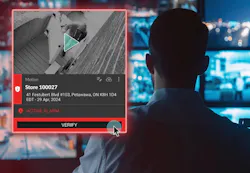
Solink showcases its enhanced VerifEye AI-assisted command center at ISC West 2026, highlighting real-time security and operational insights.
Solink has announced major advancements to its VerifEye AI-assisted command center, a platform designed to modernize global security operations centers by consolidating critical security and operational data into a single interface.
Integrated within the broader Solink platform, VerifEye enables teams to manage intrusion detection, access control events, risky transactions, and multi-site incident response from one centralized view. The system is built to help operators focus on real threats rather than sorting through excessive alerts.
The updated platform leverages vision language models and unified data from multiple systems to reduce noise and streamline decision-making. By filtering and prioritizing alerts, VerifEye is intended to limit operator fatigue and support faster, more consistent responses across an organization’s footprint.
Solink Co-founder and CEO Mike Matta said many current GSOCs are overwhelmed by the need for human operators to monitor all incoming data simultaneously. He said VerifEye is designed to reduce data overload, lower costs, and improve workplace safety by ensuring teams remain focused and prepared to respond when genuine incidents occur.
The company is also positioning VerifEye as a solution to the widespread issue of false alarms, noting that more than 90% of traditional motion alerts are considered non-actionable. This contributes to significant resource waste, with U.S. organizations spending an estimated $3.3 billion annually on manual alert triage.
VerifEye addresses this challenge through an intelligent filtering system and a user interface tailored for GSOCs and SOCs. The platform uses a human-in-the-loop approach, where AI identifies and prioritizes high-risk events such as unauthorized access or suspicious transactions, placing them into a review queue for human operators to make final decisions.
The system is designed to support staff rather than replace them, particularly as alert fatigue continues to be a major issue in the industry. According to the company, 76% of security leaders cite alert fatigue as their top challenge. VerifEye aims to alleviate this by pre-filtering false positives, reducing response times to as little as three minutes for video-enabled incidents, and consolidating workflows into a single dashboard.
Beyond traditional security monitoring, VerifEye also serves as a broader business intelligence tool. The platform logs all operator actions in an audit trail to support legal compliance and insurance requirements. It also centralizes functions such as access control, loss prevention, and operational monitoring, helping organizations identify service disruptions and anomalies that may impact performance.
Solink said VerifEye can be deployed without the need for new hardware or complex installations, allowing businesses to integrate the system into existing infrastructure within minutes.
The enhanced VerifEye platform will be demonstrated at ISC West 2026 at booth #22053.