Public Comfort With Video Surveillance Grows, But Privacy Expectations Remain High
Key Highlights
- 58% of U.S. adults are more comfortable with video surveillance now than five years ago, reflecting increased familiarity and perceived safety benefits.
- Public comfort varies by location, with transit hubs and retail centers being most acceptable, while workplaces show comparatively lower acceptance levels.
- Transparency, clear signage, and strong data privacy protections significantly increase public comfort with surveillance systems.
- AI applications focused on threat detection and security are generally well-received, but concerns about accuracy and data misuse remain high among respondents.
- Building trust through responsible use, transparent policies, and safeguarding privacy is essential for the future acceptance of surveillance technologies.
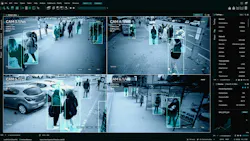
Public attitudes toward video surveillance appear to be shifting, with a growing majority of Americans expressing greater comfort with the technology even as they demand stronger safeguards around privacy, transparency and the use of artificial intelligence.
According to new research from Axis Communications, 58% of U.S. adults surveyed said they are more comfortable with video surveillance in public and private spaces than they were five years ago. The findings suggest that as surveillance becomes increasingly integrated into everyday environments—from transportation hubs and retail centers to schools and workplaces—public acceptance is growing.
But the research also makes clear that acceptance comes with conditions.
More than half of respondents said greater transparency and stronger data privacy protections would increase their comfort with surveillance. The findings point to a continuing challenge for security leaders and technology providers: demonstrating that surveillance systems are being deployed not simply because they can collect information, but because they serve a clearly defined security or operational purpose.
“This research shows that while the public is becoming more comfortable with video surveillance, that acceptance cannot be taken for granted,” said Fredrik Nilsson, vice president, Americas, Axis Communications. “The public sees a clear role for video surveillance in creating safer spaces, but they also expect organizations to use the technology responsibly.”
Growing familiarity may be changing perceptions
The Axis survey found that 20% of respondents are significantly more comfortable with video surveillance than they were five years ago, while 23% are somewhat more comfortable and 15% are slightly more comfortable.
Another 31% characterized their views as neutral or said they were unsure, while just 11% reported being less comfortable with video surveillance.
That growing familiarity is reflected in awareness levels. Seventy percent of respondents said they are either extremely or very aware of video surveillance systems in public spaces.
The survey also found that relatively few Americans actively avoid locations because of surveillance concerns. Eighteen percent said they have avoided a location because of video surveillance.
That figure, however, varies significantly by generation. Thirty-two percent of Gen Z respondents said they have chosen not to visit a location because of surveillance, compared with 28% of Millennials, 12% of Gen X respondents and 6% of Baby Boomers.
The generational differences could become increasingly important as younger consumers, employees and students become more accustomed to—and more vocal about—the collection and use of visual data.
Where surveillance feels most acceptable
Public comfort also varies depending on where surveillance is deployed.
Transit hubs ranked among the environments where respondents were most comfortable with video surveillance, with 78% describing themselves as either very or somewhat comfortable with its use. Retail stores and centers followed closely at 77%, while educational campuses registered 73%.
Workplaces produced the lowest level of comfort among the locations examined, although a majority—63%—still said they were very or somewhat comfortable with surveillance there.
The results suggest that context matters. People may be more accepting of surveillance when they perceive a direct connection between the technology and personal safety, security or the protection of public spaces.
That perception is particularly evident in what respondents said would make them more comfortable with surveillance.
The most frequently cited factor was knowing that cameras were being used solely for safety purposes, identified by 64% of respondents. Clear signage followed at 59%, while 51% cited strong data privacy protections.
For security practitioners, those findings reinforce the importance of communicating the purpose and boundaries of surveillance deployments—not simply installing cameras and assuming the public understands why they are there.
AI raises the stakes
The growing use of AI-powered video analytics introduces another layer of complexity.
Respondents expressed the greatest comfort with AI applications focused on real-time threat detection, including identifying weapons, suspicious objects and potentially threatening behavior. High-stakes law enforcement applications, including comparing facial scans against databases of known criminals, also received relatively high levels of acceptance.
Automated administrative applications, such as using identity verification to streamline airport security, also received broad support.
At the same time, concerns about AI accuracy and the handling of sensitive information remain significant.
Sixty-six percent of respondents said they are concerned about false positives or inaccurate information generated by AI-powered surveillance systems. An identical 66% expressed concern about the potential misuse or mishandling of information.
Those concerns could become increasingly consequential as security organizations move from traditional video recording toward systems capable of continuously analyzing live video, identifying events and prioritizing information for human operators.
The challenge, therefore, may no longer be simply convincing the public that cameras can make environments safer. It may be demonstrating that increasingly autonomous systems can make decisions responsibly, securely and within clearly defined boundaries.
Trust becomes part of the security equation
For security leaders, the findings underscore a fundamental reality of modern video surveillance: technology acceptance is increasingly tied to trust.
Organizations deploying cameras and AI-powered analytics must contend not only with questions about security effectiveness, but also with how information is collected, protected, retained and used.
“This desire for transparent and ethical behavior further underscores the need for security vendors to earn the trust of the public,” Nilsson said.
That responsibility extends beyond technology providers. Security, IT, privacy, legal and business leaders all have a role in defining appropriate use policies, communicating those policies and ensuring that safeguards are built into surveillance programs from the outset.
As video surveillance evolves into an increasingly intelligent sensing and analytics platform, public acceptance may ultimately depend on whether organizations can demonstrate that greater visibility does not come at the expense of privacy and responsible data stewardship.
About the survey
A third-party research provider conducted the Axis Communications 2026 Public Perception of Video Surveillance survey in July 2026. More than 1,000 U.S. adults participated in the survey, which examined consumer attitudes toward video surveillance and AI-enabled technologies, including changes in comfort levels over the previous five years.
About the Author
 Steve Lasky
Steve Lasky
Editorial Director, Editor-in-Chief/Security Technology Executive
Steve Lasky is Editorial Director of the Endeavor Business Media Security Group, which includes SecurityInfoWatch.com, as well as Security Business, Security Technology Executive, and Locksmith Ledger magazines. He is also the host of the SecurityDNA podcast series. Reach him at [email protected].