How Fire Testing Standards Put Structural Steel to the Test
Key Highlights
-
Structural steel can lose significant load-bearing strength under high heat, making properly specified passive fire protection essential.
-
Fire ratings must be supported by standards-based testing that matches the actual steel configuration and regional code requirements.
-
Independent certification and verified test data help reduce compliance risk, project delays and potential life-safety failures.
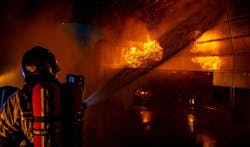
Steel is fundamental to modern commercial and industrial construction because of its strength, adaptability and structural efficiency. Whether used in high-rise residential towers or large-scale manufacturing plants, structural steel supports much of today’s built environment. Protecting that steel from fire exposure requires careful specification and application of passive fire protection (PFP) systems that preserve load-bearing capacity under extreme heat.
Building codes and fire standards continue to evolve to address emerging fire risks, and multiple PFP solutions offer distinct advantages. In this high-stakes field, rigorous and transparent fire testing is essential to ensuring safety and compliance.
Why passive protection matters
Prolonged fire exposure weakens steel. Around 1,100 degrees F., steel can lose up to half its load-bearing strength, leading to beam deflection and column buckling, according to the American Institute of Steel Construction. PFP systems insulate structural steel from extreme heat, delaying temperature rise and giving building occupants extra time to evacuate.
Different PFP methods include intumescent coatings, cementitious sprays, and mineral wool fire boards. Intumescent coatings applied as thin films to structural steel make them ideal for exposed steel elements. When temperatures rise above 400 degrees F., the coating expands up to 50 times its original thickness, forming an insulating char that protects the steel from heat and preserves structural stability.
When properly tested and installed, these coatings can extend steel integrity by minutes or hours, depending on the fire rating. Inaccurate testing, however, can lead to premature steel deformation, compartment failure, and even collapse, which risks lost escape routes and costly building damage.
Testing for real-world fire conditions
Fire testing of PFP coatings is a carefully controlled, highly technical process designed to replicate building conditions. Performance depends on numerous factors, including steel surface preparation, mixing and application, dry film thickness (DFT), and compatible primers and topcoats. Deviations in any of these variables can result in catastrophic failure.
Manufacturers should be able to demonstrate consistent coating performance, supported by independent laboratory results that follow recognized standards from organizations such as UL Solutions, International Organization for Standardization (ISO), ASTM International, and the National Fire Protection Association (NFPA). For coatings suppliers, in-house testing and third-party certification show a commitment to safety and product validation.
Testing is also important for compliance. Building codes specify fire testing standards, such as UL 263 and ASTM E119 in the U.S. and EN 13381-8 in Europe, for fire protection systems. Reliable test data ensures coatings meet those performance thresholds. The third-party certification of this test and assessment data is essential in ensuring correct, impartial product loadings for each fire scenario.

Navigating fire code complexity
Navigating fire testing standards and certification set by different organizations and referenced by building codes can be challenging. Different regions require specific fire ratings, and these evolve as materials and building designs advance.
That complexity underscores why rigorous testing and certification remain important. Substituting test data or assuming equivalence between standards is unacceptable. Ensuring that coatings have been tested to the correct regional standard, and that the test applies to the correct structural configuration, is essential.
Inside fire testing protocols
To test PFP coating performance, structural sections are coated and placed in furnaces that follow temperature curves representing how fires progress over time. For most buildings, tests use the cellulosic fire curve, which simulates the gradual heat rise from the burning of cellulose-containing items such as furniture, wood, and textiles.
Tests conducted under restrained and unrestrained conditions simulate how steel behaves when it can or cannot expand freely when part of a structure. Tests also account for different shapes, sizes and assemblies of steel sections, since heating rates vary between freestanding beams and floor or ceiling configurations. Results from these tests define the fire rating, which is a measure of how long a system can protect steel before failure and typically ranges from 30 to 120 minutes.
In most cases, PFP coatings are tested at independent laboratories that follow the procedures established by standards organizations like UL, ISO, and ASTM. Every aspect of the testing environment must be tightly controlled, from furnace temperatures to load conditions.
Evaluating coating suppliers
Even among internationally recognized fire standards, there is no centralized authority that oversees fire testing procedures and certification. The responsibility for quality and accuracy lies with the organizations who manufacture PFP coatings and conduct fire testing. Still, all stakeholders across the value chain play a role in fire safety verification.
For building owners and contractors, working with trusted partners proves important. Suppliers should have documentation that outlines which standards were used in testing, where the testing was performed, and the relevant assessment reports. Contractors should check that the fire ratings apply to the same structural configurations used in the building. Verifying product certifications and testing results with suppliers can help ensure that PFP coatings are applied properly.
Intumescent coatings at work
Intumescent coatings have proven their effectiveness across diverse, demanding environments from train stations and stadiums to industrial and civic projects. In one major airport expansion, an intumescent PFP coating was applied to an intricate double-layer truss roof, providing fire resistance with a smooth, aesthetic finish. In a fast-tracked industrial facility, the intumescent coating allowed steel sections to be fabricated, coated, and shipped on schedule without sacrificing performance.
These examples demonstrate how tested, well-engineered intumescent systems can provide fire protection and support construction efficiency.
Time-intensive and expensive fire testing often requires hundreds of steel sections and configurations. A PFP coating that fails in practice, however, can lead to project delays, rework, failed inspections, and, in the worst case, loss of life.
By insisting on tested and certified PFP systems, owners and contractors not only meet regulatory requirements but also demonstrate leadership in building resilience. Confidence in fire safety begins with confidence in testing.
--
This article was originally published on Buildings.com, an EndeavorB2B sister publication.
About the Author
Richard Mann
Product Development Director, Fire Protection, Protective and Marine Coatings, PPG
Richard Mann is the PPG Global Product Development Director, Fire Protection, Protective and Marine Coatings. He has more than 30 years of experience in fires, explosions, and cryogenic spill testing standards and safety. PPG offers holistic solutions for fire, explosion, and cryogenic protection. Download PPG’s whitepaper “Understanding Fire Testing Practices for Cellulosic Passive Fire Protection Systems: A Critical Component of Structural Safety” here.