Kastle Deploys Aliro Mobile Credentials Across Apple, Google and Samsung Wallets
Key Highlights
- Kastle claims it is the first company to deploy Aliro 1.0 credentials simultaneously across Apple, Google, and Samsung wallets — just weeks after the standard's February 2026 launch.
- The deployment targets a longstanding fragmentation problem in mixed-use buildings, where separate systems for base building, tenant suites, and parking have forced users to manage multiple credentials and created security gaps.
- Kastle says its Aliro-enabled readers, cloud-based credential management, and wallet-based mobile credentials work across any reader or manufacturer, eliminating vendor lock-in across commercial real estate, multifamily, and enterprise environments.
 Kastle’s deployment of Aliro-based mobile credentials is designed to unify access across building systems, allowing users to move through commercial properties with a single credential stored in their mobile wallet.
Kastle’s deployment of Aliro-based mobile credentials is designed to unify access across building systems, allowing users to move through commercial properties with a single credential stored in their mobile wallet.
Kastle, a Falls Church, Virginia-based leading provider of managed physical security services, announced Tuesday that it has become the first company to deploy Aliro 1.0 credentials simultaneously across Apple, Google and Samsung mobile wallets — a move the company says eliminates one of commercial real estate's most persistent operational headaches: the multi-credential building.
The announcement, which arrived during ISC West, comes just weeks after the Connectivity Standards Alliance (CSA) introduced the Aliro 1.0 specification in February, making Kastle's deployment notable for its speed to market. The company says the milestone is designed to accelerate widespread adoption of mobile access across commercial real estate, multifamily and enterprise environments.
Kastle CEO Haniel Lynn told SecurityInfoWatch the company set out to solve what he described as years of building owners and tenants being trapped in fragmented, proprietary systems with no clear path forward, and that Aliro represents the industry's first workable answer.
The Problem: Three systems, three credentials, one building
The access control challenge in mixed-use commercial real estate has been both straightforward and stubborn. According to Lynn, a typical multi-tenant building runs three separate security systems — base building, tenant suites and parking or amenities — each requiring its own credential.
"That means three credentials, three points of friction," Lynn said. "Users manage multiple cards. Operations teams issue, reissue, troubleshoot and reclaim them manually."
The security implications extend beyond inconvenience. Lynn pointed to a specific vulnerability that fragmented systems create: when an employee leaves a tenant suite, their credentials for the broader building and parking systems don't automatically deactivate.
"When someone leaves the tenant suite, they don't automatically drop from the building or parking systems," he said. "That's manual work, or worse, it doesn't happen."
Attempts to paper over the problem have sometimes made it worse. Lynn said some organizations turned to low-frequency, unencrypted cards as a workaround — a choice he described as a security step backward.
"They can be duplicated at nearly any grocery store or hardware store and cheap to copy," he said.
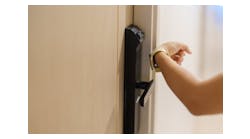 Aliro 1.0 aims to bring the same standardized, wearable-based credential experience seen in residential settings to corporate offices, universities and hospitality venues.
The Solution: One credential, every platform
Kastle's Aliro deployment delivers a single mobile credential that works across all three building systems simultaneously. The company is delivering three distinct components: Aliro-enabled readers, secure cloud-based credential management and Aliro wallet-based mobile credentials across all three platforms. Credentials are encrypted end-to-end and, according to Lynn, do not require sharing credential keys or secrets across systems. Operations teams receive real-time synchronization.
The practical barrier to mobile credential adoption in commercial real estate, Lynn said, has not been the phone itself; it has been what happens when users reach the tenant suite.
"The phone experience is seamless until users reach the tenant suite. Then the credential stops working. That friction has slowed adoption across the industry," he said. "Aliro eliminates that barrier."
Kastle-issued credentials built on the Aliro standard work with any reader or manufacturer, meaning building owners are no longer locked into a single vendor ecosystem. Lynn said several large commercial real estate portfolios had already chosen Kastle partly because of the company's commitment to Aliro.
"We've been discussing Aliro with customers for over a year now and several large CRE portfolios have already chosen Kastle partly because of our commitment to this vision. They understand vendor lock-in firsthand — including the constraints, the operational burden and added expense," Lynn said.
Speed to market
Lynn acknowledged that getting to market quickly after the standard's February launch required solving multiple technical problems in parallel.
"The real challenge wasn't the standard — it was the execution," he said. "We committed to being the first in deploying Aliro credentials on Apple, Google and Samsung wallets simultaneously. That meant solving credential format compatibility, security protocol alignment and manufacturer certification timelines all at once."
Kastle's involvement predates the standard's public release. Lynn said the company was part of the working group that developed Aliro and drew on its prior experience with related credential initiatives. "We moved fast because the industry needed a working proof point, not a theoretical standard," he said.
What comes next
Lynn framed the universal credential as a foundation rather than an endpoint. Once a unified credential spans physical space, he said, it becomes possible to layer in contextual capabilities — time-based access, location-based permissions and integration with broader workplace software platforms.
"Physical access becomes part of the broader workplace ecosystem, not a siloed system," Lynn said.
He also positioned interoperability as resolving what he called a false trade-off that has long shaped the industry.
"Interoperability removes the false trade-off between security and experience. You don't have to choose," Lynn said. "And that changes everything about how buildings operate and how people move through them."
He added that seamless access is increasingly an expectation rather than a perk, particularly as building owners compete for tenants. "In today's technology first world, people just expect their tech to be easy. Anything short of that creates disappointment."
Kastle's Aliro-enabled solutions are available now. More information can be found at kastle.com/aliro.
ISC West attendees can see a demo of Kastle’s new Aliro wallet-based mobile credentials across Apple, Google and Samsung platforms at the Allegion booth (23051).
About the Author
 Rodney Bosch
Rodney Bosch
Editor-in-Chief/SecurityInfoWatch.com
Rodney Bosch is the Editor-in-Chief of SecurityInfoWatch.com. He has covered the security industry since 2006 for multiple major security publications. Reach him at [email protected].