The Smart Money: Trust Is the Smart Home's Next Battleground
Key Highlights
- Consumer trust in smart home and home security providers is eroding — driven largely by AI, which demands unprecedented data collection at the same moment 72% of consumers say they are already concerned about AI's privacy and security implications.
- Home security providers hold a unique trust advantage over other connected device companies, but AI features like video analytics and face recognition are commoditizing fast, making data transparency and consumer control the more durable competitive differentiator.
- More than half of U.S. internet households say they would pay extra for independently certified secure devices or local data storage, signaling that cybersecurity and privacy protection are ready to become a genuine revenue line for integrators and manufacturers.
This article originally appeared in the July 2026 issue of Security Business magazine. Don’t forget to mention Security Business magazine on LinkedIn or our other social handles if you share it.
The smart home industry has spent the last decade focused on increasing adoption by expanding into new device categories and creating more connected experiences; however, this expansion has created challenges that have been exacerbated by AI – two of these being cybersecurity and data privacy.
Cybersecurity has long been viewed as a necessary investment to prevent breaches, patch vulnerabilities, and maintain regulatory compliance where required. The regulatory angle is particularly salient outside of the U.S., such as in the European Union, where cybersecurity compliance in hardware design is required for basic market access. Increasingly, however, data protection and privacy are emerging as key factors shaping brand perception, purchase decisions, and long-term customer loyalty in the U.S. market.
More Concern About Data Security
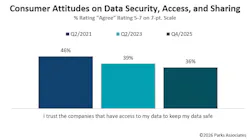
For several years, privacy and security concerns among consumers appeared to be fading as barriers to connected device adoption. That trend is now reversing, and trust in companies to keep personal information safe has steadily declined over the past several years.
Recent Parks Associates research finds that almost a third of consumers who do not own or intend to acquire a smart home device are inhibited by data privacy and security concerns. Nearly two-thirds of smart home device owners also express concerns about the security of their personal data within the devices they own.
The emergence of AI is accelerating these concerns. While the technology promises more personalized, automated, and intelligent experiences across the home, at the same time, consumers recognize that these capabilities require unprecedented amounts of data collection and analysis. Our research finds that 72% of consumers are concerned about the data privacy and security implications of AI, creating a cycle where the same data powering innovation fuels more consumer skepticism.
Trust as a Competitive Differentiator
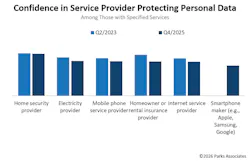
Those with a home security system or service are implicitly trusting that provider with the safety of their home and family, and that trust carries over into the protection of personal data. Our research shows consumers most trust their home security providers to keep personal data secure, while confidence in other service providers is modestly declining.
Parks Associates research finds that 72% of consumers are concerned about the data privacy and security implications of AI, creating a cycle where the same data powering innovation fuels more consumer skepticism.
As features like video analytics, face recognition, and smart video search quickly become standard, security providers should invest in the more stable differentiator of trust.
Since consumers increasingly demand greater transparency regarding how data is collected, how it is used, and who has access to it, they are placing the greatest value on capabilities such as controlling what data is collected, approving who has access to that information, and deleting collected data altogether. At the same time, consumers are asking for independent validation of device security through a cybersecurity certification or mark, as well as local storage and processing of data.
This has led to the formation and adoption of the U.S. Cyber Trust Mark. After stalling for a few months, the Federal Communications Commission (FCC) recently designated the ioXt Alliance as Lead Administrator for the Cyber Trust Mark program, representing an important step toward establishing standardized cybersecurity labeling for connected devices.
The goal is straightforward: market secure devices to consumers while encouraging manufacturers to meet baseline security requirements. For many consumers, evaluating cybersecurity protections remains difficult. Product specifications typically emphasize convenience, features, and compatibility, while security practices remain largely invisible. Security labels and certifications provide a mechanism for making trust more visible at the point of purchase.
Much like Energy Star transformed energy efficiency from a technical specification into a consumer-facing benefit, cybersecurity labels have the potential to make device security easier to understand and compare. While the program will be voluntary at first, it paves the way for trust to be a central differentiator for both manufacturers and integrators.
Device Security: A Revenue Opportunity
Perhaps the most eye-opening aspect of this consumer demand for integrators and even manufacturers is that consumers increasingly appear willing to pay for stronger protections, which can enable another revenue layer. Parks Associates research finds that more than half of U.S. internet households would pay more for products that are certified by independent cybersecurity testing organizations. Similar numbers indicate willingness to pay more for products that store data locally rather than relying heavily on cloud storage.
Consumers are also showing growing interest in cybersecurity services themselves, such as AI-powered monitoring tools that can detect suspicious activity, identify threats, and provide proactive protection. This suggests cybersecurity could even be a standalone product or incorporated as an add-on.
Cybersecurity can help reduce churn, strengthen customer relationships, support premium product positioning, and create opportunities for recurring service revenue. Companies that successfully communicate and demonstrate their security investments may gain meaningful competitive advantages.
The companies that succeed in the next phase of the market will be those that can most effectively convince consumers that their homes, their families, and their personal information are protected, regardless of ecosystem size or AI sophistication.
Editor's Note: This article is based on the Parks Associates report, Quantified Consumer: Connected Consumer Privacy & Security in the AI Era.
About the Author
 Daniel Holcomb
Daniel Holcomb
Daniel Holcomb is Senior Analyst for Parks Associates, which covers the security and smart home market extensively within its research practice. Visit www.parksassociates.com to learn more.