Jeremy Bates on Video, Consolidation, and the Next Two Years of ESA
Key Highlights
- Jeremy Bates, the incoming ESA Chairman and SVP of Business Development at Pye-Barker, says any integrator not yet invested in video needs to be, calling it the fastest-advancing segment in the industry today.
- Bates is steering ESA toward heavier investment in education and data, including the association's first staff economist and a new research center built to deliver fast benchmarking data to members.
- At Pye-Barker, Bates is shifting his own role away from dealmaking toward extracting organic growth from companies already under the corporate umbrella, even as the broader wave of industry consolidation creates room for new entrepreneurs to start fresh.
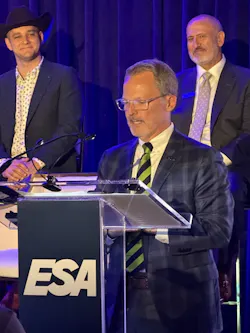
This article originally appeared in the July 2026 issue of Security Business magazine. Don’t forget to mention Security Business magazine on LinkedIn or our other social handles if you share it.
When Jeremy Bates sat down with Security Business at ESX 2026, he had a warning for any integrator still treating video as a commodity line item. “If a company’s not involved in video, then they need to be,” said Bates, the incoming Chairman of the Electronic Security Association (ESA) and Senior Vice President of Business Development for Pye-Barker Fire & Security.
Bates was speaking from a vantage point few in the industry share. He spent decades building Bates Security and Sonitrol of Lexington, Kentucky, into one of the most respected regional security companies in the country before selling to Pye-Barker and joining the firm in May 2024.
A Two-Year Plan Built on Education and Data
Bates stepped into the ESA Chairman role inheriting groundwork laid by predecessors, and he was quick to frame his agenda as a continuation rather than a reset. “It’s not just my plans, it’s the team’s plans, but we’ve had some great leadership the last four years that I’ve been on the board and really laid some strong groundwork for what we’re doing,” he said.
Education sits at the center of that agenda, and Bates traced the priority back to his own start in the business more than three decades ago. “I think about when I started over 31 years ago, just being a sponge for knowledge,” he said. “What would a young Jeremy today, how could ESA benefit and how could we be a catalyst for helping somebody just getting started? Or maybe anybody in the company in any role, how can we help them take their company to the next level?”
That philosophy is driving real investment. ESA recently announced it is hiring its first economist to staff a new ESA Research Center, a move Bates expects will generate fast-moving benchmarking data for members. “That’s going to be something very exciting,” he said. “The benchmarking we’re going to do there, I think that’s something that’s going to build pretty quickly.”
Apprenticeship programs remain part of the mix as well. ESA has done significant recent work building out an apprenticeship program in New Jersey, and Bates noted that several national companies, his own among them, have adopted ESA’s training framework for their internal pipelines. “My company, Pye-Barker, has done that,” he said.
Underneath all of it is a membership push that Bates is personally driving, even as his own company’s acquisition activity continues to absorb integrators that might otherwise be ESA members. He sees that as a tension to manage rather than a contradiction to resolve. “We’re focused on our advocacy, our education, our community that we’re building, and the advantages that we bring for our members,” he said. “You’re going to see us communicating that in a real well-coordinated manner to show the industry: this is the value you have by being a member, and your company will benefit and grow if you’re a member.”
Video is the Fulcrum
Asked to identify the technology trend most worth watching right now, and asked specifically not to default to the easy answer, Bates didn’t hesitate. “Video, video, video, video,” he said. “I’m excited to see where video will be at a year from now, five years from now. I think we’ll be shocked. Video seems to be the most advanced, the area that’s advancing the most, and the quickest.”
Within that broader video conversation, Bates pointed to proactive monitoring as the segment doing the most work. “Not just video monitoring, but proactive video monitoring, as we refer to it at Pye-Barker,” he said. He drew a direct line from that capability to the audio-verification roots of his old Sonitrol business, framing proactive monitoring less as a new product category and more as the logical successor to a model he already knows works. “You see it in the trailers, but also in fixed proactive video monitoring, where it’s actually part of a permanent system. There, you can just do so much.”
Bates was careful to separate the substance of that trend from the noise around it. AI dominates nearly every conversation on the trade show floor, and he had considered sidestepping the topic entirely in this interview. But he connected it directly to how Pye-Barker is using the technology internally, framing the real opportunity as operational rather than cosmetic. “If you’re using AI to write a better email or something like that, that’s one thing, but you should really be doing it to drive better processes, to dig in, to rethink your strategies, to make yourself a better, sharper business,” he said, recounting a presentation he’d just heard at ESX. “How can you be a better business by building AI tools?”
I’m excited to see where video will be at a year from now, five years from now. I think we’ll be shocked. Video seems to be the most advanced, the area that’s advancing the most, and the quickest.
- Jeremy Bates
Consolidation, Private Equity, and the Room It Creates
That same operational lens shapes how Bates talks about the integrator landscape. Asked whether the middle tier of integrators has been picked apart to the point where the market now runs mostly to enterprise scale on one end and small shops on the other, he didn’t fully agree.
“I think there’s less of them, but there’s still a good amount of them,” he said. He added that the wave of acquisitions, his own company’s prior growth-by-acquisition strategy included, has created room rather than scarcity. “What’s great about it is we’ve created a lot of space for other people that are going to be entrepreneurial and get out there and start the new companies.” Bates Security itself started small before becoming the company Pye-Barker eventually acquired, a path he sees repeating across the industry.
Pye-Barker’s own acquisition strategy is shifting as a result. Bates described his role moving away from deal-making toward extracting organic growth from the companies already under the Pye-Barker umbrella. “My skill set, I think, is probably better focused on improving or increasing our organic growth of our company,” he said, pointing to a more decentralized approach that lets acquired branches operate with autonomy while corporate looks for shared strategies to lift performance across the network. Three states, Alaska, West Virginia, and New Mexico, remain outside Pye-Barker’s footprint, and Bates left an open invitation for alarm, suppression, or sprinkler companies in those markets to reach out.
On private equity’s role in the business, Bates offered a measured take grounded in his own experience under PE ownership. “Good private equity, they have a solid management team that they have high confidence in on executing on the strategy that they and the private equity have laid out, and they let the team go and do their thing and prosper,” he said. He described minimal day-to-day involvement from Pye-Barker’s PE backers, so long as the operating team hits its budget targets.
For an industry built on relationships, Bates closed by pointing back to the value of simply showing up. He called the networking and education at events like ESX the most important part of his own growth story, citing what he called the R&D approach popularized by industry veteran John Loud: “Rip off and duplicate.” Said Bates, “That’s how I grew my business, that’s how we’ll continue to grow.”
About the Author
 Paul Rothman
Paul Rothman
Editor-in-Chief/Security Business
Paul Rothman is Editor-in-Chief of Security Business magazine (www.securitybusinessmag.com) and has been covering the security industry for various outlets since 2001. Email him your comments and questions at [email protected].