How Vehicle-Borne Threats Are Exposing Stadium Security Gaps
Key Highlights
- Stadiums are strengthening perimeter security, but vehicle access points remain a potential vulnerability despite advances in pedestrian screening technologies.
- Automated under-vehicle inspection systems can improve the consistency, speed and integration of vehicle screening compared with manual inspections.
- Security leaders should assess high-risk access points, traffic flow and deployment flexibility when evaluating vehicle screening technologies for sports and entertainment venues.
Every fall, as football season kicks off in cities and college towns across the country, stadium security professionals face a familiar but intensifying challenge: how do you protect tens of thousands of fans from a threat landscape that never stops evolving?
Increasingly, the answer is that you can't rely on any single solution. Drones, flash mobs, vehicle-borne improvised explosive devices (VBIEDs), and the persistent specter of terrorism all demand a layered, intelligence-driven approach that starts well before fans ever reach the gate. Despite the investment stadiums have made in advanced weapons detection and surveillance inside their walls, a critical vulnerability persists at the perimeter that too many venues have yet to adequately address.
A threat landscape that doesn't stand still
The range of incidents security leaders must plan for today is broader than it has ever been. On any given event day, a venue security team might contend with intoxicated and unruly patrons, organized crowd disturbances, drone intrusions, coordinated vandalism, and, on the extreme end of the threat spectrum, deliberate, mass-casualty attacks.
The 2024 Copa America Final at Hard Rock Stadium in Miami is a prime example of how quickly crowd dynamics can overwhelm even well-resourced security teams. Thousands of non-ticketed fans reportedly breached perimeter gates, jumping railings and forcing authorities to temporarily shut down stadium entrances and delay the match by over an hour. The incident was not the result of a terrorism plot, but rather sheer volume overwhelming a checkpoint architecture that was not designed for that kind of pressure.
At the other end of the threat spectrum, the November 2015 Paris attacks remain one of the most sobering reminders of what attackers can accomplish at the venue perimeter. Three bombers detonated explosive devices outside the gates of Stade de France while a soccer match between France and Germany was underway inside. The bombers never breached the stadium, but the devastation they caused demonstrates why the perimeter is the true first line of defense.
The 2017 Manchester Arena bombing reinforced this lesson. Twenty-two people were killed and hundreds more injured when a suicide bomber detonated an explosive device in the arena's foyer following an Ariana Grande concert.
Together, these incidents make one thing clear: the perimeter is the front line. The farther out a threat can be identified and neutralized, the better the outcome for everyone inside.
The perimeter has become the new front line
Recognizing this reality, a growing number of venues have begun extending their security infrastructure beyond the traditional gate checkpoint. License plate recognition (LPR) systems now manage vehicle access at parking structures. AI-powered video analytics monitor crowd behavior in real time. Advanced weapons detection technology, such as walk-through screening systems capable of detecting concealed firearms without requiring patrons to stop or empty their pockets, has dramatically improved throughput at entry gates.
But this expansion of the security perimeter introduces additional complexity. Vendor entrances, VIP drop-off lanes, credentialed vehicle access points, loading docks, etc., all represent potential vectors for threat actors seeking to bypass front-of-house screening. Each of these access points must be secured without creating bottlenecks that reverberate throughout the venue’s overall operations and compromise the safety of the event itself.
Balancing robust screening protocols against the demands for increased throughput is not a new challenge, but it becomes significantly harder when the subject being screened is a vehicle rather than a person.
Closing the vehicle screening gap
On a typical event day, a stadium's access points may see delivery trucks, catering vehicles, broadcast vans, team buses, maintenance fleets, and VIP motorcades, all of which require some form of screening. However, the tools many facilities currently use to screen vehicles are strikingly inadequate relative to the solutions they apply elsewhere throughout the venue. While the same teams deploying AI-driven analytics and multi-sensor weapons detection inside the venue are doing so, vehicle inspections at entry points are often still conducted with pole-mounted mirrors, flashlights, and visual spot checks by security officers.
The problem with this approach is not a question of officer competence, but rather consistency and scale. Manual under-vehicle inspection is inherently variable as its accuracy depends on the individual officer, the complexity of the vehicle's undercarriage, ambient lighting conditions, and fatigue. At a high-throughput checkpoint on event day, with pressure mounting to keep traffic moving, the conditions that enable rigorous manual inspection are rarely present. This gap is even more pronounced at temporary checkpoints, service entrances, and back-of-house access points, where formal inspection protocols may be minimal or even nonexistent.
But just as new detection modalities have changed the face of weapons screening, so to have innovations in vehicle screening tech. Numerous venues around the world are now using automated undercarriage inspection solutions that can detect even the slightest of modifications to a vehicle underbody.
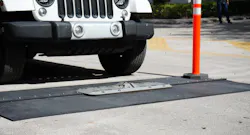
Under-vehicle scanning today pairs AI anomaly detection with advanced image stitching to create a view of a vehicle’s undercarriage, automatically detecting threats like hidden weapons, explosives, and other contraband. Rather than relying on an officer's eye to spot an irregularity, the system automatically flags deviations from baseline profiles, identifying hidden threats with a consistency that manual inspection cannot match.
Most importantly, these systems are designed to integrate within existing security architectures. Most modern undercarriage inspection solutions interface directly with LPR and access control systems, enabling data sharing across the broader security ecosystem. For multi-entrance venues, distributed architectures enable multiple vehicle screening checkpoints to be monitored and managed from a single control room, which not only reduces staffing requirements but also increases oversight.
Vehicle screening upgrade checklist
For leaders evaluating whether automated vehicle screening belongs should be part of their security tech stack, here are several considerations to weigh as part of your assessment process:
1. Analyze your highest-risk access points: Not every vehicle entrance presents equal risk. The access points that warrant the closest attention are those that provide the most direct route to high-density areas, such as loading docks adjacent to the field, VIP tunnels beneath arena seats or vendor entrances near food preparation areas. Begin your evaluation by mapping your access points against their proximity to crowded spaces and the volume and variety of vehicles that use them.
2. Identify where current inspection is inconsistent: Honest self-assessment is uncomfortable but necessary. If your current vehicle inspection relies on officer-conducted visual checks using hand mirrors, the quality of your screening is already variable, subject to shift timing, operator experience, fatigue, and the visual complexity of the undercarriage being inspected. Identifying these inconsistencies is the first step toward eliminating them.
3. Define your traffic pressure points: High-volume entry lanes are where the tension between security and throughput is at its highest. During peak periods, security personnel face pressure to process vehicles quickly and that pressure is exactly the condition under which manual inspection becomes least reliable. Mapping your highest-volume lanes will help you determine both where automated screening is most needed and what throughput requirements any solution must meet.
4. Plan for scalability and temporary deployments
Not all screening needs are permanent. Special events, high-profile matches, and elevated threat periods may require temporary checkpoint capability at locations not normally used for vehicle access. Evaluate whether proposed systems offer deployment flexibility, including rapid setup and portable configurations, to support these scenarios.
As the threat landscape for stadiums continues to evolve, security leaders will be forced to increasingly rely on new and emerging technologies as a way to combat these risks. Determining where these solutions are placed and how they are utilized are going to define the stadium safety paradigms of tomorrow.
About the Author
 Phil Jensen
Phil Jensen
Director of Sales for Under Vehicle Surveillance Systems (UVSS) at ISS
Phil Jensen serves as Director of Sales for Under Vehicle Surveillance Systems at ISS, where he leverages his extensive expertise in government sales and technical security solutions to drive strategic growth. A 21-year veteran of the U.S. Coast Guard, Phil brings a rare combination of military operational experience and deep security industry knowledge to his work with venues and critical infrastructure operators worldwide.