Giving Sound a Brain: The 4 Pillars of Acoustic Intelligence
Key Highlights
- Dismantling Legacy Imperfections: Modern edge AI replaces complex multi-sensor triangulation with independent, localized threat validation.
- Significantly Minimizing False Alarms: The system correlates muzzle blasts and ballistic shockwaves to protect operational sanity.
- Zero-Latency Visual Verification: Automated edge commands instantly slew PTZ cameras to exact coordinates for real-time validation.
- Securing Your Clients' Stack: Serverless single-sensor gunshot detection seamlessly integrates with existing VMS platforms without cloud dependencies.


For years, automated gunshot detection carried a complicated reputation in the monitoring and security integration industry. Early-generation systems frequently forced security directors and integrators to compromise between public safety and operational sanity. The industry became bogged down by high false-alarm rates, complex multi-sensor triangulation networks, and rigid, permanent infrastructure that was costly to deploy and maintain.
Today, the paradigm has shifted. By moving away from centralized audio streaming and embracing decentralized edge AI, modern acoustic threat detection addresses old industry pain points straight out of the box. True acoustic intelligence gives sound a brain, transforming passive listening into an active, automated asset for your clients' security stacks.
To understand how this technology protects modern perimeters, we must look at the complete operational journey: moving from legacy myths to the technical proof, and finally, to the real-world workflow.
The Catalyst: Overcoming the 3 Legacy Pain Points
To deploy effective acoustic security, integrators and end-users must first unlearn the limitations of the past. Legacy systems built their frameworks on three major flaws:
- The Flaw of Simple Volume Thresholds: Old technologies treat gunshot detection as a matter of volume. If an environmental sound is loud enough, the system triggers. This approach inevitably leads to a cascade of costly false alarms.
- The Flaw of Massive Networks: Traditional providers rely on expansive, fragile multi-sensor triangulation meshes. To cover a specific area, dozens of nodes must capture an audio spike and cross-reference timestamps in the cloud. This architecture introduces steep infrastructure costs and single points of network failure.
- The Flaw of Rigid, Permanent Infrastructure: Traditional systems are notoriously fixed. They require extensive cabling, heavy permanent mounting, and complex infrastructure that cannot be easily moved. This lack of portability means security teams cannot adapt to shifting threat landscapes, temporary public events, or evolving property perimeters.
The Framework: Turning Technical Expertise into Tactical Solutions
To solve these real-world frustrations, modern acoustic intelligence relies on a proprietary, edge-based framework. By embedding decades of acoustic engineering and machine learning directly at the point of detection, the Acoem ATD-300 platform answers these legacy flaws through four distinct technical pillars:
- Dual-Detection Standard: Legacy systems frequently confuse fireworks, backfiring engines, or construction noise with gunfire. Modern acoustic intelligence drastically minimizes these false alarms by mathematically correlating both the low-frequency muzzle blast and the supersonic ballistic shockwave. By requiring both signatures, the system confirms threats with unprecedented accuracy.
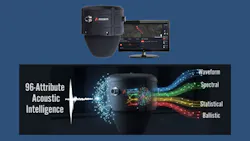
- 96-Attribute Intelligence: Rather than relying on volume, an onboard AI neural network analyzes 96 distinct acoustic characteristics, including waveform, spectral data, and ballistic decay rates. This elite precision filters out environmental background noise and mitigates multipath echo reflections in dense urban or industrial environments.
- Edge-Based Processing: Instead of streaming continuous audio to a vulnerable cloud network, all processing happens locally on the sensor node. This architecture achieves near-zero latency, guarantees uncompromised citizen privacy, and preserves network bandwidth.
- Continuous Acoustic Evolution: Risk landscapes are dynamic. Backed by a [Insert number, e.g., 30-year] military-proven gunshot library, modern systems push expert-refined performance packages periodically to the field via software management platforms like [Insert Software Name, e.g., Cadence™], ensuring the sensor fleet grows smarter over time.
The True Cost of False Positives
For a security operator or monitoring center director, a false positive is more than an inconvenience; it is a systemic threat. When an system "cries wolf," it triggers high-stress emergency protocols, desensitizes dispatchers, disrupts business continuity, and burns valuable municipal or corporate response resources. No security director wants to explain to leadership why an entire campus went into a high-alert lockdown over a firecracker or a loud truck.
By utilizing a 96-attribute engine and the dual-detection standard, acoustic intelligence gives integrators a system they can confidently stand behind. It provides the technological precision needed to significantly avoid false positives, ensuring that when an alarm sounds, it demands immediate, unfailing action.
The Workflow: The 5 Phases of Real-World Protection
In an active threat scenario, technical precision is only as good as the operational workflow it triggers. Moving the data from an instantaneous acoustic trigger to live, validating video evidence occurs seamlessly across five distinct phases:
- Phase 1: Cover: A single, ATD edge-processing sensor establishes an adaptable protection envelope covering a 500-foot radius.
- Phase 2: Detect: Onboard edge AI validates the acoustic signature, identifying the exact threat profile within milliseconds.
- Phase 3: Alert: Once identified, this critical data is transmitted instantly as a real-time audio alert directly to the Cadence platform, notifying operators without delay.
- Phase 4: Respond: Within milliseconds of that audio alert, the system automatically commands and slews connected PTZ cameras to the exact coordinates of the shot. This instant visual verification transforms raw acoustic data into validated evidence, ensuring that first responders have the critical situational awareness they need to make the safest, most informed decisions on how to respond.
- Phase 5: Adapt: The scalable, serverless deployment easily expands or reconfigures to match an organization's evolving perimeter layout or temporary event needs.
By deploying single-sensor nodes that connect directly into existing video management system (VMS) workflows, security teams bridge the critical gap between sound and sight. The result is fewer sensors to maintain, zero cloud dependency, and an automated, reliable path to real-time situational awareness.
Ready to upgrade your perimeter protection? Discover how the 4 Pillars of Acoustic Intelligence can secure your organization or contact our team to schedule a live technical demonstration.