Key Highlights
• After two years of development and 650-plus working-group hours, the Aliro 1.0 access control standard is certified and shipping — with hardware visible on the ISC West show floor.
• The Convergence Room drew 54 senior industry leaders, including the CEOs of SIA and Brivo and representatives from Apple, Google, and Samsung, signaling that the coalition behind Aliro is real and broad.
• Aliro's open standard addresses the credential and reader layer — but experts warn that adopting Aliro doesn't automatically mean a vendor is opening its entire platform, and the industry needs to hold that line.
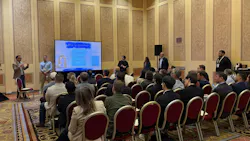
On March 25, at 10:30 a.m., 54 people entered a room on the ISC West exhibit hall’s opening day.
That detail matters more than it sounds. The first morning of the show floor is the most contested hour of the week. Everyone has somewhere to be; a lot of people are still in line at Starbucks (IYKYK); booths are starting to draw people in; meetings are stacked; and the energy is scattered by design. Getting 54 senior industry leaders into one room at that moment and keeping them there for an hour is not a coincidence. It’s a signal.
The room, Lido 3002 at Level 3, was where the Connectivity Standards Alliance brought the coalition together to demonstrate proof, with all future opportunities as the focus.
That tagline was chosen deliberately, and the hour that followed delivered on all three.
What it was
The Convergence Room was a structured discussion focused on the key questions about Aliro: its purpose, leadership, current status, and future direction.
The format was five panelists at the front of the room: Tobin Richardson, CEO and President of the Connectivity Standards Alliance; Nelson Henry, Chair of the Aliro Working Group and VP of Security Technology and Engineering at Last Lock; Lisa Corte, VP of Strategic Alliances at ASSA ABLOY and HID; Eric Dean, CTO at M.C. Dean; and Neal Kondel, Head of Home and Building Systems at NXP Semiconductors. The plan was 30 to 45 minutes of structured programming, followed by open Q&A.
This was not a panel of promotional soundbites as the panelists tackled the market's hardest questions in sequence, offering direct answers with on-screen evidence. The intentional structure delivered results, and it was really nice to see.
Why it happened
Aliro has been in development for two years, logged over 650 hours on working group calls, and met in person 68 times. The 1.0 specification has been finalized with certification underway, and it is safe to say that this is not a standards effort in its early theoretical stage. The foundation is built.
But an industry that has watched too many standards promises collapse into vaporware deserves more than slides and talking points. The Convergence Room was organized because the moment called for something different: physical proof, not roadmap promises.
Nelson Henry’s first look flex was straightforward: a show of hands in the room and a physical handout listing each ISC West booth with Aliro-certified hardware. Not theoretical or future, but present. The point was clear: Aliro is on the show floor this week.
Read more about the Aliro Access Control Standard
 Aliro 1.0 aims to bring the same standardized, wearable-based credential experience seen in residential settings to corporate offices, universities and hospitality venues.

That moment alone made clear that Aliro is no longer just theoretical, as leading companies are investing in it, users can see physical proof at major events, and the standard is gaining real-world traction.
What happened
The room skewed senior, and that was the plan. Don Erickson, SIA's CEO, was there, along with Steve Van Till, CEO of Brivo, Haniel Lynn, CEO of Kastle, and senior leaders from Google, Samsung, and Apple. The people in the room were not there because it was on a list of sessions to check off. They prioritized it, and that tells you something about where the industry believes this is heading.
The discussion covered Aliro’s core value proposition: one standard, built on NFC, Bluetooth Low Energy, and Ultra-Wideband, enabling any compliant smartphone or wearable to connect with any certified reader or lock without proprietary apps, custom integrations, or vendor lock-in. They explained how this has no middleware fragmentation, uses direct device-to-lock communication, and how the credential handshake is specified. The data elements are defined alongside the architecture to adapt to the market, not to force the market to adapt to it.
The Q&A ran long because the engagement was genuine, with thoughtful, pointed questions. Attendees came to interrogate, and the panel held up under that scrutiny.
Tobin Richardson framed the distinction that matters most: Prior interoperability efforts in this industry targeted commercial use cases and stayed there. Aliro is different because the consumer side has adopted it, vehicles have adopted it, and the ecosystem spans sectors in a way that prior standards never achieved. That is not a minor point, but a structural difference between a niche-compatibility framework and genuine infrastructure.
What it means
The access control industry has a long history of interoperability efforts that went nowhere. Proprietary ecosystems have survived not because the market wanted them, but because no coalition was ever large enough, or credible enough, to shift the center of gravity. That calculus is changing.
When Apple, Google, and Samsung are at the same table as ASSA ABLOY, NXP, Safetrust, MC Dean, Spintly, Last Lock, and HID, this is not a typical industry working group. That coalition assembles when the future is clear and the path is credible. The Convergence Room was proof that the coalition is real, the work is done, and the hardware is shipping.
What the industry needs to watch now is not whether Aliro succeeds at the credential and reader layer. The standard is solid, the ecosystem is moving, and the momentum from ISC West is real. The question worth asking is what comes after. Opening at the credential layer does not automatically mean opening at the platform layer.
A company can adopt Aliro and still maintain a closed, proprietary ecosystem everywhere else. The standard moves the lock up one level, which is progress. But the industry should hold the line on what open actually means, at every layer, not just the one we aligned on first.
The Convergence Room demonstrated that the right people understand this. The audience's questions reflected it, and the level of engagement reflected it.
The key takeaway: the foundation is built, the ecosystem is moving, and opportunity is immediate. What happens next depends on everyone’s continued engagement and commitment to openness and progress.
About the Author
 Lee Odess
Lee Odess
Lee Odess is the voice of the global access control, transforming security through strategic vision and industry expertise. As CEO of The Access Control Collective (TACC), he leads brands that redefine how the access and smart lock industry evolves. His influence spans multiple channels including LinkedIn, the Access Control Executive Brief, weekly Security Breakdown newsletter, industry Slack community, ACS Events, and TACC's marketing division, Ready Shoot Aim.
Known for challenging conventions while advocating for safer, seamless environments, Lee's vision is clear: "The next 30 years will have little to do with the last 30 years and there’s no better time than now to be in the security industry." Learn more at tacc.me.