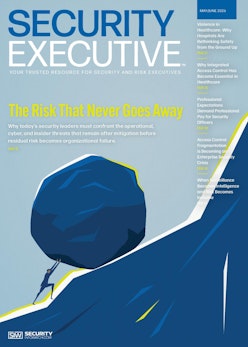
From cyber-physical convergence to insider threats and supply chain exposure, ESRM practitioners know that mitigation only reduces risk; it does not eliminate it. The challenge...
“You're traveling through another dimension — a dimension not only of sight and sound but of mind. A journey into a wondrous land whose boundaries are those of imagination...
Today’s frontline security officers are expected to manage violence, operate advanced technologies, de-escalate crises, and protect people in increasingly volatile environments...
Rising costs, supply chain volatility, and operational disruption are forcing organizations to rethink physical security as more than loss prevention. Today’s security leaders...
Modern security systems may be technically sound, but fragmented workflows, disconnected project data, and inconsistent handoffs continue to drive delays, rework, and margin erosion...
Video surveillance has evolved from a security tool into a high-value data system, forcing organizations to rethink ownership, governance, and risk accountability across physical...
As AI transforms video surveillance from passive monitoring into autonomous decision-making, security leaders face a new reality: camera systems that don’t just observe environments...
Cybercriminals are using artificial intelligence to disguise malware inside trusted workflows, legitimate-looking tools, and AI-generated guidance that employees increasingly ...
In his final column for Security Executive after more than two decades, cybersecurity veteran John McCumber reflects on the rapid rise of artificial intelligence, the surprising...
As physical security systems become more software-driven and network-connected, Ray Bernard explains why organizations must move beyond outdated product-based specifications and...
Too many organizations promote high performers into leadership roles without preparing them for the realities of managing people, accountability, and organizational responsibility...
At ISC West 2026, the Partner Alliance for Safer Schools unveiled major updates to its security guidelines, new implementation and assessment platforms, and expanded training ...
With limited budgets, lean IT staff, and growing exposure to ransomware and phishing attacks, rural hospitals are increasingly leveraging collaborative threat intelligence networks...