Smart Home Security Support Needs Eyes, Not Just Scripts
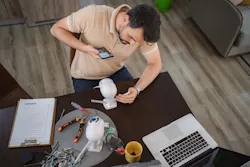
Smart home security is a category within the home that is heavily reliant on connectivity. A single system can now include a multitude of devices such as cameras, sensors, smart locks, panels, hubs, apps, routers and doorbells, and include such connected services as cloud services and monitoring.
From a customer perspective, smart home security is all part of a single experience. If a camera goes offline, a sensor triggers unexpectedly, or a smart lock does not respond, a customer does see the device as separate from the network, the app, or the service provider. They simply expect the system to work cohesively.
The expectation of cohesive functionality is changing how smart home security organizations serve their customers. Parks Associates reported that 47% of U.S. internet households now own a security solution, and 35% have a paid security service. As adoption grows, support teams are being asked to manage more devices, more installation paths and higher customer expectations across higher volumes of households participating.
The smart home security industry has invested heavily in smarter devices, better detection systems, and has put forth effort towards improving monitoring services. These improvements matter, but many common customer service issues in this industry are physical and environmental. A camera may be pointed at the wrong angle, a sensor may be placed too close to a heat source, or a router may be too far from the device.
These are problems having to do with the physical positioning of devices, yet they are often diagnosed through voice calls, troubleshooting scripts, ticket history and customer descriptions. The fact that these particular issues are being addressed through voice or text descriptions creates a disconnect between what the support team needs to understand and what it can actually see.

The hidden cost of blind troubleshooting
When support teams cannot literally see the customer’s setup, issues are harder to diagnose. Customers do their best, but they may not know the right terminology, or they may describe the wrong device or miss something that would be obvious to a trained technician.
It gets harder as product ecosystems expand. A service representative may need to support dozens of device types and hundreds of troubleshooting scenarios. A wrong diagnosis could lead to a wrong shipment, a repeat call, a non-fault-found return, or an unnecessary truck roll.
Imagine an agent correctly determines that a battery needs to be replaced, but cannot identify the exact model. The wrong battery is shipped, the issue remains unresolved and the customer has to call again. Multiply this small mistake across thousands of interactions, and it is easy to imagine the increasing operational costs through unnecessary shipments, repeat contacts, non-fault-found returns, technician dispatches and ultimately customer churn.
Adding connectivity into the mix complicates the situation further. Sixty-eight percent of U.S. households reported recurring Wi-Fi issues earlier this year, and 76% experienced weak or unreliable Wi-Fi in specific rooms. For a smart home security provider, those numbers matter. A device that appears defective may simply be located in a weak coverage area in the home.
The result is familiar to every service operation: longer calls, repeat contacts, avoidable returns and lower customer confidence. In security, the stakes are higher. If a customer experiences repeated false alarms, cannot reconnect a camera, or waits for a technician to solve something that could have been resolved remotely, customer confidence in your organization falters.
Visual intelligence has a service role
In security, visual intelligence is usually discussed in the context of surveillance. But there is another important use case: helping providers understand whether the security system itself is installed, configured and operating correctly.
When a customer can show the issue through a phone camera, support teams gain context that would be difficult to capture through a traditional call. Visual AI can identify the device, read indicators, recognize installation mistakes, validate setup steps, and help determine whether the problem is related to placement, power, connectivity or configuration.
There are already organizations taking advantage of visual intelligence, and they’re seeing success. For example, ADT has completed more than 2.6 million visual support sessions, achieving over 80% CSAT, preventing more than 75% of truck rolls and increasing Net Promoter Score to around 50.
The next step is Spatial AI, which adds context by visualizing the customer’s space. It helps interpret where a device is located, what surrounds it, what may interfere with it, and how the setup relates to the area it protects. A doorbell camera issue may involve more than the device itself. The field of view, mounting height, lighting, Wi-Fi strength and nearby obstructions may all affect performance. A sensor issue may be caused by placement rather than product failure. A smart lock issue may come from door alignment rather than software. These are all concerns that a Spatial AI system would help diagnose.
Scaling support across hundreds of devices
Home security providers are increasingly expected to support connected-home ecosystems with many devices. The customer may also have equipment from multiple brands, installed at different times, with different apps and network conditions. Support teams are expected to understand all of it.
Visual and spatial intelligence can help standardize service across brands and apps. Instead of relying only on an agent’s experience or the customer’s ability to explain the problem, providers can guide customers through visual resolution. Visual and Spatial AI agents can recognize the device and network environment, and surface the right troubleshooting path.
This model also supports guided self-service. Customers can receive step-by-step visual instructions for common scenarios such as reconnecting devices, confirming sensor placement, replacing batteries, or correcting installation issues. Human agents remain available for complex or sensitive cases, but routine issues can be resolved faster with this self-service methodology.
The next standard for smart home security service
Field service will always be part of the security industry. Some issues require professional installation, inspection, or repair. The goal is to send technicians when they are truly needed and make each visit more effective.
Visual and Spatial AI can help in this case too, determining whether a problem can be solved remotely or if it requires an on-site visit. It can also help agents collect better information before escalation. Field teams can then arrive with the right context, parts and expectations.
The next standard for smart home security support will depend on the provider’s ability to understand the customer’s real environment. That means seeing the setup, interpreting the physical context, guiding the right action and knowing when to escalate to a human expert or field technician.
Customers do not experience security as a collection of devices. They experience it as confidence that their home is protected and that help is available when something goes wrong.
For providers, visual and spatial intelligence can turn support into a clearer, faster and more scalable service model. In a connected world, seeing the problem is often the first step toward solving it.
About the Author
 Eitan Cohen
Eitan Cohen
CEO and Co-Founder of TechSee
Eitan Cohen is CEO and Co-Founder of TechSee, an agentic AI-enabled platform harnessing vision to transform customer service. He is passionate about solutions-driven technology that reduces churn, improves the customer experience and lowers operating costs.